
Pulp Fiction, 1954 · page 82 of 132
Astounding Science Fiction (British edition) — page 82: what you’re looking at
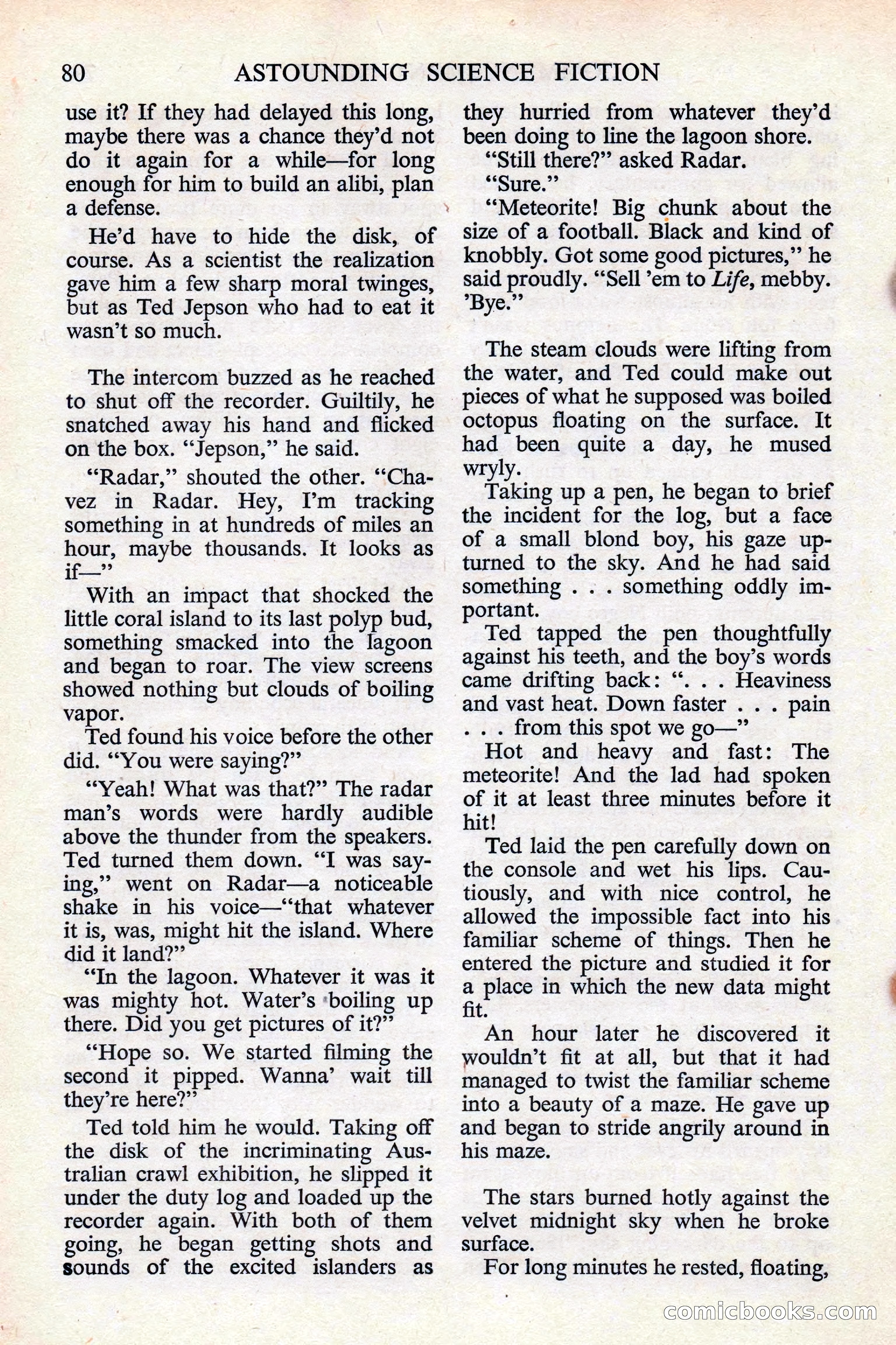
A restored page from Pulp Fiction, 1954. Page through the whole issue in the reader above.
📄 Transcribed text from this page (OCR, searchable)
Machine-transcribed from the original scan — historical spelling and the odd misread are preserved.
80 ASTOUNDING SCIENCE FICTION use it? If they had delayed this long, maybe there was a chance they’d not do it again for a while—for long enough for him to build an alibi, plan a defense. He’d have to hide the disk, of course. As a scientist the realization gave him a few sharp moral twinges, but as Ted Jepson who had to eat it wasn’t so much. The intercom buzzed as he reached to shut off the recorder. Guiltily, he snatched away his hand and flicked on the box. “Jepson,” he said. **Radar,” shouted the other. “‘Cha- vez in Radar. Hey, I’m tracking something in at hundreds of miles an hour, maybe thousands. It looks as He With an impact that shocked the little coral island to its last polyp bud, something smacked into the lagoon and began to roar. The view screens showed nothing but clouds of boiling vapor. Ted found his voice before the other did. ““You were saying?” “Yeah! What was that?” The radar man’s words were hardly audible above the thunder from the speakers. Ted turned them down. “I was say- ing,” went on Radar—a noticeable shake in his voice—‘that whatever it is, was, might hit the island. Where did it land?” “In the lagoon. Whatever it was it was mighty hot. Water’s "boiling up there. Did you get pictures of it?” ““Hope so. We started filming the second it pipped. Wanna’ wait till they’re here?” Ted told him he would. Taking off the disk of the incriminating Aus- tralian crawl exhibition, he slipped it under the duty log and loaded up the recorder again. With both of them going, he began getting shots and sounds of the excited islanders as they hurried from whatever they'd been doing to line the lagoon shore. “Still there?” asked Radar. “Sure.” “Meteorite! Big chunk about the size of a football. Black and kind of knobbly. Got some good pictures,”’ he said proudly. “Sell °em to Life, mebby. Bye.” The steam clouds were lifting from the water, and Ted could make out pieces of what he supposed was boiled octopus floating on the surface. It had been quite a day, he mused wryly. Taking up a pen, he began to brief the incident for the log, but a face of a small blond boy, his gaze up- turned to the sky. And he had said something . . . something oddly im- portant. Ted tapped the pen thoughtfully against his teeth, and the boy’s words came drifting back: “. . . Heaviness and vast heat. Down faster . . . pain . . . from this spot we go—” Hot and heavy and fast: The meteorite! And the lad had spoken of it at least three minutes before it hit! Ted laid the pen carefully down on the console and wet his lips. Cau- tiously, and with nice control, he allowed the impossible fact into his familiar scheme of things. Then he entered the picture and studied it for a place in which the new data might fit. An hour later he discovered it wouldn’t fit at all, but that it had managed to twist the familiar scheme into a beauty of a maze. He gave up and began to stride angrily around in his maze. The stars burned hotly against the velvet midnight sky when he broke surface. For long minutes he rested, floating, comilclooks.c© inl