
Pulp Fiction, 1954 · page 81 of 132
Astounding Science Fiction (British edition) — page 81: what you’re looking at
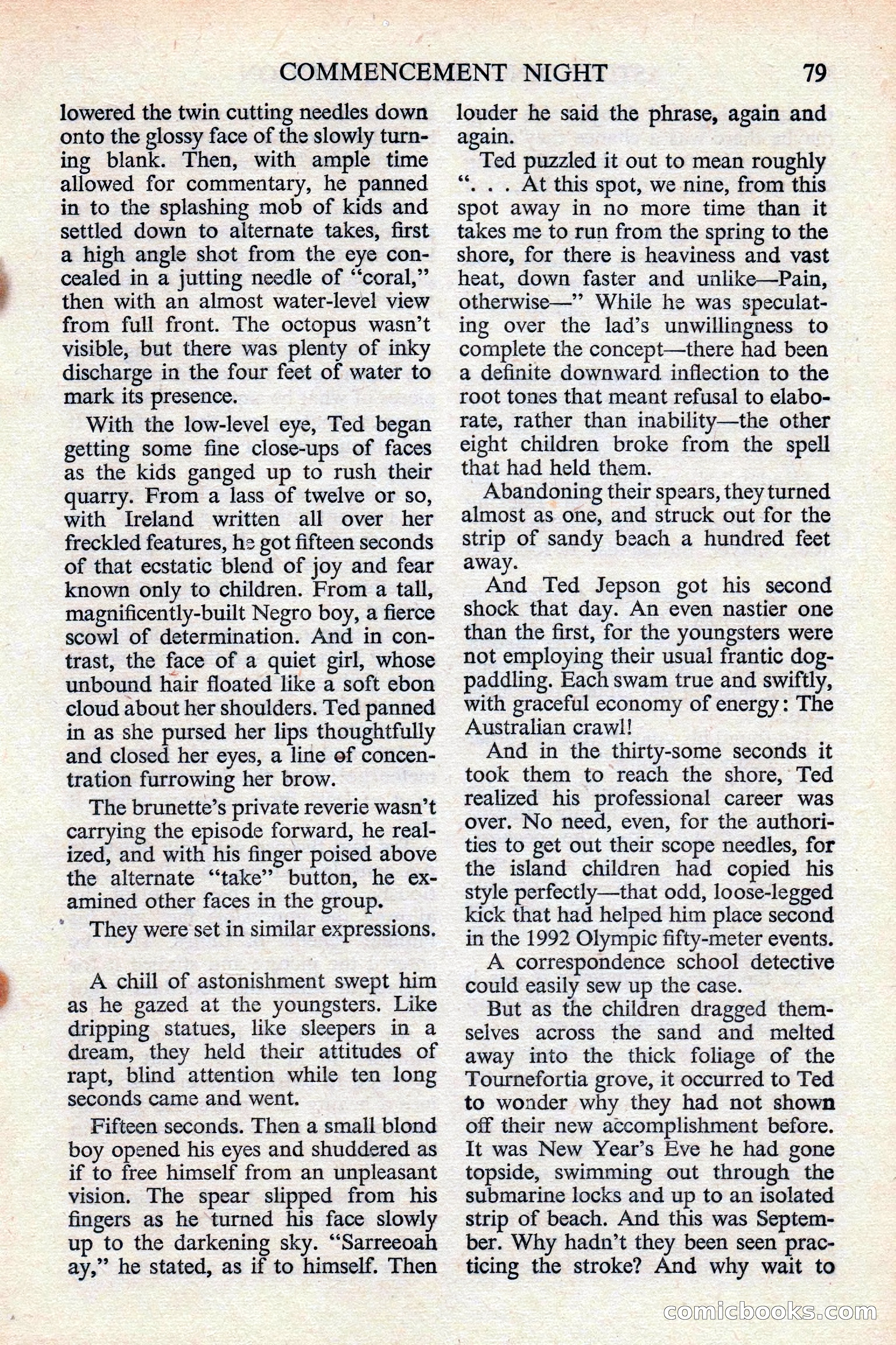
A restored page from Pulp Fiction, 1954. Page through the whole issue in the reader above.
📄 Transcribed text from this page (OCR, searchable)
Machine-transcribed from the original scan — historical spelling and the odd misread are preserved.
COMMENCEMENT NIGHT lowered the twin cutting needles down onto the glossy face of the slowly turn- ing blank. Then, with ample time allowed for commentary, he panned in to the splashing mob of kids and settled down to alternate takes, first a high angle shot from the eye con- cealed in a jutting needle of ‘“‘coral,”’ then with an almost water-level view from full front. The octopus wasn’t visible, but there was plenty of inky discharge in the four feet of water to mark its presence. With the low-level eye, Ted began getting some fine close-ups of faces as the kids ganged up to rush their quarry. From a lass of twelve or so, with Ireland written all over her freckled features, he got fifteen seconds of that ecstatic blend of joy and fear known only to children. From a tall, magnificently-built Negro boy, a fierce scowl of determination. And in con- trast, the face of a quiet girl, whose unbound hair floated like a soft ebon cloud about her shoulders. Ted panned in as she pursed her lips thoughtfully and closed her eyes, a line ef concen- tration furrowing her brow. The brunette’s private reverie wasn’t carrying the episode forward, he real- ized, and with his finger poised above the alternate “‘take” button, he ex- amined other faces in the group. They were set in similar expressions. A chill of astonishment swept him as he gazed at the youngsters. Like dripping statues, like sleepers in a dream, they held their attitudes of rapt, blind attention while ten long seconds came and went. Fifteen seconds. Then a small blond boy opened his eyes and shuddered as if to free himself from an unpleasant vision. The spear slipped from his fingers as he turned his face slowly up to the darkening sky. “Sarreeoah ay,” he stated, as if to himself. Then 719 louder he said the phrase, again and again. Ted puzzled it out to mean roughly . At this spot, we nine, from this spot away in no more time than it takes me to run from the spring to the shore, for there is heaviness and vast heat, down faster and unlike—Pain, otherwise—’’ While he was speculat- ing over the lad’s unwillingness to complete the concept—there had been a definite downward inflection to the root tones that meant refusal to elabo- rate, rather than inability—the other eight children broke from the spell that had held them. Abandoning their spears, they turned almost as one, and struck out for the strip of sandy beach a hundred feet away. And Ted Jepson got his second shock that day. An even nastier one than the first, for the youngsters were not employing their usual frantic dog- paddling. Each swam true and swiftly, with graceful economy of energy: The Australian crawl! And in the thirty-some seconds it took them to reach the shore, Ted realized his professional career was over. No need, even, for the authori- ties to get out their scope needles, for the island children had copied his style perfectly—that odd, loose-legged kick that had helped him place second in the 1992 Olympic fifty-meter events. A correspondence school detective could easily sew up the case. But as the children dragged them- selves across the sand and melted away into the thick foliage of the Tournefortia grove, it occurred to Ted to wonder why they had not shown off their new accomplishment before. It was New Year’s Eve he had gone topside, swimming out through the submarine locks and up to an isolated strip of beach. And this was Septem- ber. Why hadn’t they been seen prac- ticing the stroke? And why wait to 66 conniicloooks.c© nn