
Pulp Fiction, 1954 · page 79 of 132
Astounding Science Fiction (British edition) — page 79: what you’re looking at
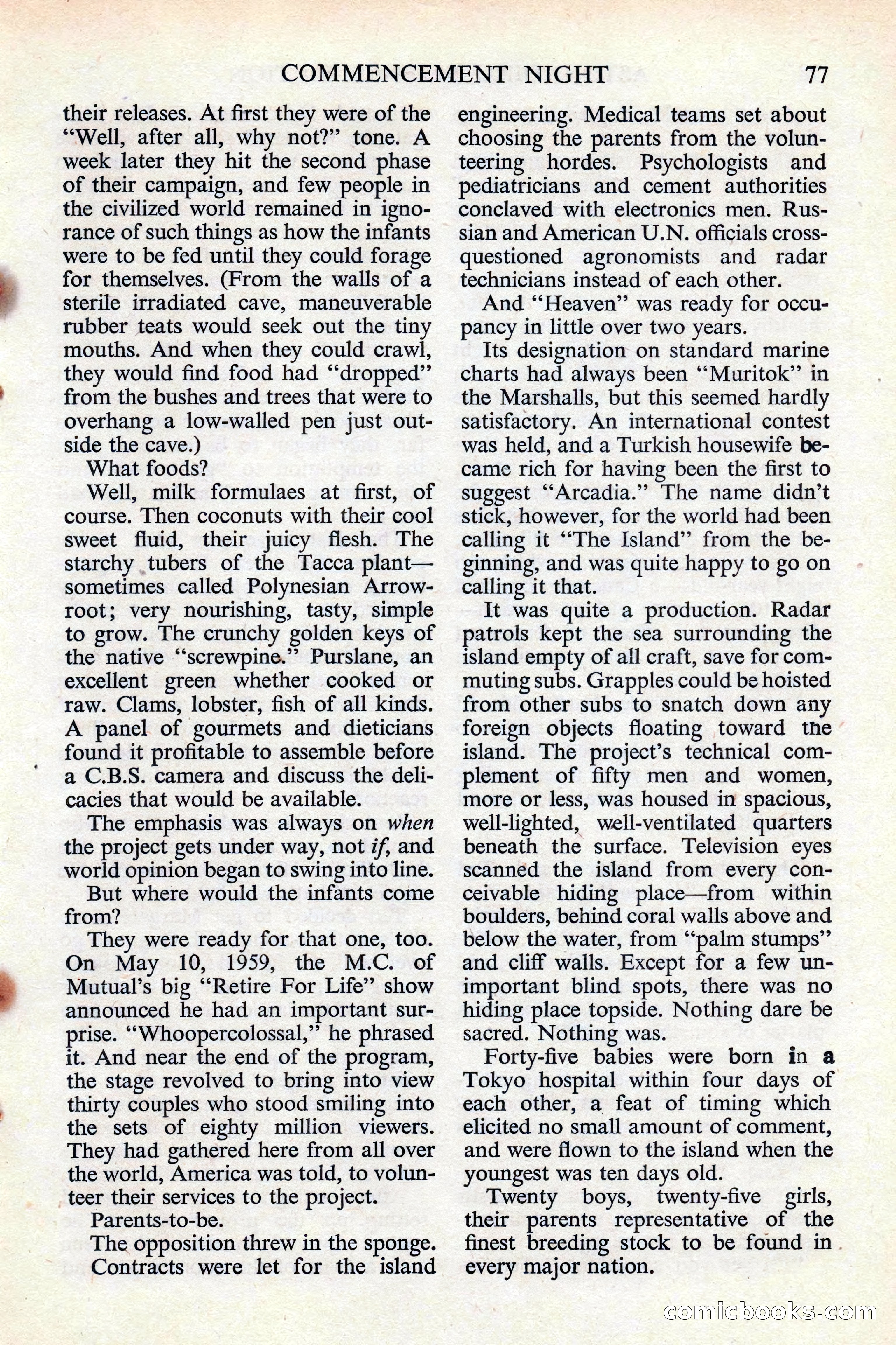
A restored page from Pulp Fiction, 1954. Page through the whole issue in the reader above.
📄 Transcribed text from this page (OCR, searchable)
Machine-transcribed from the original scan — historical spelling and the odd misread are preserved.
COMMENCEMENT NIGHT their releases. At first they were of the “Well, after all, why not?” tone. A week later they hit the second phase of their campaign, and few people in the civilized world remained in igno- rance of such things as how the infants were to be fed until they could forage for themselves. (From the walls of a sterile irradiated cave, maneuverable rubber teats would seek out the tiny mouths. And when they could crawl, they would find food had “‘dropped’’ from the bushes and trees that were to overhang a low-walled pen just out- side the cave.) What foods? Well, milk formulaes at first, of course. Then coconuts with their cool sweet fluid, their juicy flesh. The starchy tubers of the Tacca plant— sometimes called Polynesian Arrow- root; very nourishing, tasty, simple to grow. The crunchy golden keys of the native “‘screwpine.”’ Purslane, an excellent green whether cooked or raw. Clams, lobster, fish of all kinds. A panel of gourmets and dieticians found it profitable to assemble before a C.B.S. camera and discuss the deli- cacies that would be available. The emphasis was always on when the project gets under way, not if, and world opinion began to swing into line. But where would the infants come from? They were ready for that one, too. On May 10, 1959, the M.C. of Mutual’s big “Retire For Life’ show announced he had an important sur- prise. ‘““Whoopercolossal,” he phrased it. And near the end of the program, the stage revolved to bring into view thirty couples who stood smiling into the sets of eighty million viewers. They had gathered here from all over the world, America was told, to volun- teer their services to the project. Parents-to-be. The opposition threw in the sponge. Contracts were let for the island 77 engineering. Medical teams set about choosing the parents from the volun- teering hordes. Psychologists and pediatricians and cement authorities conclaved with electronics men. Rus- sian and American U.N. officials cross- questioned agronomists and radar technicians instead of each other. And “‘Heaven” was ready for occu- pancy in little over two years. Its designation on standard marine charts had always been “‘Muritok”’ in the Marshalls, but this seemed hardly satisfactory. An international contest was held, and a Turkish housewife be- came rich for having been the first to suggest “Arcadia.” The name didn’t stick, however, for the world had been calling it ““The Island’? from the be- ginning, and was quite happy to go on calling it that. It was quite a production. Radar patrols kept the sea surrounding the island empty of all craft, save for com- muting subs. Grapples could be hoisted from other subs to snatch down any foreign objects floating toward the island. The project’s technical com- plement of fifty men and women, more or less, was housed in spacious, well-lighted, well-ventilated quarters beneath the surface. Television eyes scanned the island from every con- ceivable hiding place—from within boulders, behind coral walls above and below the water, from “‘palm stumps” and cliff walls. Except for a few un- important blind spots, there was no hiding place topside. Nothing dare be sacred. Nothing was. Forty-five babies were born in a Tokyo hospital within four days of each other, a feat of timing which elicited no small amount of comment, and were flown to the island when the youngest was ten days old. Twenty boys, twenty-five girls, their parents representative of the finest breeding stock to be found in. every major nation. connicloooks.c© inn