
Pulp Fiction, 1954 · page 78 of 132
Astounding Science Fiction (British edition) — page 78: what you’re looking at
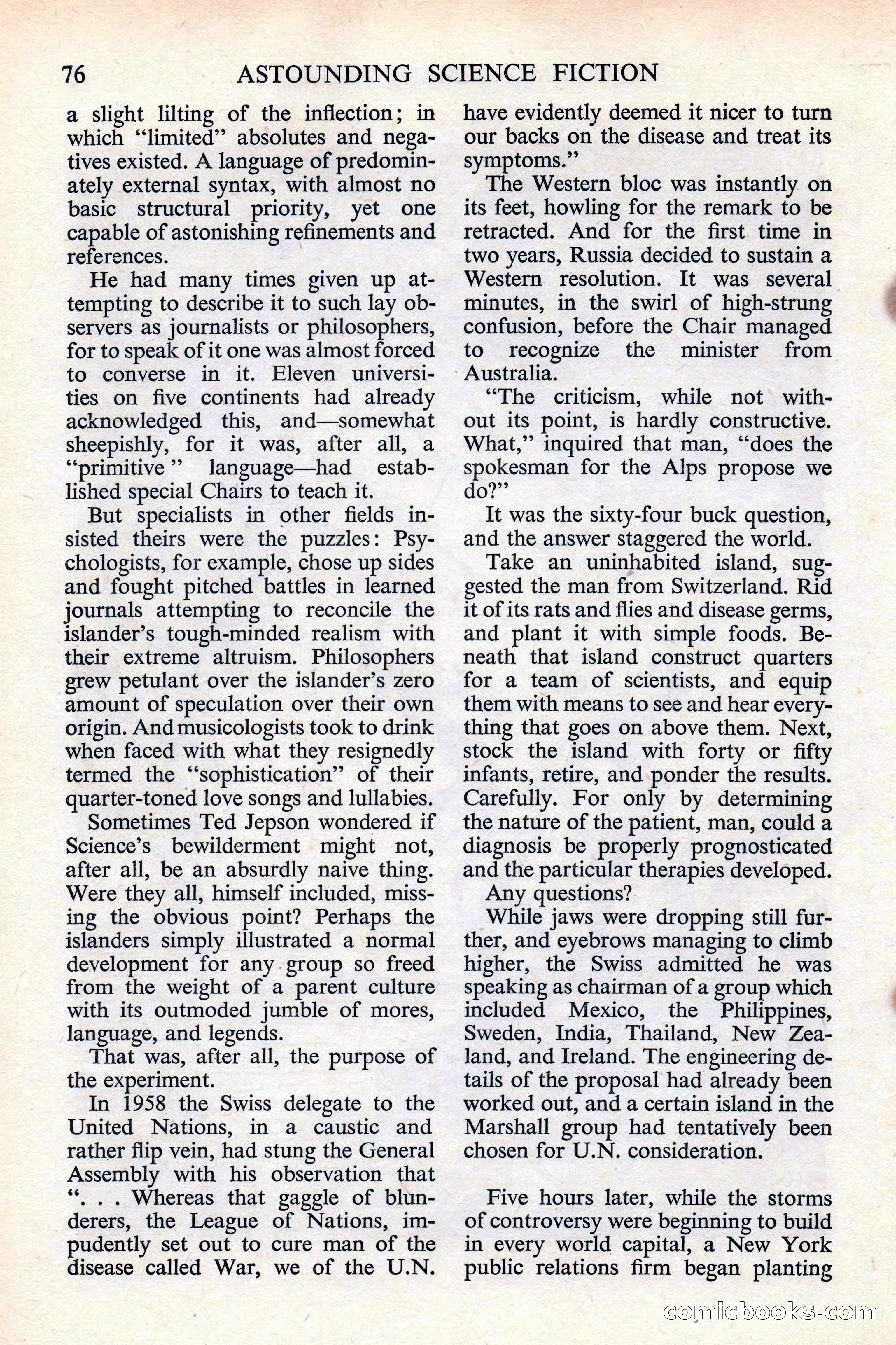
A restored page from Pulp Fiction, 1954. Page through the whole issue in the reader above.
📄 Transcribed text from this page (OCR, searchable)
Machine-transcribed from the original scan — historical spelling and the odd misread are preserved.
76 ASTOUNDING SCIENCE FICTION a slight lilting of the inflection; in which “‘limited’’ absolutes and nega- tives existed. A language of predomin- ately external syntax, with almost no basic structural priority, yet one capable of astonishing refinements and references. He had many times given up at- tempting to describe it to such lay ob- servers as journalists or philosophers, for to speak of it one was almost forced to converse in it. Eleven universi- ties on five continents had already acknowledged this, and—somewhat sheepishly, for it was, after all, a “primitive ’’ language—had __ estab- lished special Chairs to teach it. But specialists in other fields in- sisted theirs were the puzzles: Psy- chologists, for example, chose up sides and fought pitched battles in learned journals attempting to reconcile the islander’s tough-minded realism with their extreme altruism. Philosophers grew petulant over the islander’s zero amount of speculation over their own origin. And musicologists took to drink when faced with what they resignedly termed the “‘sophistication’”’ of their quarter-toned love songs and lullabies. Sometimes Ted Jepson wondered if Science’s bewilderment might not, after all, be an absurdly naive thing. Were they all, himself included, miss- ing the obvious point? Perhaps the islanders simply illustrated a normal development for any. group so freed from the weight of a parent culture with its outmoded jumble of mores, language, and legends. That was, after all, the purpose of the experiment. In 1958 the Swiss delegate to the United Nations, in a caustic and rather flip vein, had stung the General Assembly with his observation that “*. . . Whereas that gaggle of blun- derers, the League of Nations, im- pudently set out to cure man of the disease called War, we of the U.N. have evidently deemed it nicer to turn our backs on the disease and treat its symptoms.” The Western bloc was instantly on its feet, howling for the remark to be retracted. And for the first time in two years, Russia decided to sustain a Western resolution. It was several minutes, in the swirl of high-strung confusion, before the Chair managed to recognize the minister from Australia. “The criticism, while not with- out its point, is hardly constructive. What,” inquired that man, “does the spokesman for the Alps propose we do?’ It was the sixty-four buck question, and the answer staggered the world. Take an uninhabited island, sug- gested the man from Switzerland. Rid it of its rats and flies and disease germs, and plant it with simple foods. Be- neath that island construct quarters for a team of scientists, and equip them with means to see and hear every- thing that goes on above them. Next, stock the island with forty or fifty infants, retire, and ponder the results. Carefully. For only by determining the nature of the patient, man, could a diagnosis be properly prognosticated and the particular therapies developed. Any questions? While jaws were dropping still fur- ther, and eyebrows managing to climb higher, the Swiss admitted he was speaking as chairman of a group which included Mexico, the Philippines, Sweden, India, Thailand, New Zea- land, and Ireland. The engineering de- tails of the proposal had already been worked out, and a certain island in the Marshall group had tentatively been chosen for U.N. consideration. Five hours later, while the storms of controversy were beginning to build in every world capital, a New York public relations firm began planting comiclooks.com