
Pulp Fiction, 1954 · page 124 of 132
Astounding Science Fiction (British edition) — page 124: what you’re looking at
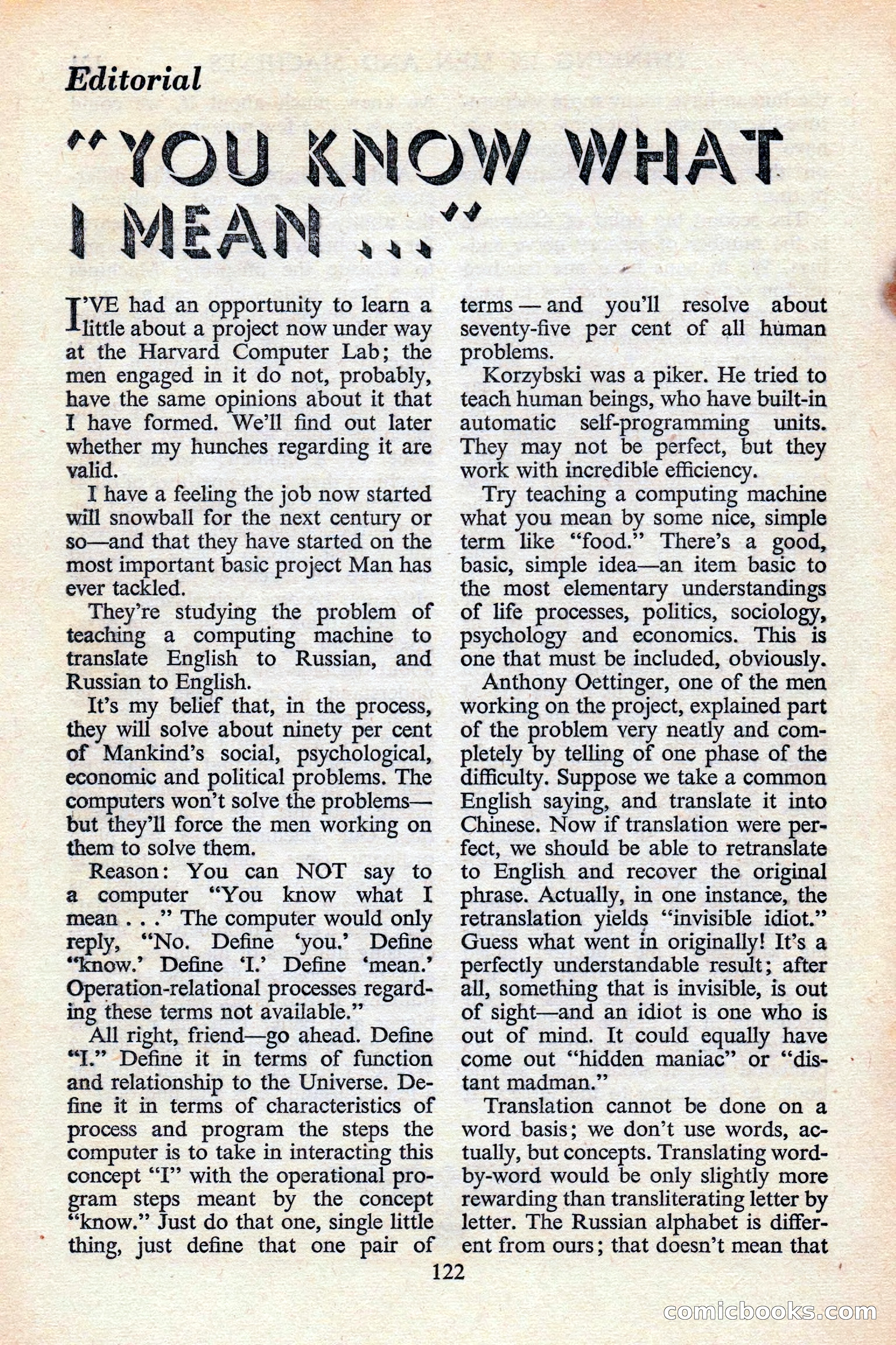
A restored page from Pulp Fiction, 1954. Page through the whole issue in the reader above.
📄 Transcribed text from this page (OCR, searchable)
Machine-transcribed from the original scan — historical spelling and the odd misread are preserved.
Editorial “YOU KNOW WHAT 1 MEAN 1...” Ee had an opportunity to learn a little about a project now under way at the Harvard Computer Lab; the men engaged in it do not, probably, have the same opinions about it that I have formed. We'll find out later whether my hunches regarding it are valid. I have a feeling the job now started will snowball for the next century or so—and that they have started on the most important basic project Man has ever tackled. They’re studying the problem of teaching a computing machine to translate English to Russian, and Russian to English. It’s my belief that, in the process, they will solve about ninety per cent of Mankind’s social, psychological, economic and political problems. The computers won’t solve the problems— but they'll force the men working on them to solve them. Reason: You can NOT say to a computer “You know what I mean...’ The computer would only reply, “No. Define ‘you.’ Define “know. Define ‘I.’ Define ‘mean.’ Operation-relational processes regard- ing these terms not available.” All right, friend—go ahead. Define “I.” Define it in terms of function and relationship to the Universe. De- fine it in terms of characteristics of process and program the steps the computer is to take in interacting this concept “I”? with the operational pro- gram steps meant by the concept “know.” Just do that one, single little thing, just define that one pair of ~ terms— and you'll resolve about seventy-five per cent of all human problems. Korzybski was a piker. He tried to teach human beings, who have built-in automatic self-programming units. They may not be perfect, but they work with incredible efficiency. Try teaching a computing machine what you mean by some nice, simple term like “food.” There’s a good, basic, simple idea—an item basic to the most elementary understandings of life processes, politics, sociology, psychology and economics. This is one that must be included, obviously. Anthony Oettinger, one of the men working on the project, explained part of the problem very neatly and com- pletely by telling of one phase of the difficulty. Suppose we take a common English saying, and translate it into Chinese. Now if translation were per- fect, we should be able to retranslate to English and recover the original phrase. Actually, in one instance, the retranslation yields “invisible idiot.” Guess what went in originally! It’s a perfectly understandable result; after all, something that is invisible, is out of sight—and an idiot is one who is out of mind. It could equally have come out “hidden maniac” or “dis- tant madman.” Translation cannot be done on a word basis; we don’t use words, ac- tually, but concepts. Translating word- by-word would be only slightly more rewarding than transliterating letter by letter. The Russian alphabet is differ- ent from ours; that doesn’t mean that 122 connicloooks.c© ‘ im