
Pulp Fiction, 1954 · page 11 of 132
Astounding Science Fiction (British edition) — page 11: what you’re looking at
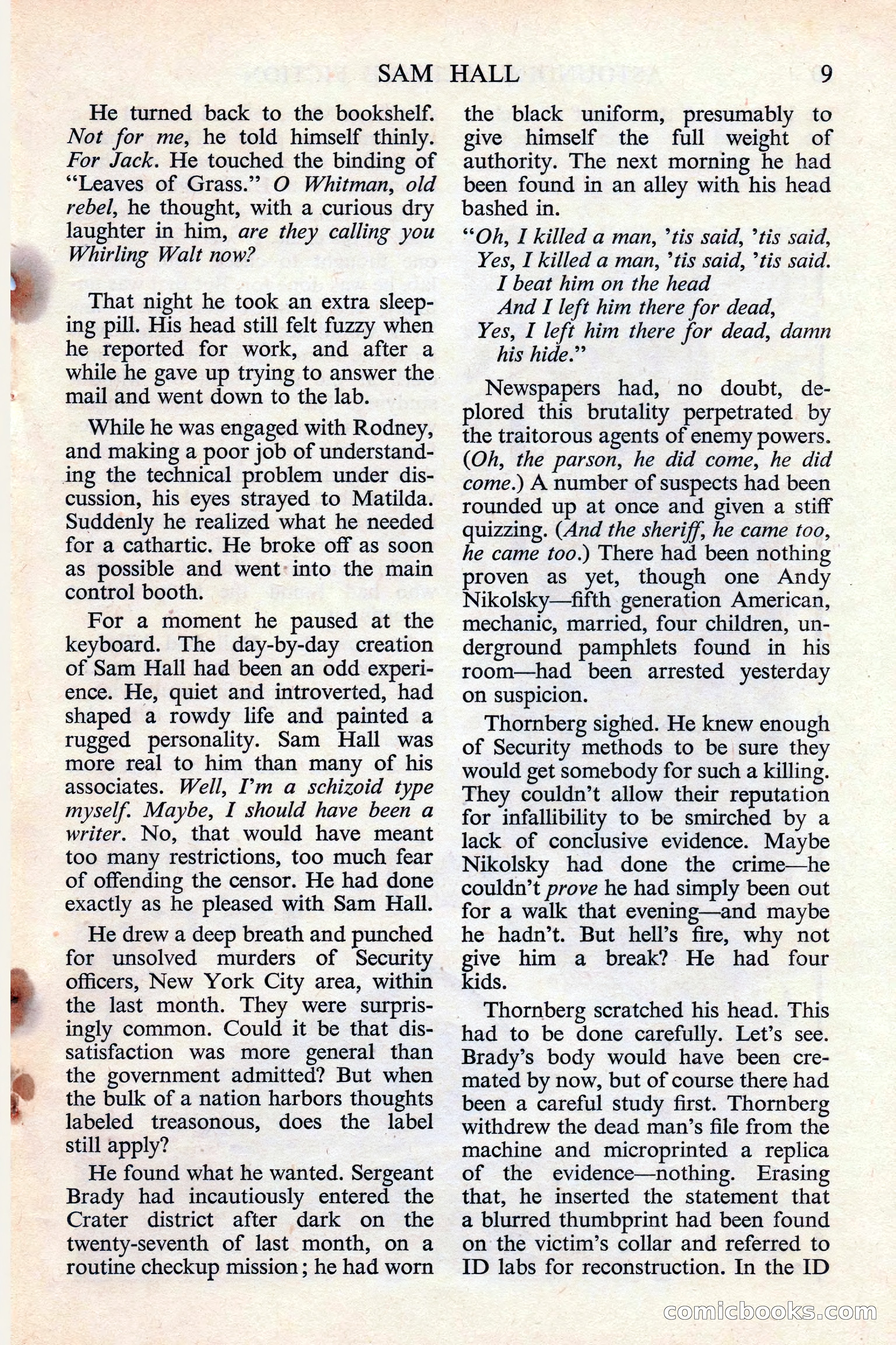
A restored page from Pulp Fiction, 1954. Page through the whole issue in the reader above.
📄 Transcribed text from this page (OCR, searchable)
Machine-transcribed from the original scan — historical spelling and the odd misread are preserved.
SAM He turned back to the bookshelf. Not for me, he told himself thinly. For Jack. He touched the binding of ““Leaves of Grass.’’ O Whitman, old rebel, he thought, with a curious dry laughter in him, are they calling you Whirling Walt now? That night he took an extra sleep- ing pill. His head still felt fuzzy when he reported for work, and after a while he gave up trying to answer the. mail and went down to the lab. While he was engaged with Rodney, and making a poor job of understand- ing the technical problem under dis- cussion, his eyes strayed to Matilda. Suddenly he realized what he needed for a cathartic. He broke off as soon as possible and went: into the main control booth. For a moment he paused at the keyboard. The day-by-day creation of Sam Hall had been an odd experi- ence. He, quiet and introverted, had shaped a rowdy life and painted a rugged personality. Sam Hall was more real to him than many of his associates. Well, I’m a schizoid type myself. Maybe, I should have been a writer. No, that would have meant too many restrictions, too much fear of offending the censor. He had done exactly as he pleased with Sam Hall. He drew a deep breath and punched for unsolved murders of Security officers, New York City area, within the last month. They were surpris- ingly common. Could it be that dis- Satisfaction was more general than the government admitted? But when the bulk of a nation harbors thoughts labeled treasonous, does the label still apply? 7 He found what he wanted. Sergeant Brady had incautiously entered the Crater district after dark on the twenty-seventh of last month, on a routine checkup mission ; he had worn HALL 9 the black uniform, presumably to give himself the full weight of authority. The next morning he had been found in an alley with his head bashed in. “Oh, I killed a man, ’tis said, ’tis said, Yes, I killed a man, ’tis said, tis said. I beat him on the head And I left him there for dead, Yes, I left him there for dead, damn his hide.” Newspapers had, no doubt, de- plored this brutality perpetrated by the traitorous agents of enemy powers. (Oh, the parson, he did come, he did come.) A number of suspects had been rounded up at once and given a stiff quizzing. (And the sheriff, he came too, he came too.) There had been nothing proven as yet, though one Andy | Nikolsky—fifth generation American, mechanic, married, four children, un- derground pamphlets found in his room—had been arrested yesterday on suspicion. Thornberg sighed. He knew enough of Security methods to be sure they would get somebody for such a killing. They couldn’t allow their reputation for infallibility to be smirched by a lack of conclusive evidence. Maybe Nikolsky had done the crime—he couldn’t prove he had simply been out for a walk that evening—and maybe he hadn’t. But hell’s fire, why not give him a break? He had four kids. Thornberg scratched his head. This had to be done carefully. Let’s see. Brady’s body would have been cre- mated by now, but of course there had been a careful study first. Thornberg withdrew the dead man’s file from the machine and microprinted a replica of the evidence—nothing. Erasing that, he inserted the statement that a blurred thumbprint had been found on the victim’s collar and referred to ID labs for reconstruction. In the ID conniclooolkks.conn