
Pulp Fiction, 1954 · page 10 of 132
Astounding Science Fiction (British edition) — page 10: what you’re looking at
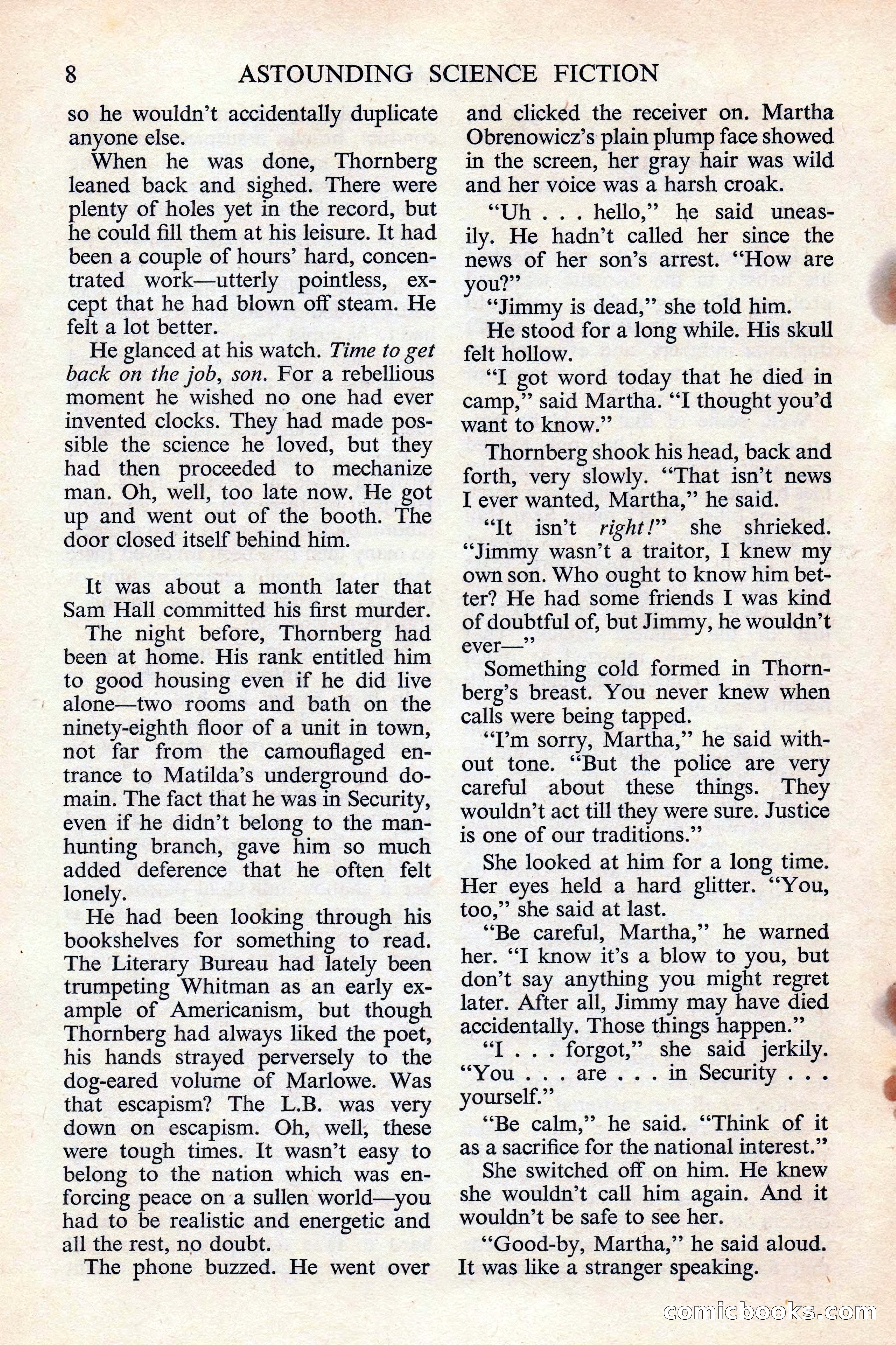
A restored page from Pulp Fiction, 1954. Page through the whole issue in the reader above.
📄 Transcribed text from this page (OCR, searchable)
Machine-transcribed from the original scan — historical spelling and the odd misread are preserved.
8 ASTOUNDING SCIENCE FICTION so he wouldn’t accidentally duplicate anyone else. When he was done, Thornberg leaned back and sighed. There were plenty of holes yet in the record, but he could fill them at his leisure. It had been a couple of hours’ hard, concen- trated work—utterly pointless, ex- cept that he had blown off steam. He felt a lot better. He glanced at his watch. Time to get back on the job, son. For a rebellious moment he wished no one had ever invented clocks. They had made pos- sible the science he loved, but they had then proceeded to mechanize man. Oh, well, too late now. He got up and went out of the booth. The door closed itself behind him. It was about a month later that Sam Hall committed his first murder. The night before, Thornberg had been at home. His rank entitled him to good housing even if he did live alone—two rooms and bath on the ninety-eighth floor of a unit in town, not far from the camouflaged en- trance to Matilda’s underground do- main. The fact that he was in Security, even if he didn’t belong to the man- hunting branch, gave him so much added deference that he often felt lonely. He had been looking through his bookshelves for something to read. The Literary Bureau had lately been trumpeting Whitman as an early ex- ample of Americanism, but though Thornberg had always liked the poet, his hands strayed perversely to the dog-eared volume of Marlowe. Was that escapism? The L.B. was very down on escapism. Oh, well, these were tough times. It wasn’t easy to belong to the nation which was en- forcing peace ona sullen world—you had to be realistic and energetic and all the rest, no doubt. The phone buzzed. He went over and clicked the receiver on. Martha Obrenowicz’s plain plump face showed in the screen, her gray hair was wild and her voice was a harsh croak. “Uh ... hello,” he said uneas- ily. He hadn’t called her since the news of her son’s arrest. ““How are you?” “Jimmy is dead,” she told him. He stood for a long while. His skull felt hollow. me got word today that he died in camp,” said Martha. “I thought you'd want to know.” Thornberg shook his head, back and forth, very slowly. “That isn’t news I ever wanted, Martha,” he said. “It isn’t right!’ she shrieked. “Jimmy wasn’t a traitor, I knew my own son. Who ought to know him bet- ter? He had some friends I was kind of doubtful of, but Jimmy, he wouldn’t ever—”’ Something cold formed in Thorn- berg’s breast. You never knew when calls were being tapped. “I’m sorry, Martha,” he said with- out tone. “But the police are very careful about these things. They wouldn’t act till they were sure. Justice is one of our traditions.” She looked at him for a long time. Her eyes held a hard glitter. “You, too,”’ she said at last. ‘Be careful, Martha,’? he warned her. “I know it’s a blow to you, but don’t say anything you might regret later. After all, Jimmy may have died sens Those things happen.” “I... forgot,” she said ek “Yotl..-....are << . IB. Secnniy yourself.”’ ‘Be calm,” he said. “‘Think of it as a sacrifice for the national interest.” She switched off on him. He knew she wouldn’t call him again. And it wouldn’t be safe to see her. ““Good-by, Martha,”’ he said aloud. It was like a stranger speaking. comicbooks.coO iin