
Pulp Fiction, 1953 · page 97 of 132
Astounding Science Fiction, British Edition — page 97: what you’re looking at
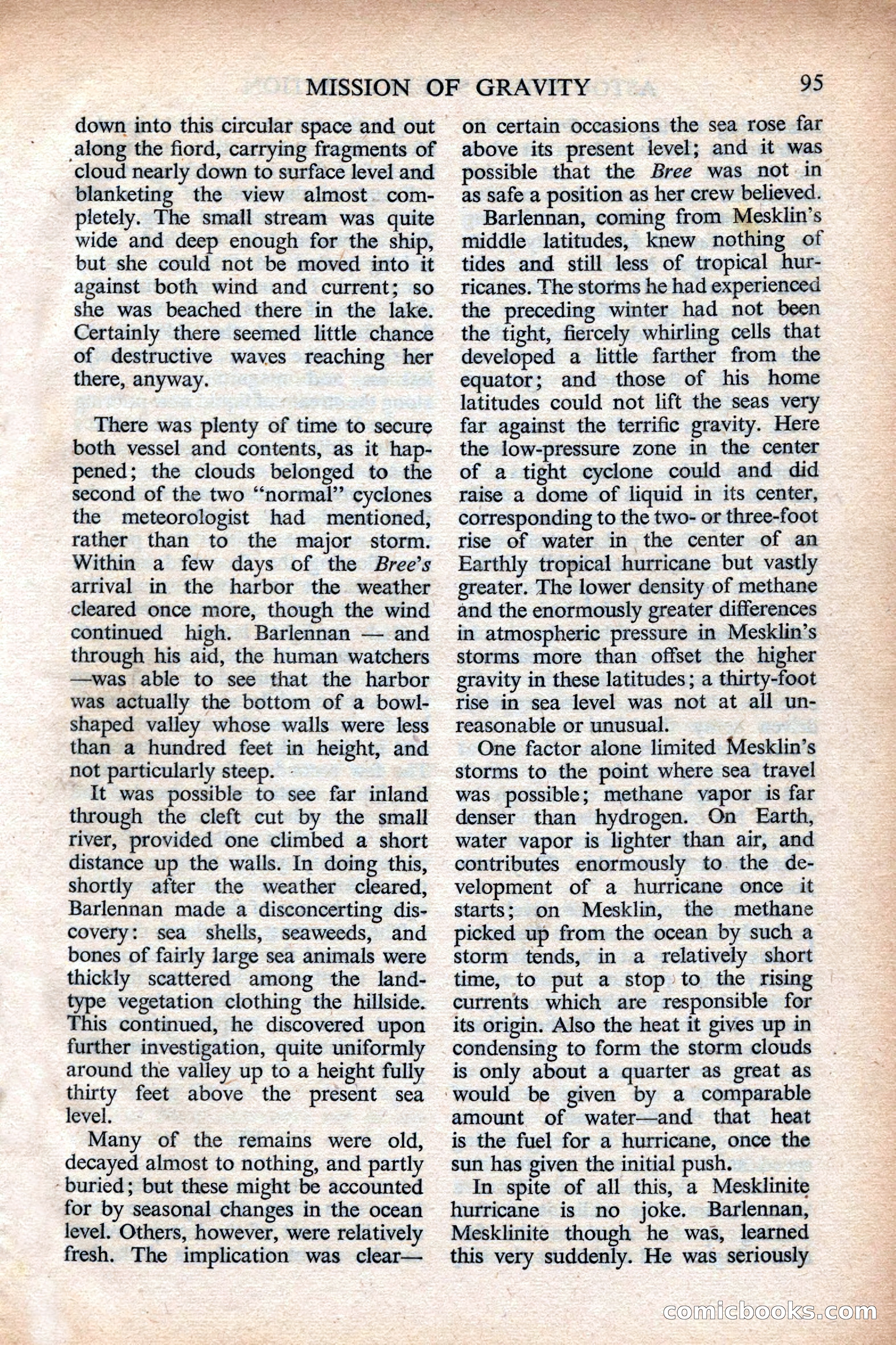
A restored page from Pulp Fiction, 1953. Page through the whole issue in the reader above.
📄 Transcribed text from this page (OCR, searchable)
Machine-transcribed from the original scan — historical spelling and the odd misread are preserved.
SA Py fea Va i} MISSION OF GRAVITY. 95 down into this circular space and out along the fiord, carrying fragments of cloud nearly down to surface level and blanketing the view almost. com- pletely. The small stream was quite wide and deep enough for the ship, but she could not be moved into it against both wind and current; so she was beached there in the lake. Certainly there seemed little chance of destructive waves reaching her there, anyway. There was plenty of time to secure both vessel and contents, as it hap- pened; the clouds belonged to the second of the two “‘normal’’ cyclones the meteorologist had mentioned, rather than to the major storm. Within a few days of the Bree’s arrival in the harbor the weather cleared once more, though the wind continued high. Barlennan — and through his aid, the human watchers —was able to see that the harbor was actually the bottom of a bowl- shaped valley whose walls were less than a hundred feet in height, and not particularly steep. - It was possible to see far inland through the cleft cut by the small river, provided one climbed a short distance up the walls. In doing this, shortly after the weather cleared, Barlennan made a disconcerting dis- covery: sea shells, seaweeds, and bones of fairly large sea animals were thickly scattered among the land- type vegetation clothing the hillside. This continued, he discovered upon further investigation, quite uniformly around the valley up to a height fully thirty feet above the present sea level. Many of the remains were old, decayed almost to nothing, and partly ‘buried; but these might be accounted for by seasonal changes in the ocean level. Others, however, were relatively fresh. The implication was clear— ‘would be on certain occasions the sea rose far above its present level; and it was possible that the Bree was not in as safe a position as her crew believed. Barlennan, coming from Mesklin’s middle latitudes, knew nothing of tides and still less of tropical hur- ricanes. The storms he had experienced the preceding winter had not been the tight, fiercely whirling cells that developed a little farther from the equator; and those of his home latitudes could not lift the seas very far against the terrific gravity. Here the low-pressure zone in the center of a tight cyclone could and did raise a dome of liquid in its center, corresponding to the two- or three-foot rise of water in the center of an Earthly tropical hurricane but vastly greater. The lower density of methane and the enormously greater differences in atmospheric pressure in Mesklin’s storms more than offset the higher gravity in these latitudes; a thirty-foot rise in sea level was not at all un- reasonable or unusual. One factor alone limited Mesklin’s storms to the point where sea travel was possible; methane vapor is far denser than hydrogen. On Earth, water vapor is lighter than air, and contributes enormously to. the de- velopment of a hurricane once it starts; on Mesklin, the methane picked up from the ocean by such a storm tends, in a relatively short time, to put a stop to the rising currents which are responsible for its origin. Also the heat it gives up in condensing to form the storm clouds is only about a quarter as great as | given by a comparable amount of water—and that heat is the fuel for a hurricane, once the sun has given the initial push. In spite of all this, a Mesklinite hurricane is no joke. Barlennan, Mesklinite though he was, learned this very suddenly. He was seriously Cconmicoooks COA