
Pulp Fiction, 1953 · page 73 of 132
Astounding Science Fiction, British Edition — page 73: what you’re looking at
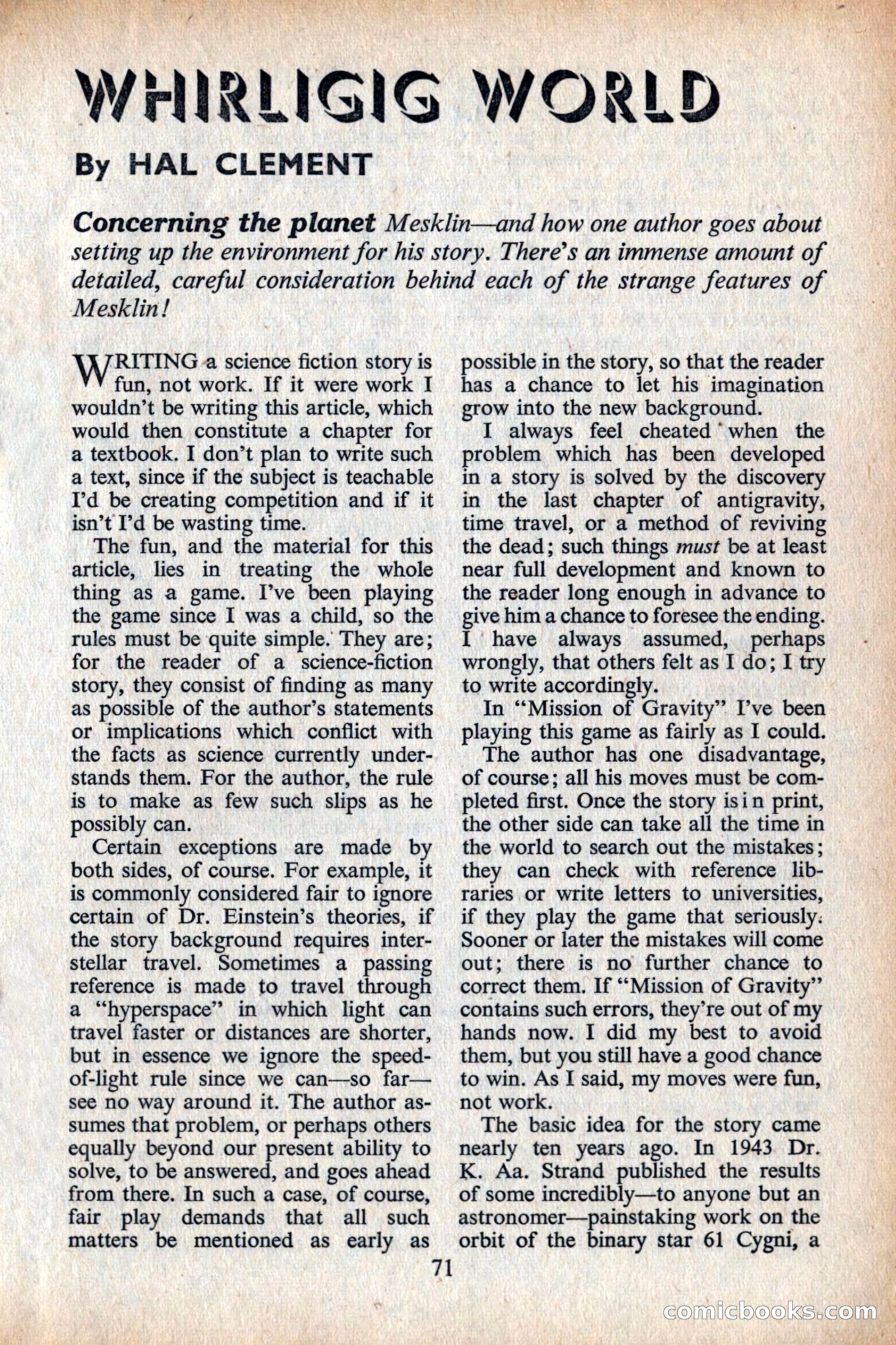
A restored page from Pulp Fiction, 1953. Page through the whole issue in the reader above.
📄 Transcribed text from this page (OCR, searchable)
Machine-transcribed from the original scan — historical spelling and the odd misread are preserved.
bag Oe sie - WrllRLIGIG By HAL CLEMENT WORLD Concerning the planet Mesklin—and how one author goes about setting up the environment for his story. There’s an immense amount of detailed, careful consideration behind each of the strange features of Mesklin! 'RITING a science fiction story is fun, not work. If it were work I wouldn’t be writing this article, which would then constitute a chapter for a textbook. I don’t plan to write such a text, since if the subject is teachable I'd be creating competition and if it isn’t I’d be wasting time. The fun, and the material for this article, lies in treating the whole thing as a game. I’ve been playing the game since I was a child, so the rules must be quite simple. They are; for the reader of a science-fiction story, they consist of finding as many as possible of the author’s statements or implications which conflict with the facts as science currently under- stands them. For the author, the rule is to make as few such slips as he possibly can. Certain exceptions are made by both sides, of course. For example, it is commonly considered fair to ignore certain of Dr. Einstein’s theories, if the story background requires inter- stellar travel. Sometimes a passing reference is made to travel through a “hyperspace” in which light can travel faster or distances are shorter, but in essence we ignore the speed- of-light rule since we can—so far— see no way around it. The author as- sumes that problem, or perhaps others equally beyond our present ability to solve, to be answered, and goes ahead from there. In such a case, of course, fair play demands that all such matters be mentioned as early as 71 possible in the story, so that the reader has a chance to let his imagination grow into the new background. I always feel cheated “when the problem which has been developed in a story is solved by the discovery in the last chapter of antigravity, time travel, or a method of reviving the dead; such things must be at least near full development and known to the reader long enough in advance to give him a chance to foresee the ending. I have always assumed, perhaps wrongly, that others felt as I do; I try to write accordingly. In “‘Mission of Gravity” Vve been playing this game as fairly as I could. The author has one disadvantage, of course; all his moves must be com- pleted first. Once the story isin print, the other side can take all the time in the world to search out the mistakes; they can check with reference lib- raries or write letters to universities, if they play the game that seriously: Sooner or later the mistakes will come out; there is no further chance to correct them. If ““Mission of Gravity”’ contains such errors, they’re out of my hands now. I did my best to avoid them, but you still have a good chance to win. As I said, my moves were fun, not work. The basic idea for the story came nearly ten years ago. In 1943. Dr. K. Aa. Strand published the results of some incredibly—to anyone but an astronomer—painstaking work on the orbit of the binary star 61 Cygni, a CoOnniclooolks