
Pulp Fiction, 1953 · page 72 of 132
Astounding Science Fiction, British Edition — page 72: what you’re looking at
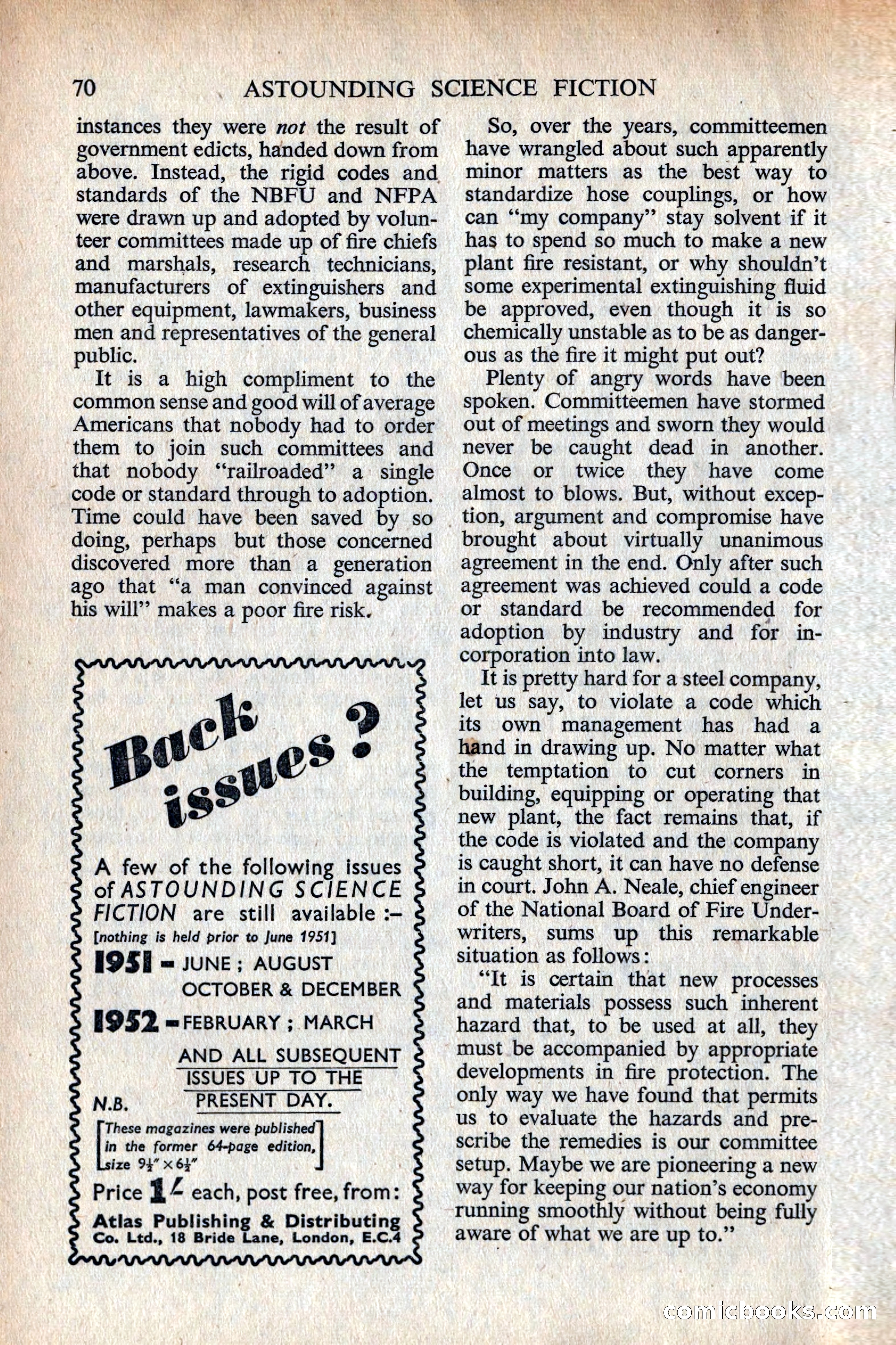
A restored page from Pulp Fiction, 1953. Page through the whole issue in the reader above.
📄 Transcribed text from this page (OCR, searchable)
Machine-transcribed from the original scan — historical spelling and the odd misread are preserved.
70 instances they were not the result of government edicts, handed down from above. Instead, the rigid codes and standards of the NBFU and NFPA were drawn up and adopted by volun- teer committees made up of fire chiefs and marshals, research technicians, manufacturers of extinguishers and other equipment, lawmakers, business men and representatives of the general public. It is a high compliment to the common sense and good will of average Americans that nobody had to order them to join such committees and that nobody “railroaded’”’ a single code or standard through to adoption. Time could have been saved by so . doing, perhaps but those concerned discovered more than a generation ago that “a man convinced against his will’’ makes a poor fire risk. A few of the following issues of ASTOUNDING SCIENCE FICTION are still available :- [nothing is held prior to June 1951] 1950 = JUNE; AUGUST OCTOBER & DECEMBER 8952. = FEBRUARY ; MARCH AND ALL SUBSEQUENT ISSUES UP TO THE N.B. PRESENT DAY. E hese magazines were eat in the former 64-page edition, ize 94" x 64” Price [4 each, post free, from: Atlas Publishing & Distributing Co. Ltd., 18 Bride Lane, London, E.C.4 : + ” - vy ), { ‘ pohly So ML iS 7 ’ 8 ‘ ‘ a? Ris . be | ' ASTOUNDING SCIENCE FICTION So, over the years, committeemen have wrangled about such apparently minor matters as the best way to standardize hose couplings, or how can “my company” stay solvent if it has to spend so much to make a new plant fire resistant, or why shouldn’t some experimental extinguishing fluid be approved, even though it is so chemically unstable as to be as danger- ous as the fire it might put out? Plenty of angry words have been spoken. Committeemen have stormed out of meetings and sworn they would never be caught dead in another. Once or twice they have come almost to blows. But, without excep- tion, argument and compromise have brought about virtually unanimous agreement in the end. Only after such agreement was achieved could a code or standard be recommended for adoption by industry and for in- corporation into law. | It is pretty hard for a steel company, let us say, to violate a code which its own management has had a hand in drawing up. No matter what _the temptation to cut corners in building, equipping or operating that new plant, the fact remains that, if the code is violated and the company is caught short, it can have no defense in court. John A. Neale, chief engineer of the National Board of Fire Under- writers, sums up this remarkable situation as follows: “It is certain that new processes and materials possess such inherent hazard that, to be used at all, they must be accompanied by appropriate developments in fire protection. The only way we have found that permits us to evaluate the hazards and pre- scribe the remedies is our committee setup. Maybe we are pioneering a new way for keeping our nation’s economy running smoothly without being fully aware of what we are up to.” Connicloooks —., -h. COTM