
Pulp Fiction, 1953 · page 70 of 132
Astounding Science Fiction, British Edition — page 70: what you’re looking at
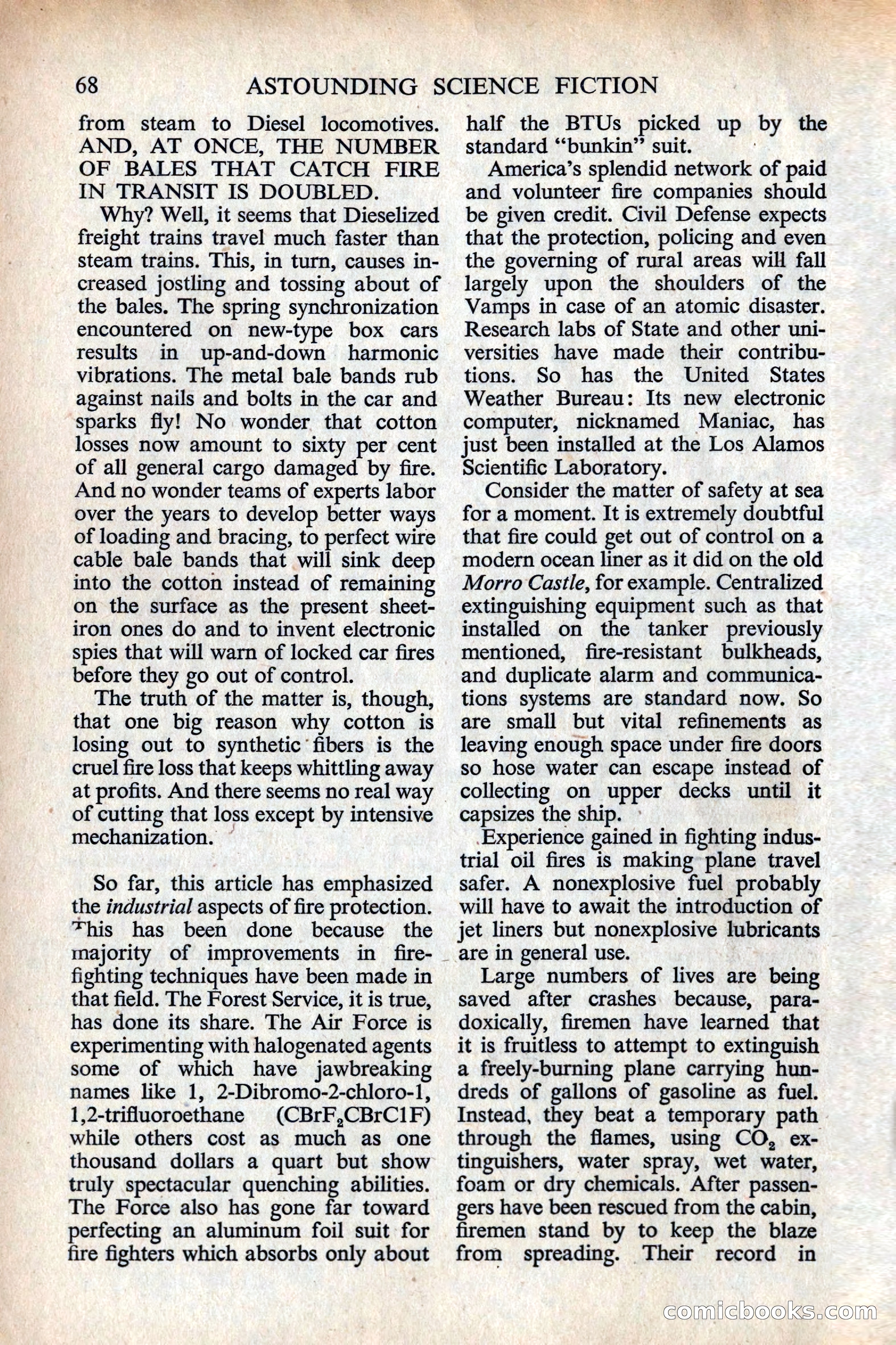
A restored page from Pulp Fiction, 1953. Page through the whole issue in the reader above.
📄 Transcribed text from this page (OCR, searchable)
Machine-transcribed from the original scan — historical spelling and the odd misread are preserved.
68 from steam to Diesel locomotives. AND, AT ONCE, THE NUMBER OF BALES THAT CATCH FIRE IN TRANSIT IS DOUBLED. Why? Well, it seems that Dieselized freight trains travel much faster than steam trains. This, in turn, causes in- creased jostling and tossing about of the bales. The spring synchronization encountered on new-type box cars results in up-and-down harmonic vibrations. The metal bale bands rub against nails and bolts in the car and sparks fly! No wonder that cotton losses now amount to sixty per cent of all general cargo damaged by fire. And no wonder teams of experts labor over the years to develop better ways of loading and bracing, to perfect wire cable bale bands that will sink deep into the cotton instead of remaining on the surface as the present sheet- iron ones do and to invent electronic spies that will warn of locked car fires before they go out of control. The truth of the matter is, though, that one big reason why cotton is losing out to synthetic’ fibers is the cruel fire loss that keeps whittling away at profits. And there seems no real way — of cutting that loss except by intensive mechanization. © So far, this article has emphasized the industrial aspects of fire protection. his has been done because the majority of improvements in fire- fighting techniques have been made in that field. The Forest Service, it is true, has done its share. The Air Force is experimenting with halogenated agents some of which have jawbreaking names like 1, 2-Dibromo-2-chloro-l, 1,2-trifluoroethane (CBrF,CBrC1F) while others cost as much as one thousand dollars a quart but show truly spectacular quenching abilities. The Force also has gone far toward perfecting an aluminum foil suit for fire fighters which absorbs only about ASTOUNDING SCIENCE FICTION half the BTUs picked up by the standard “‘bunkin” suit. America’s splendid network of paid and volunteer fire companies should be given credit. Civil Defense expects that the protection, policing and even the governing of rural areas will fall largely upon the shoulders of the Vamps in case of an atomic disaster. Research labs of State and other uni- versities have made their contribu- tions. So has the United States Weather Bureau: Its new electronic computer, nicknamed Maniac, has just been installed at the Los Alamos Scientific Laboratory. Consider the matter of safety at sea for a moment. It is extremely doubtful that fire could get out of control on a modern ocean liner as it did on the old Morro Castle, for example. Centralized extinguishing equipment such as that installed on the tanker previously mentioned, fire-resistant bulkheads, and duplicate alarm and communica- tions systems are standard now. So are small but vital refinements as leaving enough space under fire doors so hose water can escape instead of collecting on upper decks until it capsizes the ship. » Experience gained in fighting indus- trial oil fires is making plane travel safer. A nonexplosive fuel probably will have to await the introduction of jet liners but nonexplosive lubricants _ are in general use. Large numbers of lives are being saved after crashes because, para- doxically, firemen have learned that it is fruitless to attempt to extinguish a freely-burning plane carrying hun- dreds of gallons of gasoline as fuel. Instead, they beat a temporary path through the flames, using CO, ex- tinguishers, water spray, wet water, foam or chemicals. After passen- gers have been rescued from the cabin, firemen stand by to keep the blaze from spreading. Their record in Conmicloooks COTM