
Pulp Fiction, 1953 · page 30 of 132
Astounding Science Fiction, British Edition — page 30: what you’re looking at
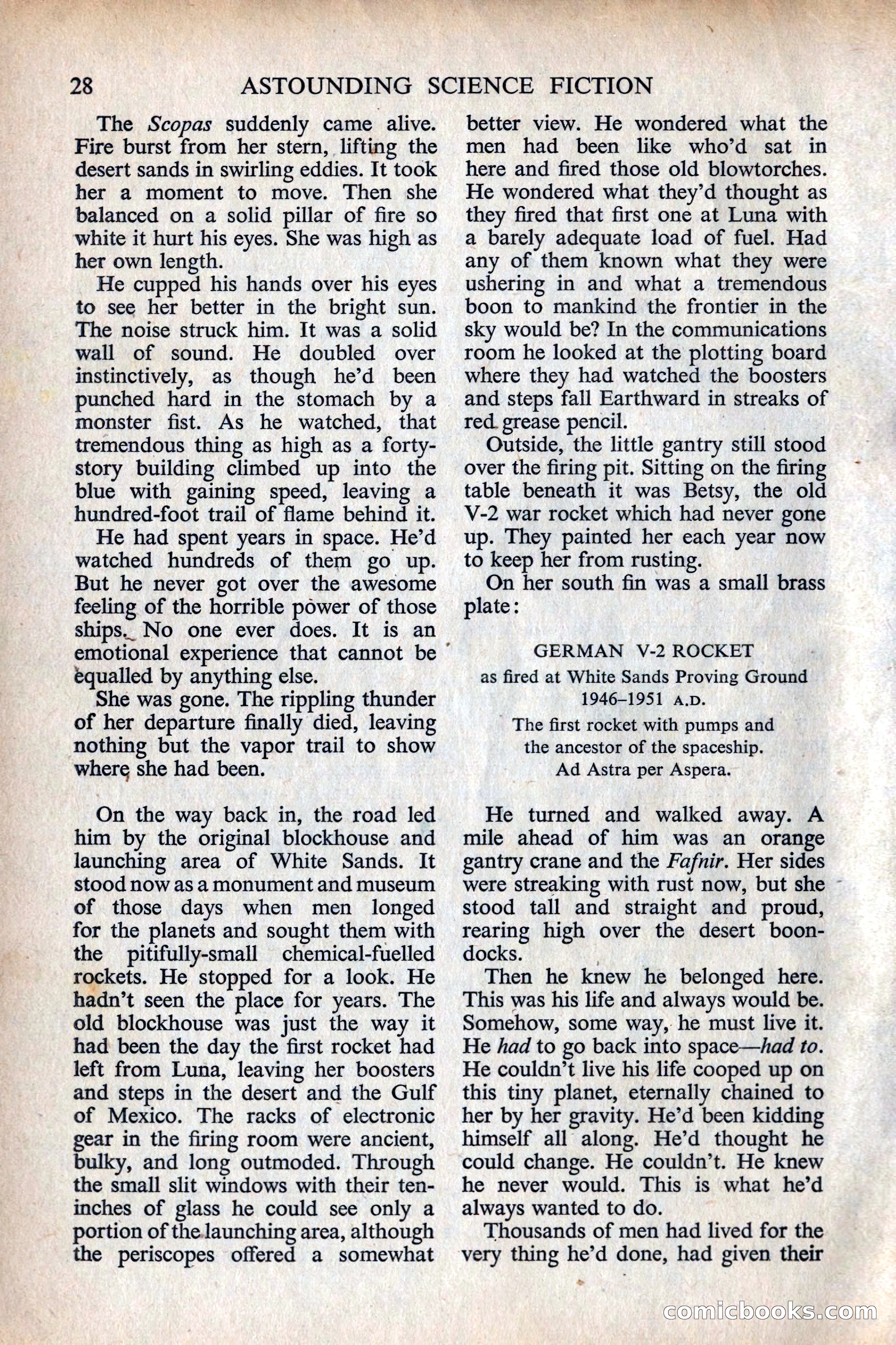
A restored page from Pulp Fiction, 1953. Page through the whole issue in the reader above.
📄 Transcribed text from this page (OCR, searchable)
Machine-transcribed from the original scan — historical spelling and the odd misread are preserved.
28 ASTOUNDING SCIENCE FICTION The Scopas suddenly came alive. Fire burst from her stern, lifting the desert sands in swirling eddies. It took her a moment to move. Then she balanced on a solid pillar of fire so white it hurt his eyes. She was high as her own length. He cupped his hands over his eyes to see her better in the bright sun. The noise struck him. It was a solid wall of sound. He doubled over instinctively, as though he’d been punched hard in the stomach by a monster fist. As he watched, that tremendous thing as high as a forty- story building climbed up into the blue with gaining speed, leaving a hundred-foot trail of flame behind it. He had spent years in space. He’d watched hundreds of them go up. But he never got over the awesome feeling of the horrible power of those ships. No one ever does. It is an emotional experience that cannot be © equalled by anything else. She was gone. The rippling thunder of her departure finally died, leaving nothing but the vapor trail to show where she had been. On the way back in, the road led him by the original blockhouse and launching area of White Sands. It stood now as a monument and museum of those days when men _ longed for the planets and sought them with the pitifully-small chemical-fuelled rockets. He stopped for a look. He hadn’t seen the place for years. The old blockhouse was just the way it had been the day the first rocket had left from Luna, leaving her boosters and steps in the desert and the Gulf of Mexico. The racks of electronic gear in the firing room were ancient, bulky, and long outmoded. Through the small slit windows with their ten- inches of glass he could see only a portion of the launching area, although the periscopes offered a somewhat better view. He wondered what the men had been like who’d sat in here and fired those old blowtorches. He wondered what they’d thought as they fired that first one at Luna with a barely adequate load of fuel. Had any of them known what they were ushering in and what a tremendous boon to mankind the frontier in the sky would be? In the communications room he looked at the plotting board where they had watched the boosters and steps fall Earthward in streaks of red grease pencil. Outside, the little gantry still stood over the firing pit. Sitting on the firing table beneath it was Betsy, the old V-2 war rocket which had never gone up. They painted her each year now to keep her from rusting. On her south fin was a small brass plate: GERMAN V-2 ROCKET as fired at White Sands Proving Ground 1946-1951 A.p. The first rocket with pumps and the ancestor of the spaceship. Ad Astra per Aspera. He turned and walked away. A mile ahead of him was an orange gantry crane and the Fa/fnir. Her sides were streaking with rust now, but she - stood tall and straight and proud, rearing high over the desert boon- docks. : Then he knew he belonged here. This was his life and always would be. Somehow, some way, he must live it. He had to go back into space—had to. He couldn’t live his life cooped up on this tiny planet, eternally chained to her by her gravity. He’d been kidding himself all along. He’d thought he could change. He couldn’t. He knew he never would. This is what he’d always wanted to do. Thousands of men had lived for the very thing he’d done, had given their ConnicloolkkxS.con