
Pulp Fiction, 1953 · page 29 of 132
Astounding Science Fiction, British Edition — page 29: what you’re looking at
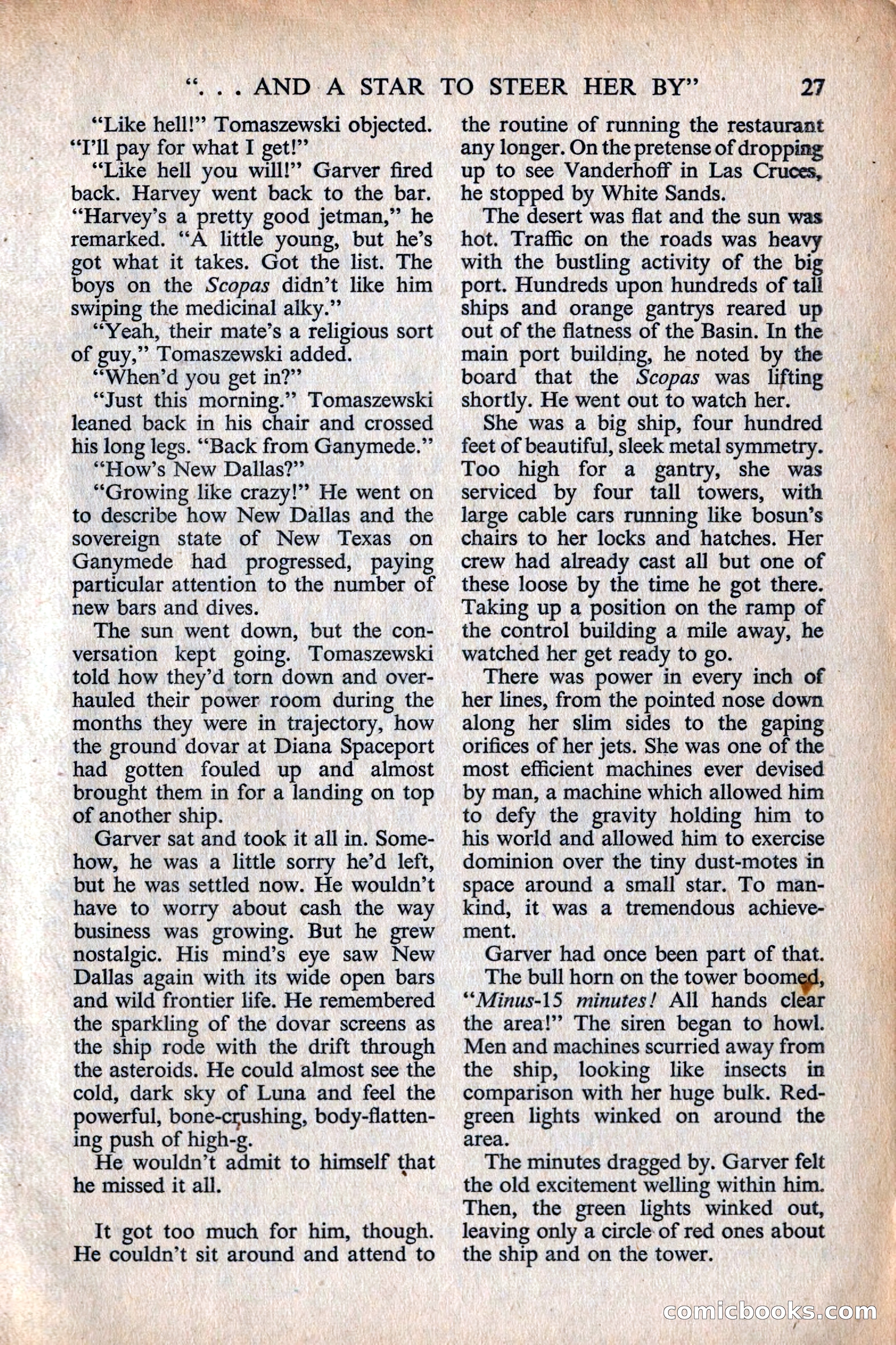
A restored page from Pulp Fiction, 1953. Page through the whole issue in the reader above.
📄 Transcribed text from this page (OCR, searchable)
Machine-transcribed from the original scan — historical spelling and the odd misread are preserved.
« —. AND-A STAR TO STEER HER BY” 27 *“Like hell!’ Tomaszewski objected. “T’ll pay for what I get!” “Like hell you willl’? Garver fired back. Harvey went back to the bar. ““Harvey’s a pretty good jetman,” he remarked. “‘A little young, but he’s got what it takes. Got the list. The boys on the Scopas didn’t like him swiping the medicinal alky.” “Yeah, their mate’s a religious sort of guy,” Tomaszewski added. ““When’d you get in?” “Just this morning.’ Tomaszewski leaned back in his chair and crossed his long legs. ““Back from Ganymede.” ““How’s New Dallas?” “Growing like crazy!” He went on to describe how New Dallas and the sovereign state of New Texas on Ganymede had progressed, paying particular attention to the number of new bars and dives. The sun went down, but the con- versation kept going. Tomaszewski told how they’d torn down and over- hauled their power room during the months they were in trajectory, how the ground dovar at Diana Spaceport had gotten fouled up and almost brought them in for a landing on top of another ship. Garver sat and took it all in. Some- how, he was a little sorry he'd left, but he was settled now. He wouldn’t have to worry about cash the way business was growing. But he grew nostalgic. His mind’s eye saw New Dallas again with its wide open bars and wild frontier life. He remembered the sparkling of the dovar screens as the ship rode with the drift through the asteroids. He could almost see the cold, dark sky of Luna and feel the powerful, bone-crushing, body-flatten- ing push of high-g. He wouldn’t admit to himself that he missed it all. It got too much for him, though. He couldn’t sit around and attend to the routine of running the restaurant any longer. On the pretense of dropping up to see Vanderhoff in Las Cruces, he stopped by White Sands. The desert was flat and the sun was hot. Traffic on the roads was heavy with the bustling activity of the big port. Hundreds upon hundreds of ta ships and orange gantrys reared up out of the flatness of the Basin. In the main port building, he noted by the board that the Scopas was lifting shortly. He went out to watch her. She was a big ship, four hundred feet of beautiful, sleek metal symmetry. Too high for a gantry, she was serviced by four tall towers, with large cable cars running like bosun’s chairs to her locks and hatches. Her crew had already cast all but one of these loose by the time he got there. Taking up a position on the ramp of the control building a mile away, he watched her get ready to go. There was power in every inch of © her lines, from the pointed nose down along her slim sides to the gaping. orifices of her jets. She was one of the most efficient machines ever devised by man, a machine which allowed him to defy the gravity holding him to his world and allowed him to exercise dominion over the tiny dust-motes in space around a small star. To man- kind, it was a tremendous achieve- ment. Garver had once been part of that. The bull horn on the tower boomed, ““Minus-15 minutes! All hands clear the area!’’ The siren began to howl. Men and machines scurried away from the ship, looking like insects in comparison with her huge bulk. Red- green lights winked on around the area. The minutes dragged by. Garver felt the old excitement welling within him. Then, the green lights winked out, leaving only a circle of red ones about the ship and on the tower. COMMIC DOO“ com