
Pulp Fiction, 1955 · page 5 of 133
Astounding Science Fiction, British Edition, December 1955 — page 5: what you’re looking at
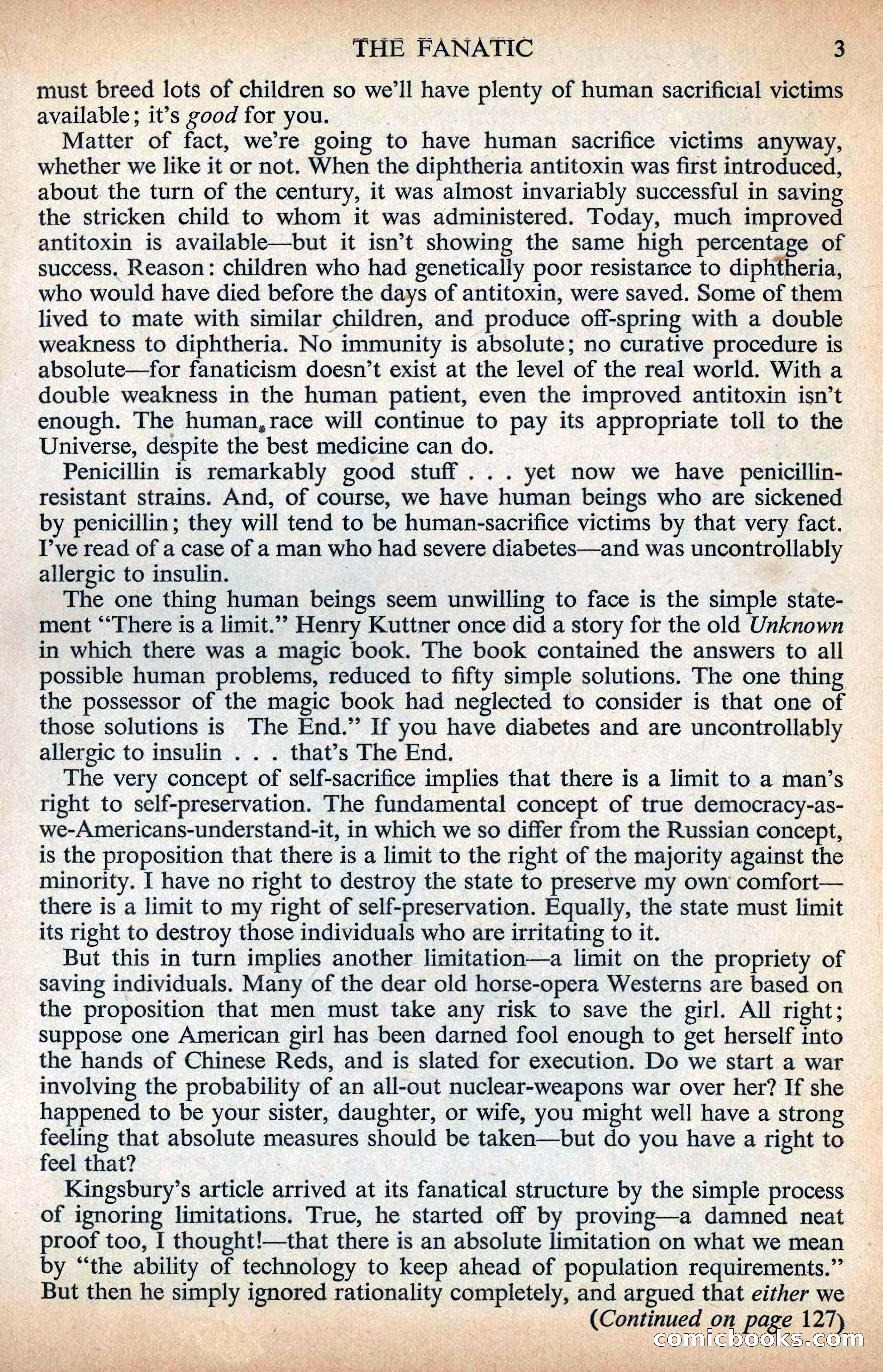
A restored page from Pulp Fiction, 1955. Page through the whole issue in the reader above.
📄 Transcribed text from this page (OCR, searchable)
Machine-transcribed from the original scan — historical spelling and the odd misread are preserved.
THE FANATIC 3 must breed lots of children so we'll have plenty of human sacrificial victims available; it’s good for you. | Matter of fact, we’re going to have human sacrifice victims anyway, whether we like it or not. When the diphtheria antitoxin was first introduced, about the turn of the century, it was almost invariably successful in saving the stricken child to whom it was administered. Today, much improved antitoxin is available—but it isn’t showing the same high percentage of success. Reason: children who had genetically poor resistance to diphtheria, who would have died before the days of antitoxin, were saved. Some of them lived to mate with similar children, and produce off-spring with a double weakness to diphtheria. No immunity is absolute; no curative procedure is | absolute—for fanaticism doesn’t exist at the level of the real world. With a double weakness in the human patient, even the improved antitoxin isn’t enough. The human,race will continue to pay its appropriate toll to the Universe, despite the best medicine can do. Penicillin is remarkably good stuff... yet now we have penicillin- resistant strains. And, of course, we have human beings who are sickened by penicillin; they will tend to be human-sacrifice victims by that very fact. I’ve read of a case of a man who had severe diabetes—and was uncontrollably allergic to insulin. The one thing human beings seem unwilling to face is the simple state- ment “There is a limit.”” Henry Kuttner once did a story for the old Unknown in which there was a magic book. The book contained the answers to all possible human problems, reduced to fifty simple solutions. The one thing the possessor of the magic book had neglected to consider is that one of those solutions is The End.” If you have diabetes and are uncontrollably allergic to insulin . . . that’s The End. The very concept of self-sacrifice implies that there is a limit to a man’s right to self-preservation. The fundamental concept of true democracy-as- we-Americans-understand-it, in which we so differ from the Russian concept, is the proposition that there is a limit to the right of the majority against the minority. I have no right to destroy the state to preserve my own comfort— there is a limit to my right of self-preservation. Equally, the state must limit its right to destroy those individuals who are irritating to it. But this in turn implies another limitation—a limit on the propriety of saving individuals. Many of the dear old horse-opera Westerns are based on the proposition that men must take any risk to save the girl. All right; suppose one American girl has been darned fool enough to get herself into the hands of Chinese Reds, and is slated for execution. Do we start a war involving the probability of an all-out nuclear-weapons war over her? If she happened to be your sister, daughter, or wife, you might well have a strong feeling that absolute measures should be taken—but do you have a right to feel that? ; Kingsbury’s article arrived at its fanatical structure by the simple process of ignoring limitations. True, he started off by proving—a damned neat proof too, I thought!—that there is an absolute limitation on what we mean by “‘the ability of technology to keep ahead of population requirements.” But then he simply ignored rationality completely, and argued that either we (Continued on page 127 : Comicbookskcom