
Pulp Fiction, 1955 · page 4 of 133
Astounding Science Fiction, British Edition, December 1955 — page 4: what you’re looking at
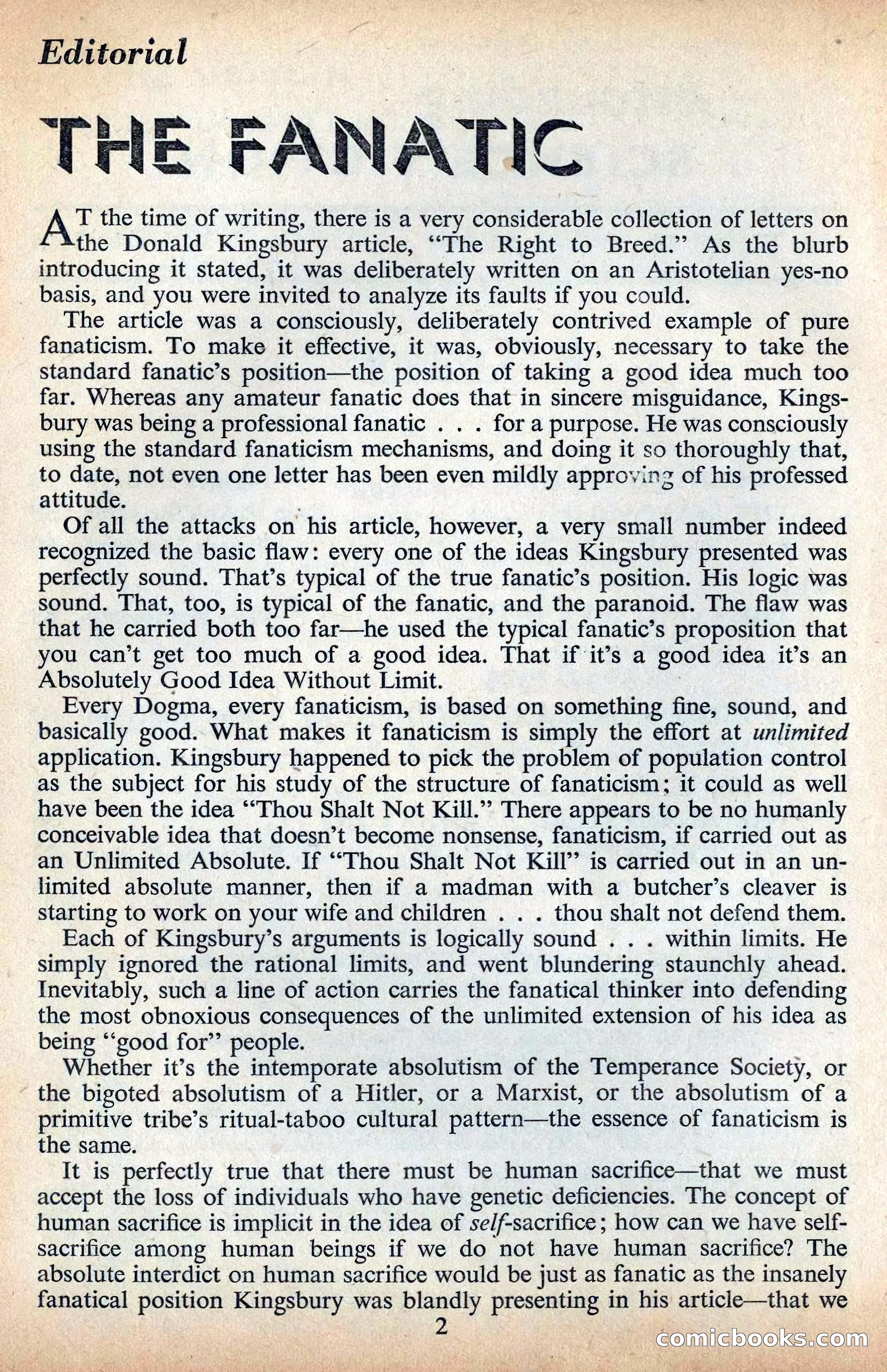
A restored page from Pulp Fiction, 1955. Page through the whole issue in the reader above.
📄 Transcribed text from this page (OCR, searchable)
Machine-transcribed from the original scan — historical spelling and the odd misread are preserved.
Editorial THE FANATIC At the time of writing, there is a very considerable collection of letters on the Donald Kingsbury article, ““The Right to Breed.’ As the blurb introducing it stated, it was deliberately written on an Aristotelian yes-no basis, and you were invited to analyze its faults if you could. The article was a consciously, deliberately contrived example of pure fanaticism. To make it effective, it was, obviously, necessary to take the standard fanatic’s position—the position of taking a good idea much too far. Whereas any amateur fanatic does that in sincere misguidance, Kings- bury was being a professional fanatic . . . for a purpose. He was consciously using the standard fanaticism mechanisms, and doing it so thoroughly that, to date, not even one letter has been even mildly approving of his professed attitude. ! Of all the attacks on his article, however, a very small number indeed recognized the basic flaw: every one of the ideas Kingsbury presented was perfectly sound. That’s typical of the true fanatic’s position. His logic was sound. That, too, is typical of the fanatic, and the paranoid. The flaw was that he carried both too far—he used the typical fanatic’s proposition that you can’t get too much of a good idea. That if it’s a good idea it’s an Absolutely Good Idea Without Limit. : Every Dogma, every fanaticism, is based on something fine, sound, and basically good. What makes it fanaticism is simply the effort at unlimited application. Kingsbury happened to pick the problem of population control as the subject for his study of the structure of fanaticism; it could as well have been the idea ““Thou Shalt Not Kill.” There appears to be no humanly conceivable idea that doesn’t become nonsense, fanaticism, if carried out as an Unlimited Absolute. If ““Thou Shalt Not Kill” is carried out in an un- limited absolute manner, then if a madman with a butcher’s cleaver is starting to work on your wife and children . . . thou shalt not defend them. Each of Kingsbury’s arguments is logically sound . . . within limits. He simply ignored the rational limits, and went blundering staunchly ahead. Inevitably, such a line of action carries the fanatical thinker into defending the most obnoxious consequences of the unlimited extension of his idea as being “‘good for’’ people. Whether it’s the intemporate absolutism of the Temperance Society, or the bigoted absolutism of a Hitler, or a Marxist, or the absolutism of a primitive tribe’s ritual-taboo cultural pattern—the essence of fanaticism is the same. It is perfectly true that there must be human sacrifice—that we must accept the loss of individuals who have genetic deficiencies. The concept of human sacrifice is implicit in the idea of self-sacrifice; how can we have self- sacrifice among human beings if we do not have human sacrifice? The absolute interdict on human sacrifice would be just as fanatic as the insanely fanatical position Kingsbury was blandly presenting in his article—that we cComichbooks com