
Pulp Fiction, 1955 · page 41 of 67
Astounding Science Fiction, British Edition — page 41: what you’re looking at
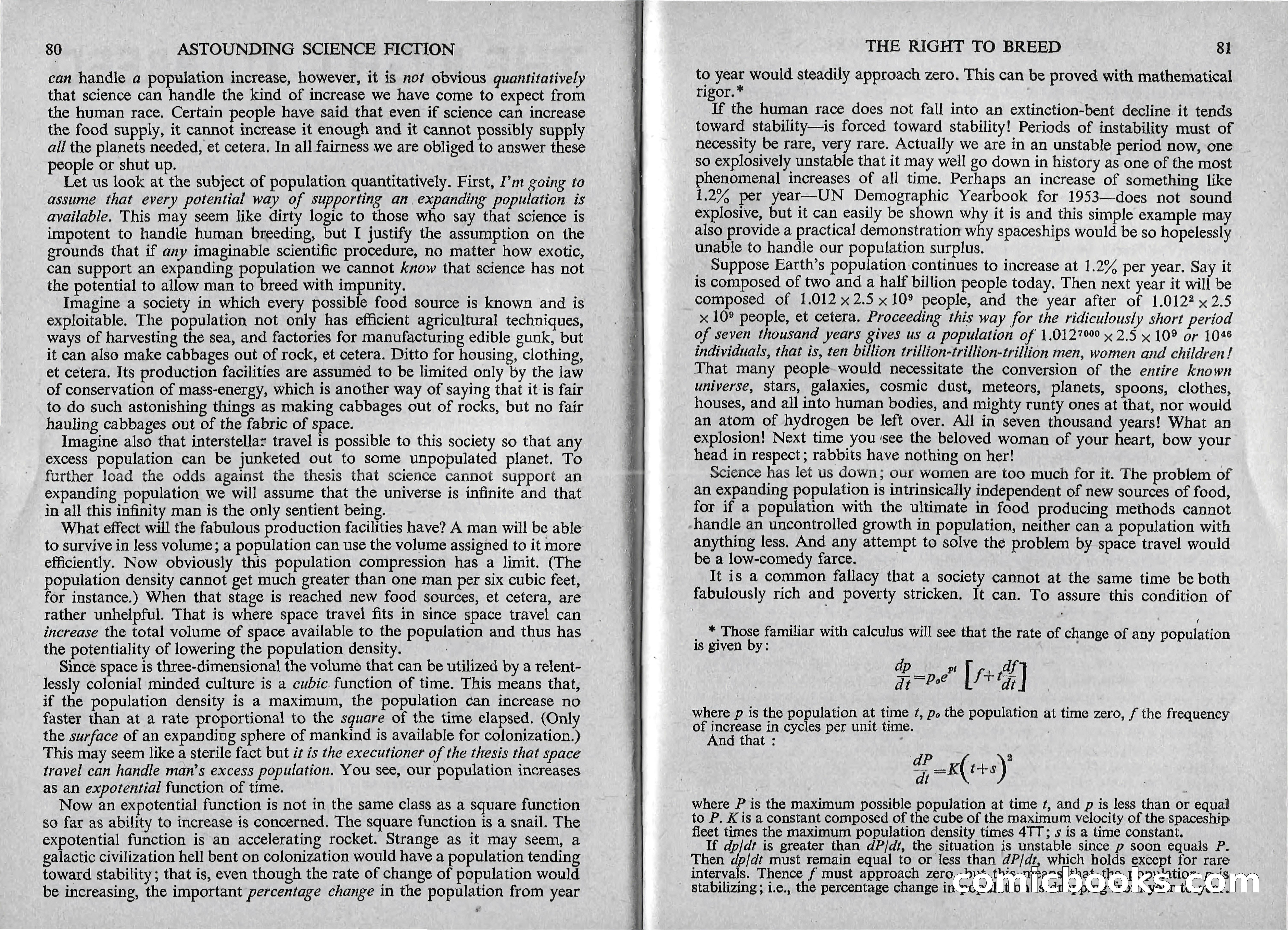
A restored page from Pulp Fiction, 1955. Page through the whole issue in the reader above.
📄 Transcribed text from this page (OCR, searchable)
Machine-transcribed from the original scan — historical spelling and the odd misread are preserved.
80 ASTOUNDING SCIENCE FICTION can handle a population increase, however, it is not obvious quantitatively that science can handle the kind of increase we have come to expect from the human race. Certain people have said that even if science can increase the food supply, it cannot increase it enough and it cannot possibly supply all the planets needed, et cetera. In all fairness we are obliged to answer these people or shut up. Let us look at the subject of population quantitatively. First, I’m going to assume that every potential way of supporting an expanding population is available. This may seem like dirty logic to those who say that science is impotent to handle human breeding, but I justify the assumption on the grounds that if any imaginable scientific procedure, no matter how exotic, can support an expanding population we cannot know that science has not the potential to allow man to breed with impunity. Imagine a society in which every possible food source is known and is exploitable. The population not only has efficient agricultural techniques, ways of harvesting the sea, and factories for manufacturing edible gunk, but it can also make cabbages out of rock, et cetera. Ditto for housing, clothing, et cetera. Its production facilities are assumed to be limited only by the law of conservation of mass-energy, which is another way of saying that it is fair to do such astonishing things as making cabbages out of rocks, but no fair hauling cabbages out of the fabric of space. Imagine also that interstellar travel is possible to this society so that any excess population can be junketed out to some unpopulated planet. To further load the odds against the thesis that science cannot support an expanding population we will assume that the universe is infinite and that in all this infinity man is the only sentient being. What effect will the fabulous production facilities have? A man will be able to survive in less volume; a population can use the volume assigned to it more efficiently. Now obviously this population compression has a limit. (The population density cannot get much greater than one man per six cubic feet, for instance.) When that stage is reached new food sources, et cetera, are rather unhelpful. That is where space travel fits in since space travel can increase the total volume of space available to the population and thus has — , the potentiality of lowering the population density. ! Since space is three-dimensional the volume that can be utilized by a relent- lessly colonial minded culture is a cubic function of time. This means that, if the population density is a maximum, the population can increase no faster than at a rate proportional to the square of the time elapsed. (Only the surface of an expanding sphere of mankind is available for colonization.) This may seem like a sterile fact but it is the executioner of the thesis that space travel can handle man’s excess population. You see, our population increases as an expotential function of time. Now an expotential function is not in the same class as a square function so far as ability to increase is concerned. The square function is a snail. The expotential function is an accelerating rocket. Strange as it may seem, a galactic civilization hell bent on colonization would have a population tending toward stability; that is, even though the rate of change of population would be increasing, the important percentage change in the population from year 2 THE RIGHT TO BREED 8] to year would steadily approach zero. This can be proved with mathematical rigor. | If the human race does not fall into an extinction-bent decline it tends toward stability—is forced toward stability! Periods of instability must of necessity be rare, very rare. Actually we are in an unstable period now, one so explosively unstable that it may well go down in history as one of the most phenomenal increases of all time. Perhaps an increase of something like 1.2% per year—UN Demographic Yearbook for 1953—does not sound explosive, but it can easily be shown why it is and this simple example may also provide a practical demonstration why spaceships would be so hopelessly . unable to handle our population surplus. Suppose Earth’s population continues to increase at 1.2% per year. Say it is composed of two and a half billion people today. Then next year it will be composed of 1.012 x 2.5 x 10° people, and the year after of 1.012? x 2.5 x 10° people, et cetera. Proceeding this way for the ridiculously short period of seven thousand years gives us a population of 1.01279 x 2.5 x 10® or 1046 individuals, that is, ten billion trillion-trillion-trillion men, women and children! That many people would necessitate the conversion of the entire known universe, stars, galaxies, cosmic dust, meteors, planets, spoons, clothes, houses, and all into human bodies, and mighty runty ones at that, nor would an atom of hydrogen be left over. All in seven thousand years! What an explosion! Next time you ‘see the beloved woman of your heart, bow your head in respect; rabbits have nothing on her! 3 Science has let us down; our women are too much for it. The problem of an expanding population is intrinsically independent of new sources of food, for if a population with the ultimate in food producing methods cannot handle an uncontrolled growth in population, neither can a population with anything less, And any attempt to solve the problem by space travel would be a low-comedy farce. It is a common fallacy that a society cannot at the same time be both fabulously rich and poverty stricken. It can. To assure this condition of _ * Those familiar with calculus will see that the rate of change of any population is given by: d d gimp” [Peg of increase in cycles per unit time. And that : : ade ( )y a K( t+s where P is the maximum possible population at time f, and p is less than or equal to P. K is a constant composed of the cube of the maximum velocity of the spaceship fleet times the maximum population density times 4TT; s is a time constant. If dp/dt is greater than dP/dt, the situation is unstable since p soon equals P. Then ae must remain equal to or less than dP/dt, which holds except for rare S intervals. Thence f must approach ECQOmi ofoy - ks: Pp Stabilizing; 1.e., the percentage change i oo ® 0 iG G foye| where p is the population at time /, po the population at time zero, f the frequency