
Pulp Fiction, 1955 · page 40 of 67
Astounding Science Fiction, British Edition — page 40: what you’re looking at
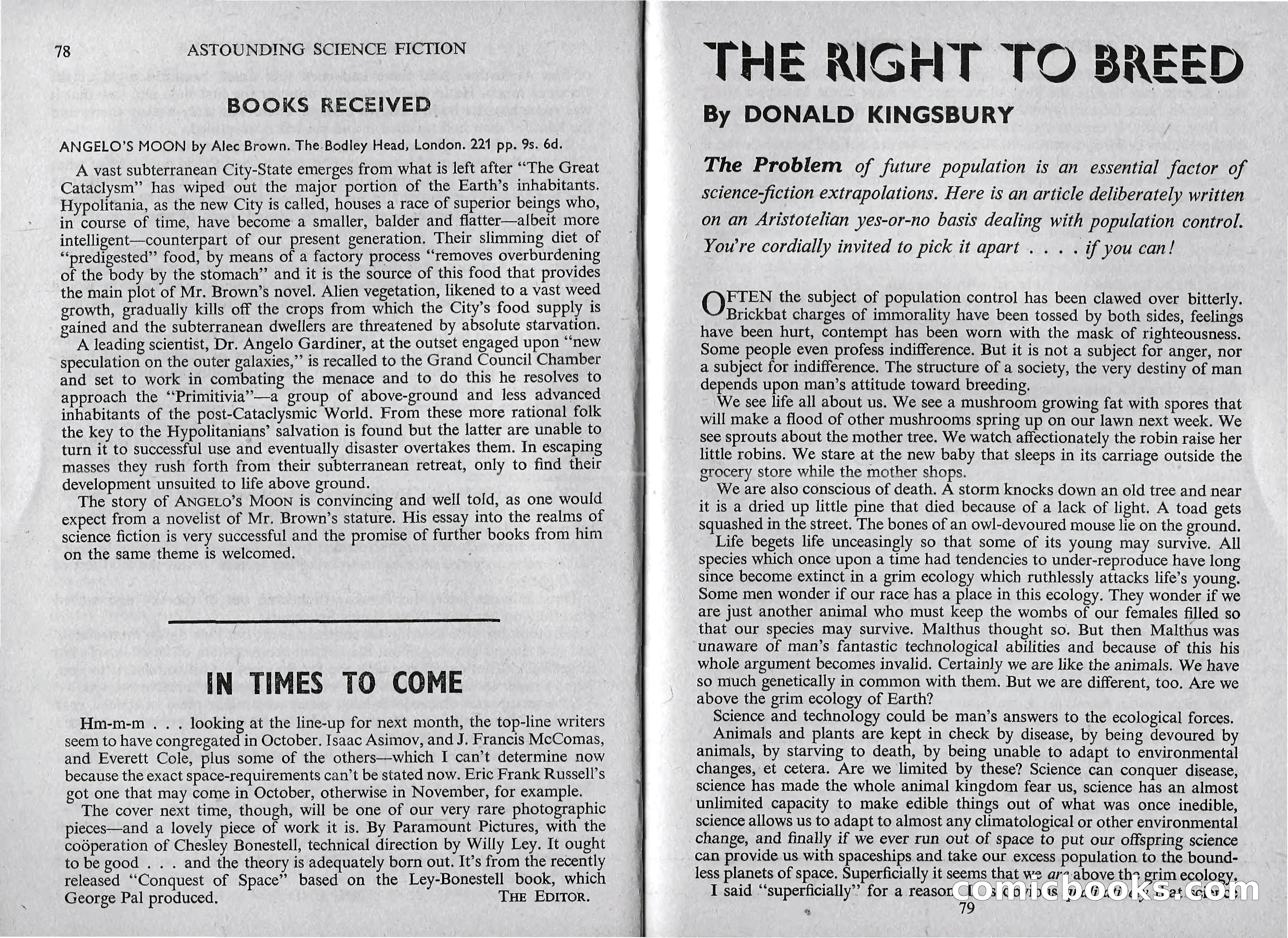
A restored page from Pulp Fiction, 1955. Page through the whole issue in the reader above.
📄 Transcribed text from this page (OCR, searchable)
Machine-transcribed from the original scan — historical spelling and the odd misread are preserved.
78 ASTOUNDING SCIENCE FICTION BOOKS RECEIVED ANGELO’S MOON by Alec Brown. The Bodley Head, London. 221 pp. 9s. 6d. A vast subterranean City-State emerges from what is left after “The Great Cataclysm” has wiped out the major portion of the Earth’s inhabitants. Hypolitania, as the new City is called, houses a race of superior beings who, in course of time, have become a smaller, balder and flatter—albeit more intelligent—counterpart of our present generation. Their slimming diet of “‘predigested” food, by means of a factory process “removes overburdening of the body by the stomach” and it is the source of this food that provides the main plot of Mr. Brown’s novel. Alien vegetation, likened to a vast weed growth, gradually kills off the crops from which the City’s food supply is gained and the subterranean dwellers are threatened by absolute starvation. A leading scientist, Dr. Angelo Gardiner, at the outset engaged upon “new speculation on the outer galaxies,” is recalled to the Grand Council Chamber and set to work in combating the menace and to do this he resolves to approach the “Primitivia”’—a group of above-ground and less advanced inhabitants of the post-Cataclysmic World. From these more rational folk the key to the Hypolitanians’ salvation is found but the latter are unable to turn it to successful use and eventually disaster overtakes them. In escaping masses they rush forth from their subterranean retreat, only to find their development unsuited to life above ground. The story of ANGELO’s Moon is convincing and well told, as one would expect from a novelist of Mr. Brown’s stature. His essay into the realms of science fiction is very successful and the promise of further books from him on the same theme is welcomed. IN TIMES TO COME Hm-m-m .. . looking at the line-up for next month, the top-line writers seem to have congregated in October. Isaac Asimov, and J. Francis McComas, and Everett Cole, plus some of the others—which I can’t determine now because the exact space-requirements can’t be stated now. Eric Frank Russell's got one that may come in October, otherwise in November, for example. The cover next time, though, will be one of our very rare photographic pieces—and a lovely piece of work it is. By Paramount Pictures, with the codperation of Chesley Bonestell, technical direction by Willy Ley. It ought to be good . . . and the theory is adequately born out. It’s from the recently released “Conquest of Space” based on the Ley-Bonestell book, which George Pal produced. : THE EDITOR. Tele RIGHT TO BREED By DONALD KINGSBURY The Problem of future population is an essential factor of science-fiction extrapolations. Here is an article deliberately written on an Aristotelian yes-or-no basis dealing with population control. You're cordially invited to pick it apart. . . . if you can! @EEX the subject of population control has been clawed over bitterly. Brickbat charges of immorality have been tossed by both sides, feelings have been hurt, contempt has been worn with the mask of righteousness. Some people even profess indifference. But it is not a subject for anger, nor a subject for indifference. The structure of a society, the very destiny of man depends upon man’s attitude toward breeding. We see life all about us. We see a mushroom growing fat with spores that will make a flood of other mushrooms spring up on our lawn next week. We see sprouts about the mother tree. We watch affectionately the robin raise her little robins. We stare at the new baby that sleeps in its carriage outside the grocery store while the mother shops. We are also conscious of death. A storm knocks down an old tree and near it is a dried up little pine that died because of a lack of light. A toad gets squashed in the street. The bones of an owl-devoured mouse lie on the ground. Life begets life unceasingly so that some of its young may survive. All Species which once upon a time had tendencies to under-reproduce have long since become extinct in a grim ecology which ruthlessly attacks life’s young. Some men wonder if our race has a place in this ecology. They wonder if we are just another animal who must keep the wombs of our females filled so that our species may survive. Malthus thought so. But then Malthus was unaware of man’s fantastic technological abilities and because of this his whole argument becomes invalid. Certainly we are like the animals. We have so much genetically in common with them. But we are different, too. Are we above the grim ecology of Earth? Science and technology could be man’s answers to the ecological forces. Animals and plants are kept in check by disease, by being devoured by animals, by starving to death, by being unable to adapt to environmental changes, et cetera. Are we limited by these? Science can conquer disease, science has made the whole animal kingdom fear us, science has an almost unlimited capacity to make edible things out of what was once inedible, science allows us to adapt to almost any climatological or other environmental change, and finally if we ever run out of space to put our offspring science _ Can provide us with spaceships and take our excess population to the bound- less planets of space. Superficially it seems that we ar7:above th> grim ecology. be Onl I said “‘superficially” for a Begsou LO) COKE OLOKG) Coal G %