
Pulp Fiction, 1955 · page 19 of 67
Astounding Science Fiction, British Edition — page 19: what you’re looking at
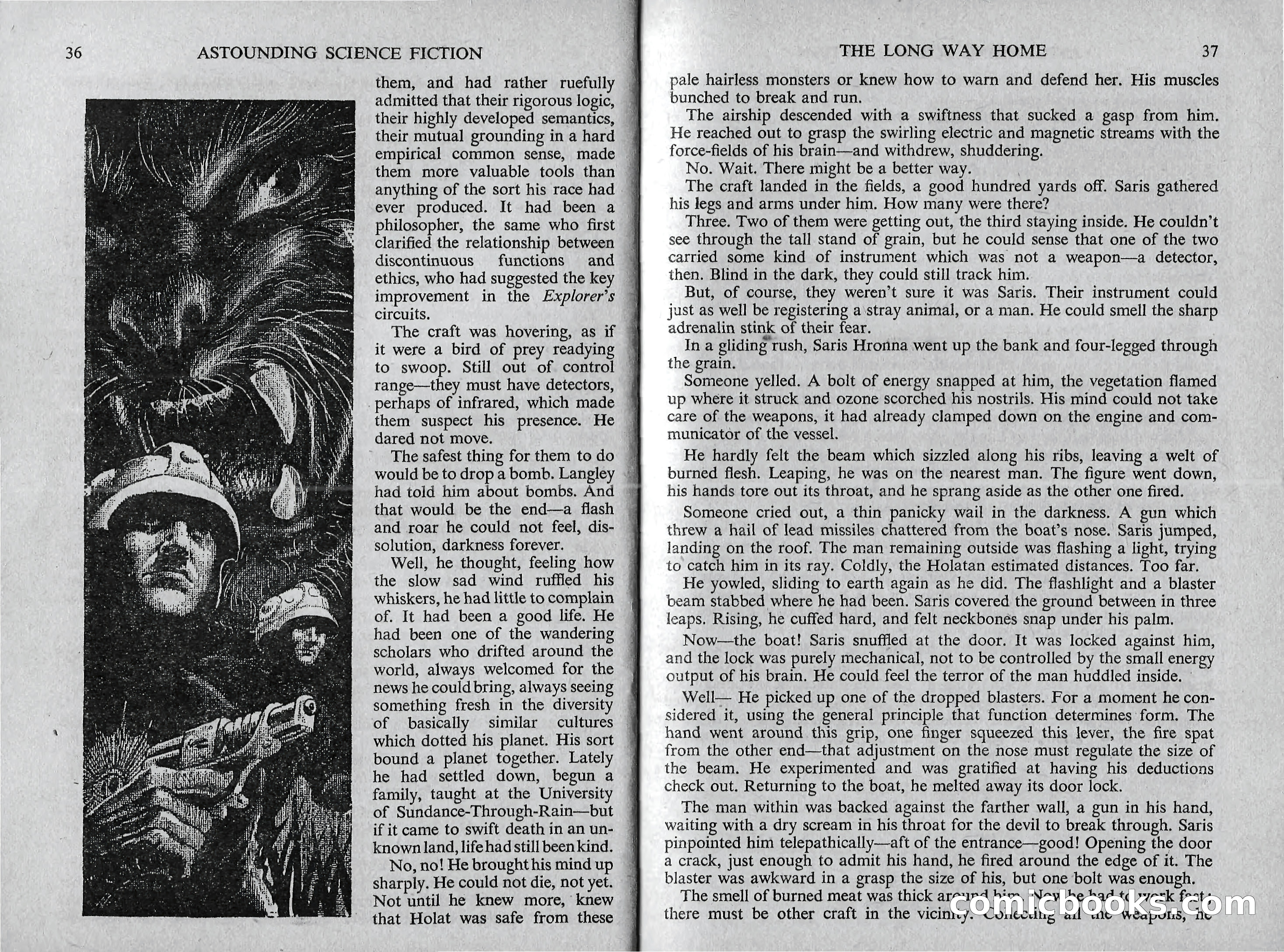
A restored page from Pulp Fiction, 1955. Page through the whole issue in the reader above.
📄 Transcribed text from this page (OCR, searchable)
Machine-transcribed from the original scan — historical spelling and the odd misread are preserved.
36 ASTOUNDING SCIENCE FICTION them, and had rather ruefully admitted that their rigorous logic, their highly developed semantics, their mutual grounding in a hard empirical common sense, made © them more valuable tools than anything of the sort his race had ever produced. It had been a philosopher, the same who first clarified the relationship between discontinuous functions and ethics, who had suggested the key improvement in the Explorer’s circuits. The craft was hovering, as if it were a bird of prey readying to swoop. Still out of control range—they must have detectors, perhaps of infrared, which made them suspect his presence. He dared not move. The safest thing for them to do would be to drop a bomb. Langley had told him about bombs. And that would be the end—a flash and roar he could not feel, dis- solution, darkness forever. Well, he thought, feeling how the slow sad wind ruffled his whiskers, he had little to complain of. It had been a good life. He had been one of the wandering scholars who drifted around the world, always welcomed for the news he could bring, always seeing something fresh in the diversity of basically similar cultures which dotted his planet. His sort bound a planet together. Lately he had settled down, begun a family, taught at the University of Sundance-Through-Rain—but if it came to swift death in an un- known land, life had still been kind. No, no! He brought his mind up sharply. He could not die, not yet. Not until he knew more, knew that Holat was safe from these THE LONG WAY HOME 37 pale hairless monsters or knew how to warn and defend her. His muscles bunched to break and run. The airship descended with a swiftness that sucked a gasp from him. He reached out to grasp the swirling electric and magnetic streams with the force-fields of his brain—and withdrew, shuddering. No. Wait. There might be a better way. The craft landed in the fields, a good hundred yards off. Saris gathered his legs and arms under him. How many were there? Three. Two of them were getting out, the third staying inside. He couldn’t see through the tall stand of grain, but he could sense that one of the two carried some kind of instrument which was not a weapon—a detector, then. Blind in the dark, they could still track him. But, of course, they weren’t sure it was Saris. Their instrument could just as well be registering a\stray animal, or a man. He could smell the sharp adrenalin stink of their fear. In a gliding rush, Saris Hronna went up the bank and four-legged through the grain. Someone yelled. A bolt of energy snapped at him, the vegetation flamed up where it struck and ozone scorched his nostrils. His mind could not take care of the weapons, it had already clamped down on the engine and com- municator of the vessel. He hardly felt the beam which sizzled along his ribs, leaving a welt of burned flesh. Leaping, he was on the nearest man. The figure went down, his hands tore out its throat, and he sprang aside as the other one fired. Someone cried out, a thin panicky wail in the darkness. A gun which threw a hail of lead missiles chattered from the boat’s nose. Saris jumped, landing on the roof. The man remaining outside was flashing a light, trying to catch him in its ray. Coldly, the Holatan estimated distances. Too far. He yowled, sliding to earth again as he did. The flashlight and a blaster beam stabbed where he had been. Saris covered the ground between in three leaps. Rising, he cuffed hard, and felt neckbones snap under his palm. Now—the boat! Saris snuffled at the door. It was locked against him, and the lock was purely mechanical, not to be controlled by the small energy output of his brain. He could feel the terror of the man huddled inside. Well— He picked up one of the dropped blasters. For a moment he con- sidered it, using the general principle that function determines form. The hand went around this grip, one finger squeezed this lever, the fire spat from the other end—that adjustment on the nose must regulate the size of the beam. He experimented and was gratified at having his deductions check out. Returning to the boat, he melted away its door lock. The man within was backed against the farther wall, a gun in his hand, waiting with a dry scream in his throat for the devil to break through. Saris pinpointed him telepathically—aft of the entrance—good! Opening the door a crack, just enough to admit his hand, he fired around the edge of it. The blaster was awkward in a grasp the size of Paes me one bolt was enough. The smell of burned meat was thick ar re, ~e = 4 there must be other craft in the COM