
Pulp Fiction, 1955 · page 18 of 67
Astounding Science Fiction, British Edition — page 18: what you’re looking at
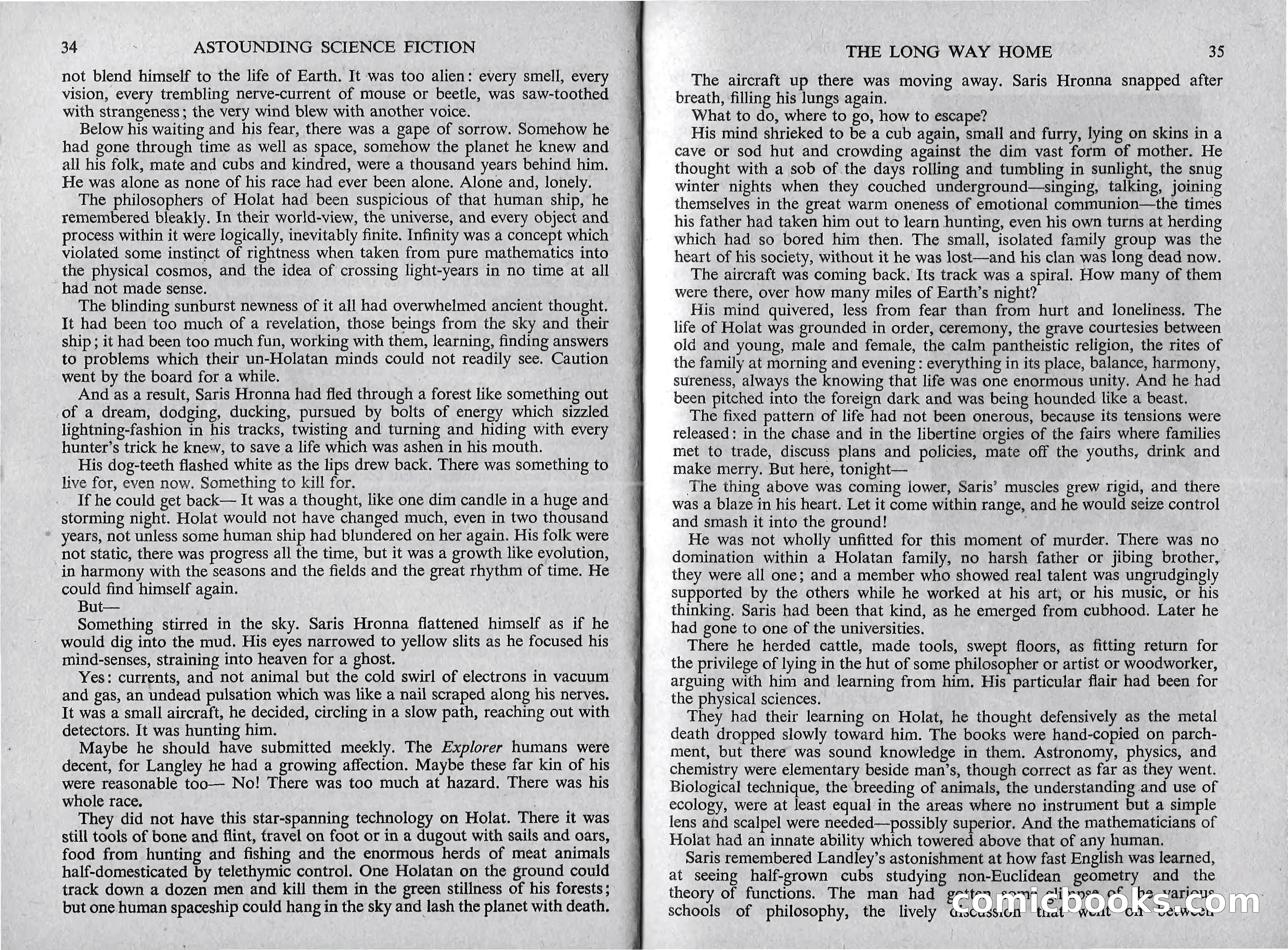
A restored page from Pulp Fiction, 1955. Page through the whole issue in the reader above.
📄 Transcribed text from this page (OCR, searchable)
Machine-transcribed from the original scan — historical spelling and the odd misread are preserved.
34 ASTOUNDING SCIENCE FICTION not blend himself to the life of Earth. It was too alien: every smell, every vision, every trembling nerve-current of mouse or beetle, was saw-toothed with strangeness; the very wind blew with another voice. Below his waiting and his fear, there was a gape of sorrow. Somehow he had gone through time as well as space, somehow the planet he knew and all his folk, mate and cubs and kindred, were a thousand years behind him. He was alone as none of his race had ever been alone. Alone and, lonely. The philosophers of Holat had been suspicious of that human ship, he remembered bleakly. In their world-view, the universe, and every object and process within it were logically, inevitably finite. Infinity was a concept which violated some instinct of rightness when taken from pure mathematics into the physical cosmos, and the idea of crossing light-years in no time at all had not made sense. The blinding sunburst newness of it all had overwhelmed ancient thought. It had been too much of a revelation, those beings from the sky and their ship ; it had been too much fun, working with them, learning, finding answers to problems which their un-Holatan minds could not readily see. Caution went by the board for a while. Andas a result, Saris Hronna had fled through a forest like something out of a dream, dodging, ducking, pursued by bolts of energy which sizzled lightning-fashion in his tracks, twisting and turning and hiding with every hunter’s trick he knew, to save a life which was ashen in his mouth. His dog-teeth flashed white as the lips drew back. There was something to live for, even now. Something to kill for. If he could get back— It was a thought, like one dim candle in a huge and storming night. Holat would not have changed much, even in two thousand — years, not unless some human ship had blundered on her again. His folk were not static, there was progress all the time, but it was a growth like evolution, in harmony with the seasons and the fields and the great rhythm of time. He could find himself again. But— ) Something stirred in the sky. Saris Hronna flattened himself as if he would dig into the mud. His eyes narrowed to yellow slits as he focused his mind-senses, straining into heaven for a ghost. Yes: currents, and not animal but the cold swirl of electrons in vacuum and gas, an undead pulsation which was like a nail scraped along his nerves. It was a small aircraft, he decided, circling in a slow path, reaching out with detectors. It was hunting him. | . Maybe he should have submitted meekly. The Explorer humans were decent, for Langley he had a growing affection. Maybe these far kin of his were reasonable too— No! There was too much at hazard. There was his whole race. i. Ra They did not have this star-spanning technology on Holat. There it was still tools of bone and flint, fravel on foot or in a dugout with sails and oars, food from hunting and fishing and the enormous herds of meat animals half-domesticated by telethymic control. One Holatan on the ground could track down a dozen men and kill them in the green stillness of his forests; but one human spaceship could hang in the sky and lash the planet with death. THE LONG WAY HOME 35 The aircraft up there was moving away. Saris Hronna snapped after breath, filling his lungs again. | What to do, where to go, how to escape? His mind shrieked to be a cub again, small and furry, lying on skins in a cave or sod hut and crowding against the dim vast form of mother. He thought with a sob of the days rolling and tumbling in sunlight, the snug winter nights when they couched underground—singing, talking, joining themselves in the great warm oneness of emotional communion—the times his father had taken him out to learn hunting, even his own turns at herding which had so bored him then. The small, isolated family group was the heart of his society, without it he was lost—and his clan was long dead now. The aircraft was coming back. Its track was a spiral. How many of them were there, over how many miles of Earth’s night? His mind quivered, less from fear than from hurt and loneliness. The life of Holat was grounded in order, ceremony, the grave courtesies between old and young, male and female, the calm pantheistic religion, the rites of the family at morning and evening : everything in its place, balance, harmony, sureness, always the knowing that life was one enormous unity, And he had been pitched into the foreign dark and was being hounded like a beast. The fixed pattern of life had not been onerous, because its tensions were released: in the chase and in the libertine orgies of the fairs where families met to trade, discuss plans and policies, mate off the youths, drink and make merry. But here, tonight— The thing above was coming lower, Saris’ muscles grew rigid, and there was a blaze in his heart. Let it come within range, and he would seize control and smash it into the ground! ; He was not wholly unfitted for this moment of murder. There was no domination within a Holatan family, no harsh father or jibing brother, they were all one; and a member who showed real talent was ungrudgingly supported by the others while he worked at his art, or his music, or his thinking. Saris had been that kind, as he emerged from cubhood. Later he had gone to one of the universities. 3 There he herded cattle, made tools, swept floors, as fitting return for the privilege of lying in the hut of some philosopher or artist or woodworker, | arguing with him and learning from him. His particular flair had been for the physical sciences. They had their learning on Holat, he thought defensively as the metal death dropped slowly toward him. The books were hand-copied on parch- ment, but there was sound knowledge in them. Astronomy, physics, and chemistry were elementary beside man’s, though correct as far as they went. Biological technique, the breeding of animals, the understanding and use of ecology, were at least equal in the areas where no instrument but a simple lens ahd scalpel were needed—possibly superior. And the mathematicians of Holat had an innate ability which towered above that of any human, Saris remembered Landley’s astonishment at how fast English was learned, at seeing half-grown cubs studying non-Euclidean geometry and the el asim es COMIcbooks.com