
Pulp Fiction, 1955 · page 122 of 133
Astounding Science Fiction, August 1955 (British Edition) — page 122: what you’re looking at
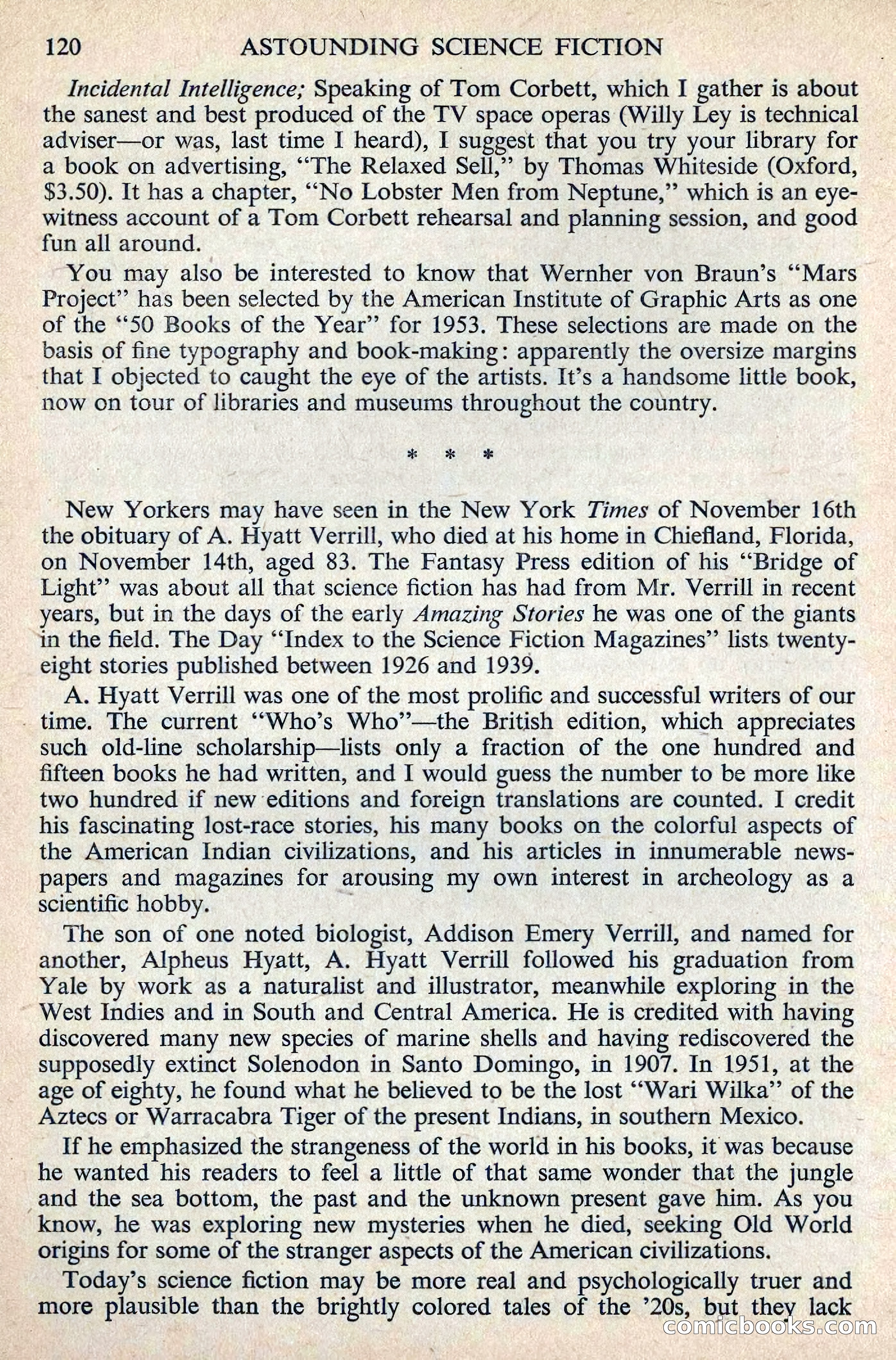
A restored page from Pulp Fiction, 1955. Page through the whole issue in the reader above.
📄 Transcribed text from this page (OCR, searchable)
Machine-transcribed from the original scan — historical spelling and the odd misread are preserved.
120 ASTOUNDING SCIENCE FICTION Incidental Intelligence; Speaking of Tom Corbett, which I gather is about the sanest and best produced of the TV space operas (Willy Ley is technical adviser—or was, last time I heard), I suggest that you try your library for a book on advertising, ‘““The Relaxed Sell,” by Thomas Whiteside (Oxford, $3.50). It has a chapter, ““No Lobster Men from Neptune,” which is an eye- witness account of a Tom Corbett rehearsal and planning session, and good fun all around. You may also be interested to know that Wernher von Braun’s “‘Mars Project” has been selected by the American Institute of Graphic Arts as one of the “50 Books of the Year’ for 1953. These selections are made on the basis of fine typography and book-making: apparently the oversize margins that I objected to caught the eye of the artists. It’s a handsome little book, now on tour of libraries and museums throughout the country. * % New Yorkers may have seen in the New York Times of November 16th the obituary of A. Hyatt Verrill, who died at his home in Chiefland, Florida, on November 14th, aged 83. The Fantasy Press edition of his “Bridge of Light’? was about all that science fiction has had from Mr. Verrill in recent years, but in the days of the early Amazing Stories he was one of the giants in the field. The Day “Index to the Science Fiction Magazines”’ lists twenty- eight stories published between 1926 and 1939. A. Hyatt Verrill was one of the most prolific and successful writers of our - time. The current ‘““Who’s Who’’—the British edition, which appreciates such old-line scholarship—lists only a fraction of the one hundred and fifteen books he had written, and I would guess the number to be more like two hundred if new editions and foreign translations are counted. I credit his fascinating lost-race stories, his many books on the colorful aspects of the American Indian civilizations, and his articles in innumerable news- papers and magazines for arousing my own interest in archeology as a scientific hobby. The son of one noted biologist, Addison Emery Verrill, and named for another, Alpheus Hyatt, A. Hyatt Verrill followed his graduation from Yale by work as a naturalist and illustrator, meanwhile exploring in the West Indies and in South and Central America. He is credited with having discovered many new species of marine shells and having rediscovered the supposedly extinct Solenodon in Santo Domingo, in 1907. In 1951, at the age of eighty, he found what he believed to be the lost ““Wari Wilka”’ of the Aztecs or Warracabra Tiger of the present Indians, in southern Mexico. If he emphasized the strangeness of the world in his books, it was because he wanted his readers to feel a little of that same wonder that the jungle _and the sea bottom, the past and the unknown present gave him. As you know, he was exploring new mysteries when he died, seeking Old World origins for some of the stranger aspects of the American civilizations. Today’s science fiction may be more real and psychologically truer and more plausible than the brightly colored tales of the ’20s, but they lack : COMiCcOOXS.COM