
Pulp Fiction, 1953 · page 7 of 68
Astounding British Edition, May 1953 — page 7: what you’re looking at
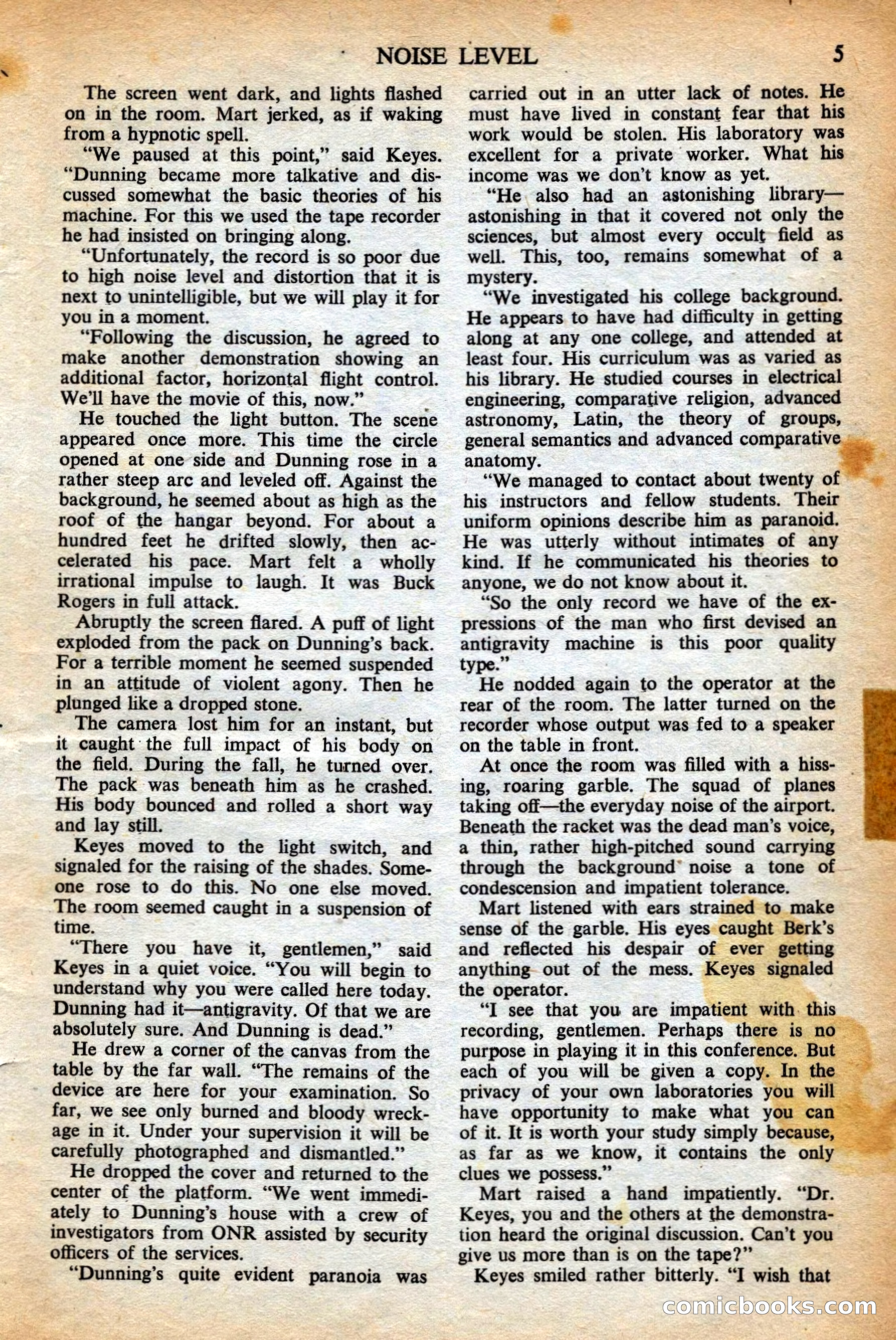
A restored page from Pulp Fiction, 1953. Page through the whole issue in the reader above.
📄 Transcribed text from this page (OCR, searchable)
Machine-transcribed from the original scan — historical spelling and the odd misread are preserved.
The screen went dark, and lights flashed on in the room. Mart jerked, as if waking from a hypnotic spell. “We paused at this point,” said Keyes. “Dunning became more talkative and dis- cussed somewhat the basic theories of his machine. For this we used the tape recorder he had insisted on bringing along. “Unfortunately, the record is so poor due to high noise level and distortion that it is next to unintelligible, but we will play it for you in a moment. “Following the discussion, he agreed to make another demonstration showing an additional factor, horizontal flight control. We'll have the movie of this, now.” : He touched the light button. The scene appeared once more. This time the circle opened at one side and Dunning rose in a rather steep arc and leveled off. Against the background, he seemed about as high as the roof of the hangar beyond. For about a hundred feet he drifted slowly, then ac- celerated his pace. Mart felt a wholly irrational impulse to laugh. It was Buck Rogers in full attack. Abruptly the screen flared. A puff of light exploded from the pack on Dunning’s back. For a terrible moment he seemed suspended in an attitude of violent agony. Then he plunged like a dropped stone. The camera lost him for an instant, but it caught the full impact of his body on the field. During the fall, he turned over. The pack was beneath him as he crashed. His body bounced and rolled a short way and lay still. Keyes moved to the light switch, and signaled for the raising of the shades. Some- one rose to do this. No one else moved. The room seemed caught in a suspension of time. “There you have it, gentlemen,” said Keyes in a quiet voice. “You will begin to understand why you were called here today. Dunning had it—antigravity. Of that we are absolutely sure. And Dunning is dead.” He drew a corner of the canvas from the table by the far wall. “The remains of the device are here for your examination. So far, we see only burned and bloody wreck- age in it. Under your supervision it will be carefully photographed and dismantled.” He dropped the cover and returned to the center of the platform. “We went immedi- ately to Dunning’s house with a crew of investigators from ONR assisted by security Officers of the services. “Dunning’s quite evident paranoia was ey cnr carried out in an utter lack of notes. He must have lived in constant fear that his work would be stolen. His laboratory was excellent for a private worker. What his income was we don’t know as yet. BY “He. also had an astonishing library— = astonishing in that it covered not only the Ee sciences, but almost every occult field as well. This, too, remains somewhat of a mystery. “We investigated his college background. He appears to have had difficulty in getting along at any one college, and attended at least four. His curriculum was as varied as his library. He studied courses in electrical engineering, comparative religion, advanced astronomy, Latin, the theory of groups, | general semantics and advanced comparativ anatomy. “We managed to contact about twenty of © his instructors and fellow students. Their uniform opinions describe him as paranoid. He was utterly without intimates of any kind. If he communicated his theories to anyone, we do not know about it. ) “So the only record we have of the ex- = pressions of the man who first devised an ee antigravity machine is this poor quality type.” He nodded again to the operator at the rear of the room. The latter turned on the recorder whose output was fed to a speaker on the table in front. At once the room was filled with a hiss- | ing, roaring garble. The squad of planes taking off—the everyday noise of the airport. Beneath the racket was the dead man’s voice, a thin, rather high-pitched sound carrying through the background” noise a tone of — condescension and impatient tolerance. Pn Mart listened with ears strained to make ai? sense of the garble. His eyes caught Berk’s ee and reflected his despair of ever ge = anything- out of the mess. Keyes : : ign the operator. “I see that you are impatient with, this recording, gentlemen. Perhaps there is no — purpose in playing it in this conferenc S each of you will be given a copy. privacy of your own laboratories yo = have opportunity to make what you car of it. It is worth your study simply bt sca . as far as we know, it contains the only —~ clues we possess.’ SRS Mart raised a hand impatiently. “Dr. Keyes, you and the others at the demonstra- | tion heard the original discussion. Can’t you give us more than is on the tape?” Keyes smiled rather bitterly. “I wish that COMIC OOK<SSCOl Me aay de. AR ee. 6 be el a =s ; <r a -— > EBay s Soe 7X * De x - - \— Ve ¢ 7 be ES Pe ee a et