
Pulp Fiction, 1953 · page 6 of 68
Astounding British Edition, May 1953 — page 6: what you’re looking at
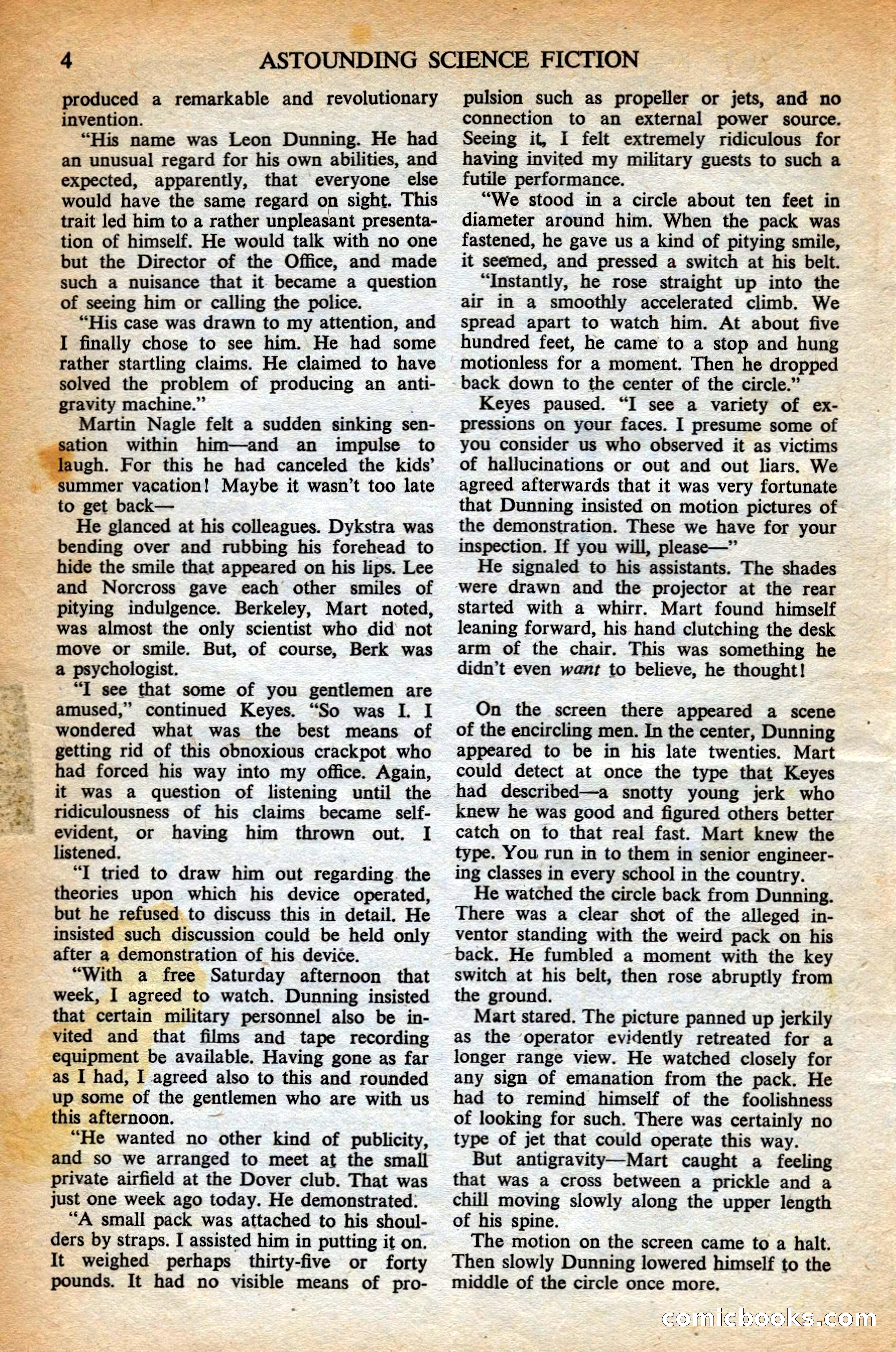
A restored page from Pulp Fiction, 1953. Page through the whole issue in the reader above.
📄 Transcribed text from this page (OCR, searchable)
Machine-transcribed from the original scan — historical spelling and the odd misread are preserved.
ee "produced a remarkable and revolutionary ___ invention. __ *#fig name was Leon Dunning. He had an unusual regard for his own abilities, and expected, apparently, that everyone else would have the same regard on sight. This trait led him to a rather unpleasant presenta- tion of himself. He would talk with no one but the Director of the Office, and made such a nuisance that it became a question of seeing him or calling the police. “His case was drawn to my attention, and I finally chose to see him. He had some rather startling claims. He claimed to have solved the problem of producing an anti- gravity machine.” 4 Martin Nagle felt a sudden sinking sen- gation within him—and an impulse to & augh. For this he had canceled the kids’ summer vacation! Maybe it wasn’t too late to get back— Ee He glanced at his colleagues. Dykstra was bending over and rubbing his forehead to hide the smile that appeared on his lips. Lee and Norcross gave each other smiles of pitying indulgence. Berkeley, Mart noted, was almost the only scientist who did not move or smile. But, of course, Berk was a psychologist. “I see that some of you gentlemen are amused,” continued Keyes. “So was IL. I wondered what was the best means of getting rid of this obnoxious crackpot who had forced his way into my office. Again, it was a question of listening until the ridiculousness of his claims became self- evident, or having him thrown out. I listened. ae “I tried to draw him out regarding. the theories upon which his device operated, but he refused. to discuss this in detail. He insisted such discussion could be held only after a demonstration of his device. “With a free Saturday afternoon that _ week, I agreed to watch. Dunning insisted at certain military personnel also be in- vited and that films and tape recording equipment be available. Having gone as far Se as I had, I agreed also to this and rounded thi ie Barnocn. = “He wanted no other kind of publicity, Se ~ and SO we arranged to meet at the small private airfield at the Dover club. That was _ just one week ago today. He demonstrated: “A small pack was attached to his shoul- ders by straps. I assisted him in putting it on. It weighed perhaps thirty-five or forty pounds. It had no visible means of pro- < pulsion such as propeller or jets, and no connection to an external power source. — Seeing it, I felt extremely ridiculous for having invited my military guests to such a futile performance. “We stood in a circle about ten feet in diameter around him. When the pack was fastened, he gave us a kind of pitying smile, it seemed, and pressed a switch at his belt. “Instantly, he rose straight up into the air in a smoothly accelerated climb. We spread apart to watch him. At about five hundred feet, he came to a stop and hung motionless for a moment. Then he dropped back down to the center of the circle.” Keyes paused. “I see a variety of ex- pressions on your faces. I presume some of you consider us who observed it as victims of hallucinations or out and out liars. We agreed afterwards that it was very fortunate that Dunning insisted on motion pictures of the demonstration. These we have for your inspection. If you will, please—” He signaled to his assistants. The shades ‘were drawn and the projector at the rear started with a whirr. Mart found himself leaning forward, his hand clutching the desk arm of the chair. This was something he didn’t even want to believe, he thought! On the screen there appeared a scene of the encircling men. In the center, Dunning appeared to be in his late twenties. Mart could detect at once the type that Keyes had described—a snotty young jerk who knew he was good and figured others better catch on to that real fast. Mart knew the type. You run in to them in senior engineer- ing classes in every school in the country. He watched the circle back from Dunning. There was a clear shot of the alleged in- ventor standing with the weird pack on his back. He fumbled a moment with the key switch at his belt, then rose abruptly from the ground. Mart stared. The picture panned up jerkily as the operator evidently retreated for a longer range view. He watched closely for any sign of emanation from the pack. He had to remind himself of the foolishness of looking for such. There was certainly no type of jet that could operate this way. But antigravity—Mart caught a feeling that was a cross between a prickle and a chill moving slowly along the upper length of his spine. The motion on the screen came to a halt. Then slowly Dunning lowered himself to the middle of the circle once more. S (E() Comichoo