
Pulp Fiction, 1953 · page 19 of 68
Astounding British Edition, May 1953 — page 19: what you’re looking at
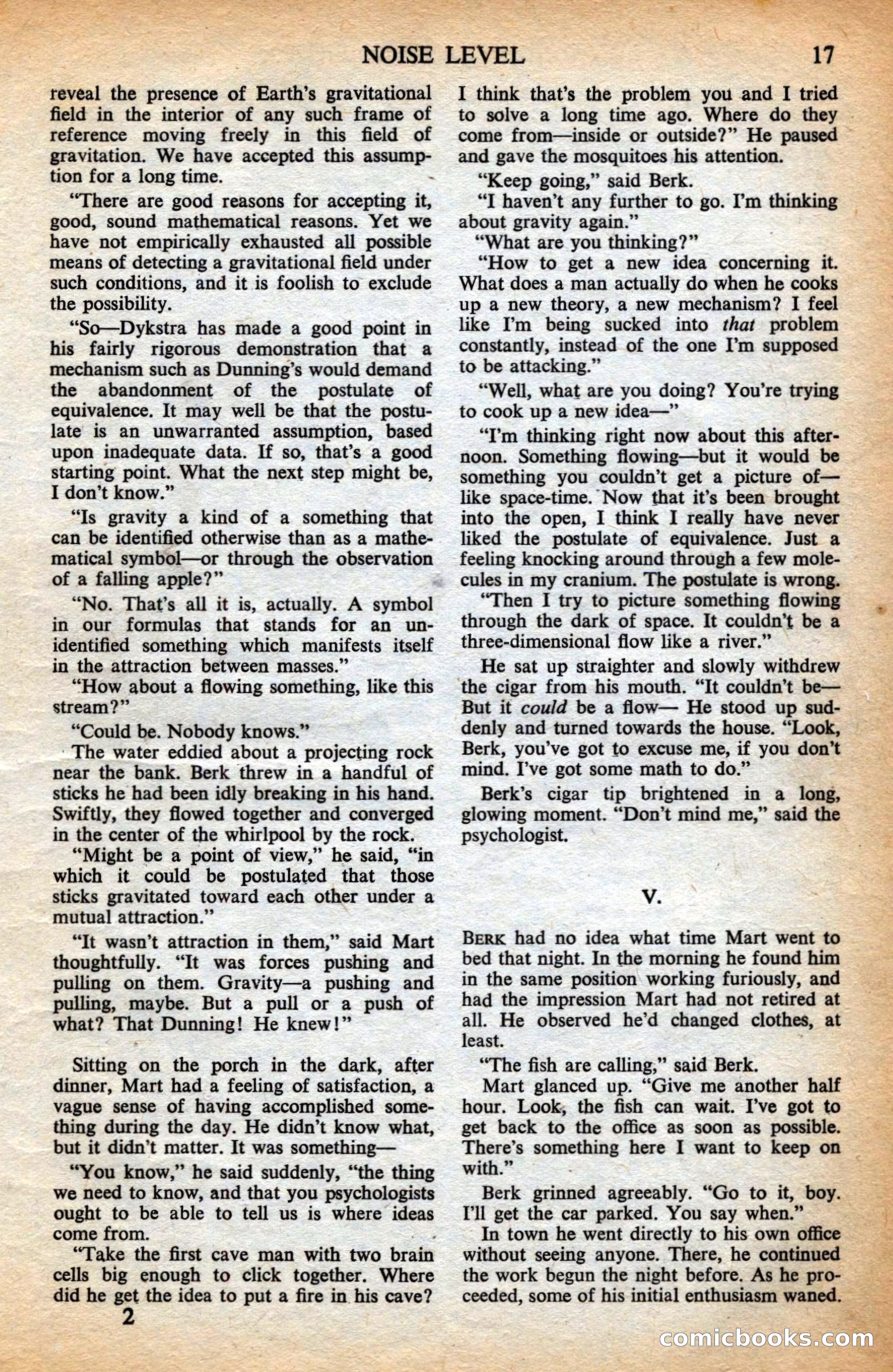
A restored page from Pulp Fiction, 1953. Page through the whole issue in the reader above.
📄 Transcribed text from this page (OCR, searchable)
Machine-transcribed from the original scan — historical spelling and the odd misread are preserved.
ie os) —. 22tt Ye Sa er ee, ow +> —- NOISE LEVEL reveal the presence of Earth’s gravitational field in the interior of any such frame of reference moving freely in this field of gravitation. We have accepted this sane tion for a long time. “There are good reasons for accepting it, good, sound mathematical reasons. Yet we have not empirically exhausted all possible means of detecting a gravitational field under such conditions, and it is foolish to exclude the possibility. ~“So—Dykstra has made a good point in his fairly rigorous demonstration that a mechanism such as Dunning’s would demand the abandonment of the postulate of equivalence. It may well be that the postu- late is an unwarranted assumption, based upon inadequate data. If so, that’s a good starting point. What the next step might be, I don’t know.” “Is gravity a kind of a something that can be identified otherwise than as a mathe- matical symbol—or through the observation of a falling apple?” “No. That’s all it is, actually. A symbol in our formulas that stands for an un- identified something which manifests itself in the attraction between masses.” “How about a flowing something, like this stream?” “Could be. Nobody knows.” The water eddied about a projecting rock near the bank. Berk threw in a handful of sticks he had been idly breaking in his hand. Swiftly, they flowed together and converged in the center of the whirlpool by the rock. “Might be a point of view,” he said, “in which it could be postulated that those sticks gravitated toward each other under a mutual attraction.” “It wasn’t attraction in them,” said Mart thoughtfully. “It was forces pushing and pulling on them. Gravity—a pushing and pulling, maybe. But a pull or a push of what? That Dunning! He knew!” Sitting on the porch in the dark, after dinner, Mart had a feeling of satisfaction, a vague sense of having accomplished some- thing during the day. He didn’t know what, but it didn’t matter. It was something— “You know,” he said suddenly, “the thing we need to know, and that you psychologists ought to be able to tell us is where ideas come from. “Take the first cave man with two brain cells big enough to click together. Where did he ot the idea to put a fire in his cave? I think that’s the problem you and I tried to solve a long time ago. Where do they | come from—inside or outside?” He paused ~ and gave the mosquitoes his attention. “Keep going,” said Berk. “T haven’t any further to go. I’m thinking about gravity again.” “What are you thinking?” “How to get a new idea concerning it. What does a man actually do when he cooks _up a new theory, a new mechanism? I feel like I’m being sucked into that problem constantly, instead of the one I’m supposed to be attacking.” “Well, what are you doing? You're trying to cook up a new idea—” “I’m thinking right now about this after- noon. Something flowing—but it would be something you couldn’t get a picture of— like space-time. Now that it’s been brought into the open, I think I really have never liked the postulate of equivalence. Just a feeling knocking around through a few mole- cules in my cranium. The postulate is wrong. “Then I try to picture something flowing through the dark of space. It couldn’t be a three-dimensional flow like a river.” He sat up straighter and slowly withdrew the cigar from his mouth. “It couldn’t be— But it could be a flow— He stood up sud- denly and turned towards the house. “Look, — Berk, you’ve got to excuse me, if you don’t mind. I’ve got some math to do.” Berk’s cigar tip brightened in a long, glowing moment. “Don’t mind me,” said the psychologist. V. Berk had no idea what time Mart went to bed that night. In the morning he found him in the same position working furiously, and had the impression Mart had not retired at all. He observed he’d changed clothes, at least. “The fish are calling,” said Berk. Mart glanced up. “Give me another half hour. Look; the fish can wait. I’ve got to get back to the office as soon as possible. There’s something here I want to keep on with.” Berk paused agreeably. “Go to it, boy. = 3 I'll get the car parked. You say when.” In town he went directly to his own office without seeing anyone. There, he continued — the work begun the night before. As he pro- — ceeded, some of his initial enthusiasm waned. Oo comicbooks.cc