
Pulp Fiction, 1953 · page 18 of 68
Astounding British Edition, May 1953 — page 18: what you’re looking at
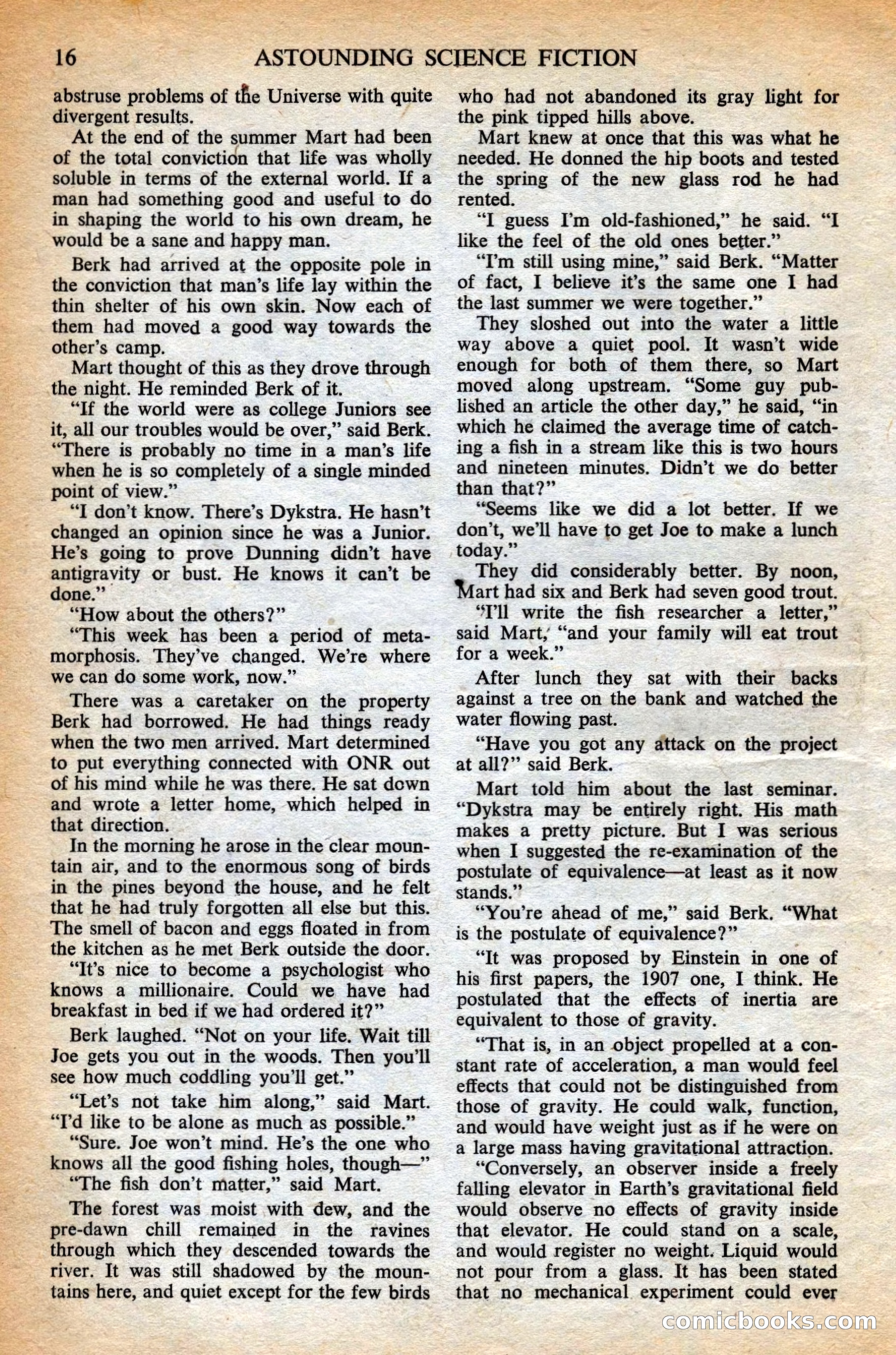
A restored page from Pulp Fiction, 1953. Page through the whole issue in the reader above.
📄 Transcribed text from this page (OCR, searchable)
Machine-transcribed from the original scan — historical spelling and the odd misread are preserved.
divergent results. At the end of the summer Mart had been of the total conviction that life was wholly soluble in terms of the external world. If a man had something good and useful to do in shaping the world to his own dream, he would be a sane and happy man. Berk had arrived at the opposite pole in the conviction that man’s life lay within the thin shelter of his own skin. Now each of them had moved a good way towards the other’s camp. Mart thought of this as they save through the night. He reminded Berk of it. “If the world were as college Juniors see it, all our troubles would be over,” said Berk. “There is probably no time in a man’s life when he is so completely of a single minded point of view.” “I don’t know. There’s Dykstra. He hasn’t changed an opinion since he was a Junior. He’s going to prove Dunning didn’t have antigravity or bust. He knows it can’t be done.” “How about the others?” “This week has been a period of meta- morphosis. They’ve changed. We’re where we can do some work, now.” There was a caretaker on the property Berk had borrowed. He had things ready when the two men arrived. Mart determined to put everything connected with ONR out of his mind while he was there. He sat down and wrote a letter home, which helped in that direction. In the morning he arose in the clear moun- tain air, and to the enormous song of birds in the pines beyond the house, and he felt that he had truly forgotten all else but this. The smell of bacon and eggs floated in from the kitchen as he met Berk outside the door. “It’s nice to become a psychologist who knows a millionaire. Could we have had breakfast in bed if we had ordered it?” Berk laughed. “Not on your life. Wait till Joe gets you out in the woods. Then you'll see how much coddling you'll get.” “Let’s not take him along,” said Mart. “Td like to be alone as much as possible.” “Sure. Joe won’t mind. He’s the one who knows all the good fishing holes, though—”’ “The fish don’t matter,” said Mart. The forest was moist with dew, and the pre-dawn chill remained in the ravines through which they descended towards the river. It was still shadowed by the moun- - tains here, and quiet except for the few birds ASTOUNDING SCIENCE FICTION abstruse problems of the Universe with quite who had not abandoned its gray light for the pink tipped hills above. Mart knew at once that this was what he needed. He donned the hip boots and tested the spring of the new glass rod he had rented. “I guess I’m old-fashioned,” he said. “I like the feel of the old ones better.” “Tm still using mine,” said Berk. “Matter of fact, I believe it’s the same one I had the last summer we were together.” They sloshed out into the water a little way above a quiet pool. It wasn’t wide enough for both of them there, so Mart moved along upstream. “Some guy pub- lished an article the other day,” he said, “in which he claimed the average time of catch- ing a fish in a stream like this is two hours and nineteen minutes. Didn’t we do better than that?” “Seems like we did a lot better. If we don’t, we'll have to get Joe to make a lunch today.” They did considerably better. By noon, art had six and Berk had seven good trout. “Ill write the fish researcher a letter,” said Mart, “and your family will eat trout for a week.” After lunch they sat with their backs against a tree on the bank and watched the water flowing past. “Have you got any attack on the project at all?” said Berk. Mart told him about the last seminar. “Dykstra may be entirely right. His math makes a pretty picture. But I was serious when I suggested the re-examination of the postulate of equivalence—at least as it now stands.” “You're ahead of me,” said Berk. “What is the postulate of equivalence?” — “It was proposed by Einstein in one of his first papers, the 1907 one, I think. He postulated that the effects of inertia are equivalent to those of gravity. “That is, in an object propelled at a con- stant rate of acceleration, a man would feel effects that could not be distinguished from those of gravity. He could walk, function, and would have weight just as if he were on a large mass having gravitational attraction. “Conversely, an observer inside a freely falling elevator in Earth’s gravitational field would observe no effects of gravity inside that elevator. He could stand on a scale, and would register no weight. Liquid would not pour from a glass. It has been stated that no mechanical experiment could ever oO GOMmIchbooks.co