
Pulp Fiction, 1953 · page 16 of 68
Astounding British Edition, May 1953 — page 16: what you’re looking at
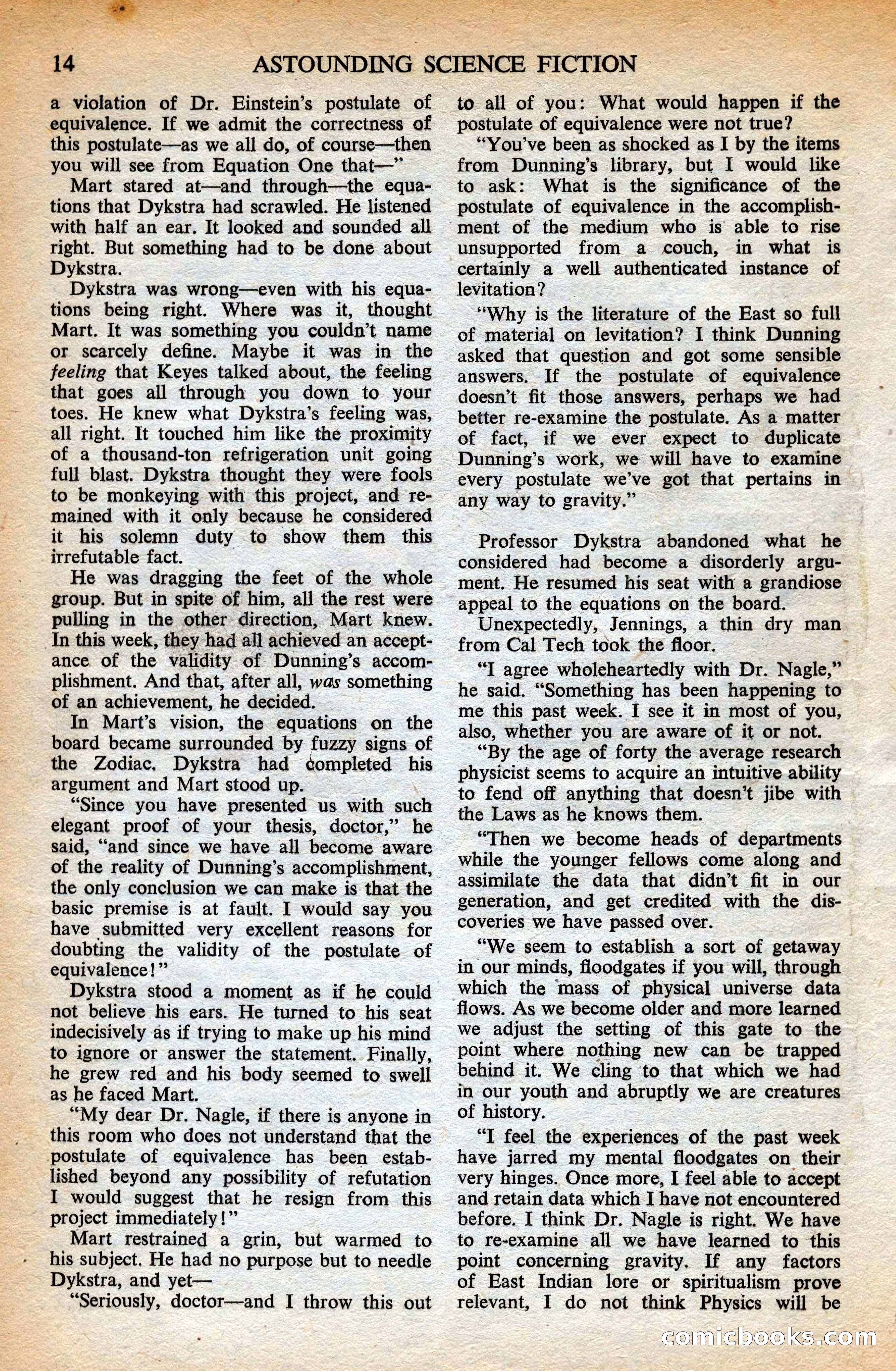
A restored page from Pulp Fiction, 1953. Page through the whole issue in the reader above.
📄 Transcribed text from this page (OCR, searchable)
Machine-transcribed from the original scan — historical spelling and the odd misread are preserved.
a violation of Dr. Einstein’s postulate of equivalence. If we admit the correctness of this postulate—as we all do, of course—then you will see from Equation One that—” Mart stared at—and through—the equa- tions that Dykstra had scrawled. He listened with half an ear. It looked and sounded all right. But something had to be done about Dykstra. Dykstra was wrong—even with his equa- tions being right. Where was it, thought Mart. It was something you couldn’t name or scarcely define. Maybe it was in the feeling that Keyes talked about, the feeling that goes all through you down to your toes. He knew what Dykstra’s feeling was, all right. It touched him like the proximity of a thousand-ton refrigeration unit going full blast. Dykstra thought they were fools to be monkeying with this project, and re- mained with it only because he considered it his solemn duty to show them this irrefutable fact. He was dragging the feet of the whole group. But in spite of him, all the rest were pulling in the other direction, Mart knew. In this week, they had all achieved an accept- ance of the validity of Dunning’s accom- plishment. And that, after all, was something of an achievement, he decided. In Mart’s vision, the equations on the board became surrounded by fuzzy signs of the Zodiac. Dykstra had completed his argument and Mart stood up. “Since you have presented us with such elegant proof of your thesis, doctor,’ he said, “and since we have all become aware of the reality of Dunning’s accomplishment, the only conclusion we can make is that the basic premise is at fault. I would say you have submitted very excellent reasons for doubting the validity of the postulate of equivalence!” Dykstra stood a moment as if he could not believe his ears. He turned to his seat indecisively as if trying to make up his mind to ignore or answer the statement. Finally, he grew red and his body seemed to swell as he faced Mart. ““My dear Dr. Nagle, if there is anyone in this room who does not understand that the postulate of equivalence has been estab- lished beyond any possibility of refutation I would suggest that he resign from this project immediately !” Mart restrained a grin, but warmed to his subject. He had no purpose but to needle 3 Dykstra, and yet— “Seriously, doctor—and I throw this out ASTOUNDING SCIENCE FICTION to all of you: What would happen if the postulate of equivalence were not true? ““You’ve been as shocked as I by the items from Dunning’s library, but I would like to ask: What is the significance of the postulate of equivalence in the accomplish- “ment of the medium who is able to rise unsupported from a couch, in what is certainly a well authenticated instance of levitation? “Why is the literature of the East so full of material on levitation? I think Dunning asked that question and got some sensible answers. If the postulate of equivalence doesn’t fit those answers, perhaps we had better re-examine the postulate. As a matter of fact, if we ever expect to duplicate Dunning’s work, we will have to examine every postulate we've got that pertains in any way to gravity.” Professor Dykstra abandoned what he considered had become a disorderly argu- ment. He resumed his seat with a grandiose appeal to the equations on the board. Unexpectedly, Jennings, a thin dry man from Cal Tech took the floor. : “TJ agree wholeheartedly with Dr. Nagle,” he said. “Something has been happening to me this past week. I see it in most of you, also, whether you are aware of it or not. “By the age of forty the average research physicist seems to acquire an intuitive ability to fend off anything that doesn’t jibe with the Laws as he knows them. “Then we become heads of departments while the younger fellows come along and assimilate the data that didn’t fit in our generation, and get credited with the dis- coveries we have passed over. “We seem to establish a sort of getaway in our minds, floodgates if you will, through which the mass of physical universe data flows. As we become older and more learned we adjust the setting of this gate to the point where nothing new can be trapped behind it. We cling to that which we had in our youth and abruptly we are creatures of history. “I feel the experiences of the past week have jarred my mental floodgates on their very hinges. Once more, I feel able to accept and retain data which I have not encountered before. I think Dr. Nagle is right. We have to re-examine all we have learned to this point concerning gravity. If any factors of East Indian lore or spiritualism prove relevant, I do not think Physics will be EOmichbooks.co