
Pulp Fiction, 1953 · page 15 of 68
Astounding British Edition, May 1953 — page 15: what you’re looking at
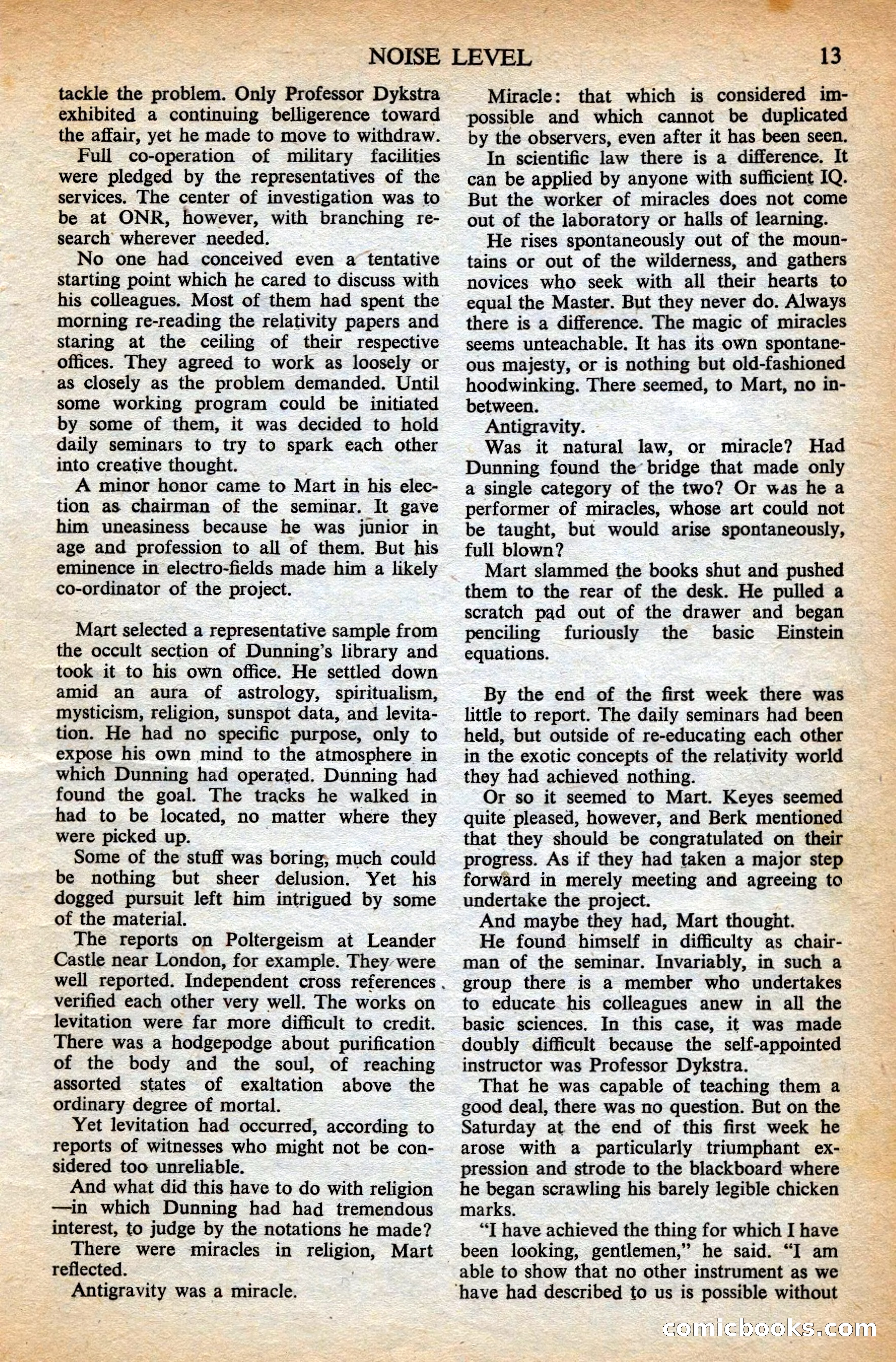
A restored page from Pulp Fiction, 1953. Page through the whole issue in the reader above.
📄 Transcribed text from this page (OCR, searchable)
Machine-transcribed from the original scan — historical spelling and the odd misread are preserved.
tackle the problem. Only Professor Dykstra exhibited a continuing belligerence toward the affair, yet he made to move to withdraw. Full co-operation of military facilities were pledged by the representatives of the services. The center of investigation was to be at ONR, however, with branching re- search wherever needed. No one had conceived even a tentative starting point which he cared to discuss with his colleagues. Most of them had spent the morning re-reading the relativity papers and staring at the ceiling of their respective _ Offices. They agreed to work as loosely or as Closely as the problem demanded. Until some working program could be initiated by some of them, it was decided to hold daily seminars to try to spark each other into creative thought. A minor honor came to Mart in his elec- tion as chairman of the seminar. It gave him uneasiness because he was junior in age and profession to all of them. But his eminence in electro-fields made him a likely co-ordinator of the project. Mart selected a representative sample from the occult section of Dunning’s library and took it to his own office. He settled down amid an aura of astrology, spiritualism, mysticism, religion, sunspot data, and levita- tion. He had no specific purpose, only to expose his own mind to the atmosphere in which Dunning had operated. Dunning had found the goal. The tracks he walked in had to be located, no matter where they were picked up. Some of the stuff was boring; much could be nothing but sheer delusion. Yet his dogged pursuit left him intrigued by some of the material. The reports on Poltergeism at Leander Castle near London, for example. They were well reported. Independent cross references . verified each other very well. The works on levitation were far more difficult to credit. There was a hodgepodge about purification of the body and the soul, of reaching assorted states of exaltation above the ordinary degree of mortal. Yet levitation had occurred, according to reports of witnesses who might not be con- sidered too unreliable. And what did this have to do with religion —in which Dunning had had tremendous interest, to judge by the notations he made? There were miracles in os Mart reflected. Antigravity was a miracle. NOISE LEVEL Miracle: by the observers, even after it has been seen. In scientific law there is a difference. It can be applied by anyone with sufficient IQ. But the worker of miracles does not come out of the laboratory or halls of learning. He rises spontaneously out of the moun- tains or out of the wilderness, and gathers novices who seek with all their hearts to equal the Master. But they never do. Always there is a difference. The magic of miracles seems unteachable. It has its own spontane- ous majesty, or is nothing but old-fashioned hoodwinking. There seemed, to Mart, no in- between. Antigravity. Was it natural law, or miracle? Had Dunning found the bridge that made only a single category of the two? Or was he a performer of miracles, whose art could not be taught, but would arise spontaneously, full blown? Mart slammed the books shut and pushed them to the rear of the desk. He pulled a scratch pad out of the drawer and began penciling furiously the basic LEinstein equations. By the end of the first week there was little to report. The daily seminars had been held, but outside of re-educating each other in the exotic concepts of the relativity world they had achieved nothing. Or so it seemed to Mart. Keyes seemed quite pleased, however, and Berk mentioned that they should be congratulated on their progress. As if they had taken a major step forward in merely meeting and agreeing to undertake the project. And maybe they had, Mart thought. He found himself in difficulty as chair- man of the seminar. Invariably, in such a group there is a member who undertakes to educate his colleagues anew in all the basic sciences. In this case, it was made doubly difficult because the self-appointed instructor was Professor Dykstra. That he was capable of teaching them a good deal, there was no question. But on the Saturday at the end of this first week he arose with a particularly triumphant ex- — pression and strode to the blackboard where he began scrawling his barely legible chicken marks. “T have achieved the thing for which I have been looking, gentlemen,” he said. “I am able to show that no other instrument as we have had described to us is possible without (E(0) CORNICE OOS that which is considered im- = possible and which cannot be duplicated