
Pulp Fiction, 1952 · page 47 of 68
Astounding Science Fiction, February 1952 (British Edition) — page 47: what you’re looking at
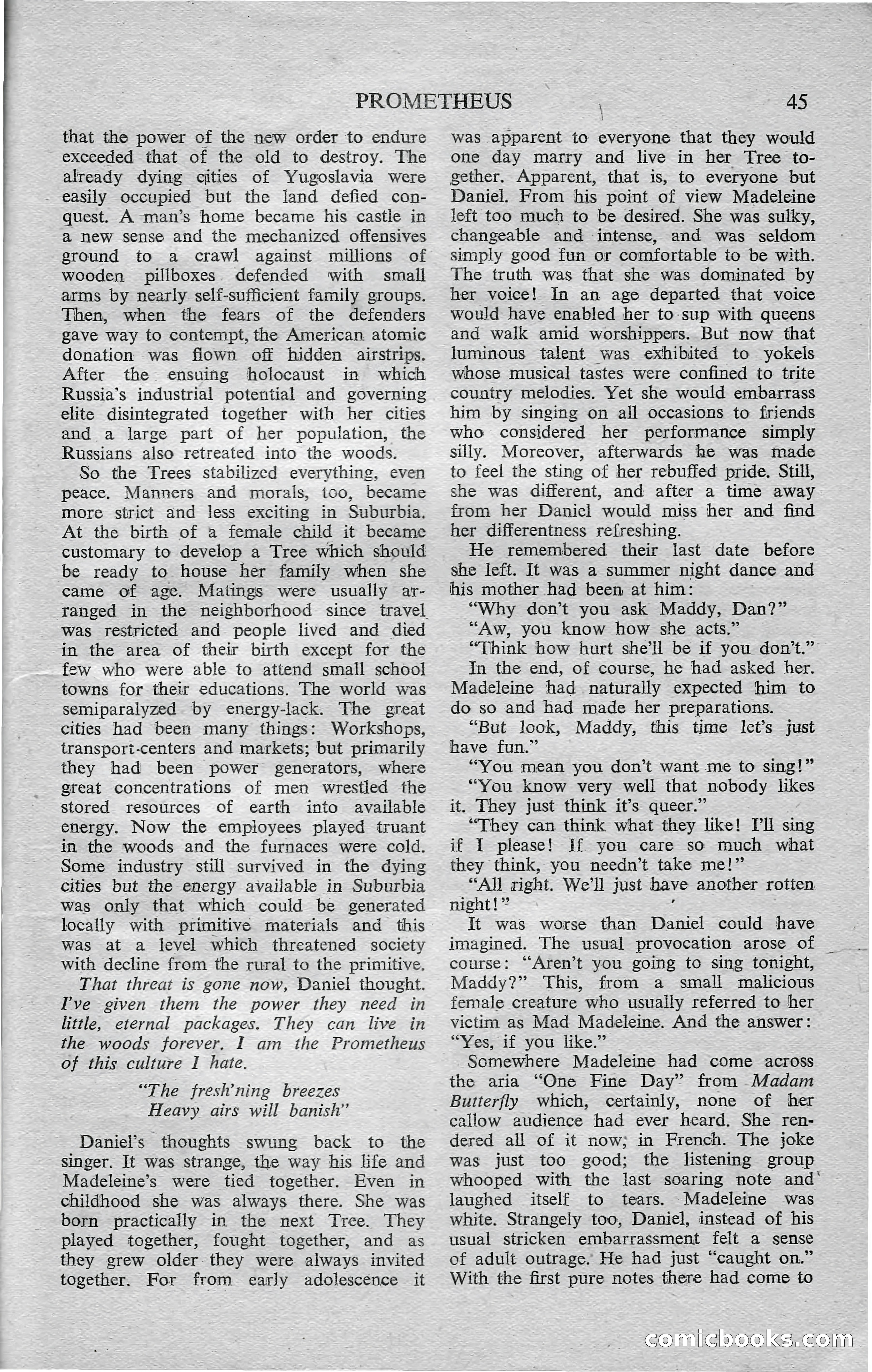
A restored page from Pulp Fiction, 1952. Page through the whole issue in the reader above.
📄 Transcribed text from this page (OCR, searchable)
Machine-transcribed from the original scan — historical spelling and the odd misread are preserved.
PROMETHEUS that the power of the mew order to endure exceeded that of the old to destroy. The already dying cities of Yugoslavia were - easily occupied but the land defied con- quest. A man’s home became his castle in a new sense and the mechanized offensives ground to a crawl against millions of wooden pillboxes defended with small arms by nearly self-sufficient family groups. Then, when the fears of the defenders gave way to contempt, the American atomic donation was fiown off hidden airstrips. After the ensuing holocaust in which. Russia’s industrial potential and governing elite disintegrated together with her cities and a large part of her population, the Russians also retreated into the woods. So the Trees stabilized everything, even peace. Manners and morals, too, became more strict and less exciting in Suburbia. At the birth of a female child it became customary to develop a Tree which should be ready to house her family when she came of age. Matings were usually ar- ranged in the neighborhood since travel. was restricted and people lived and died in the area of their birth except for the ew who were able to attend small school towns for their educations. The world was semiparalyzed by energy-lack. The great cities had been many things: Workshops, transport-centers and markets; but primarily they had been power generators, where great concentrations of men wrestled the stored resources of earth into available energy. Now the employees played truant in the woods and the furnaces were cold. Some industry still survived in the dying cities but the energy available in Suburbia was only that which could be generated locally with primitive materials and this was at a level which threatened society with decline from the rural to the primitive. That threat is gone now, Daniel thought. I've given them the power they need in little, eternal packages. They can live in the woods forever, I am the Prometheus of this culture I hate. “The fresWning breezes Heavy airs will banish’ Daniel's thoughts swung back to the singer. It was strange, the way his life and Madeleine’s were tied together. Even in childhood she was always there. She was born practically in the next Tree. They played together, fought together, and as they grew older they were always invited together. For from early adolescence it 45 was apparent to everyone that they would one day marry and live in her Tree to- gether. Apparent, that is, to everyone but Daniel. From his point of view Madeleine left too much to be desired. She was sulky, changeable and -intense, and was seldom simply good fun or comfortable to be with. The truth was that she was dominated by her voice! In an age departed that voice would have enabled her to sup with queens and walk amid worshippers. But now that luminous talent was exhibited to yokels whose musical tastes were confined to trite country melodies. Yet she would embarrass him by singing on all occasions to friends who considered her performance simply silly. Moreover, afterwards he was made to feel the sting of her rebuffed pride. Still, she was different, and after a time away from her Daniel would miss her and find her differentness refreshing. He remembered their last date before she left. It was a summer night dance and his mother had been at him: “Why don’t you ask Maddy, Dan?” “Aw, you know how she acts.” “Think how hurt shell be if you don’t.” In the end, of course, he had asked her. Madeleine had naturally expected him to do so and had made her preparations. “But look, Maddy, this time let’s just have fun.” “You mean you don’t want me to sing!” “You Know very well that nobody likes it. They just think it’s queer.” “They can think what they like! TI sing if I please! If you care so much what they think, you needn’t take me!” “All right. We'll just have another rotten night!” : : It was worse than Daniel could have imagined. The usual provocation arose of course: “Aren’t you going to sing tonight, Maddy?” This, from a small malicious female creature who usually referred to her victim as Mad Madeleine. And the answer: “Yes, if you like.” Somewhere Madeleine had come across the aria “One Fine Day” from Madam Butterfly which, certainly, none of her callow audience had ever heard. She ren- dered all of it now; in French. The joke was just too good; the listening group whooped with the last soaring note and‘ laughed itself to tears. Madeleine was white. Strangely too, Daniel, instead of his usual stricken embarrassment felt a sense of adult outrage. He had just “caught on.” With the first pure notes there had come to EOomicbooks com