
Pulp Fiction, 1952 · page 46 of 68
Astounding Science Fiction, February 1952 (British Edition) — page 46: what you’re looking at
A restored page from Pulp Fiction, 1952. Page through the whole issue in the reader above.
📄 Transcribed text from this page (OCR, searchable)
Machine-transcribed from the original scan — historical spelling and the odd misread are preserved.
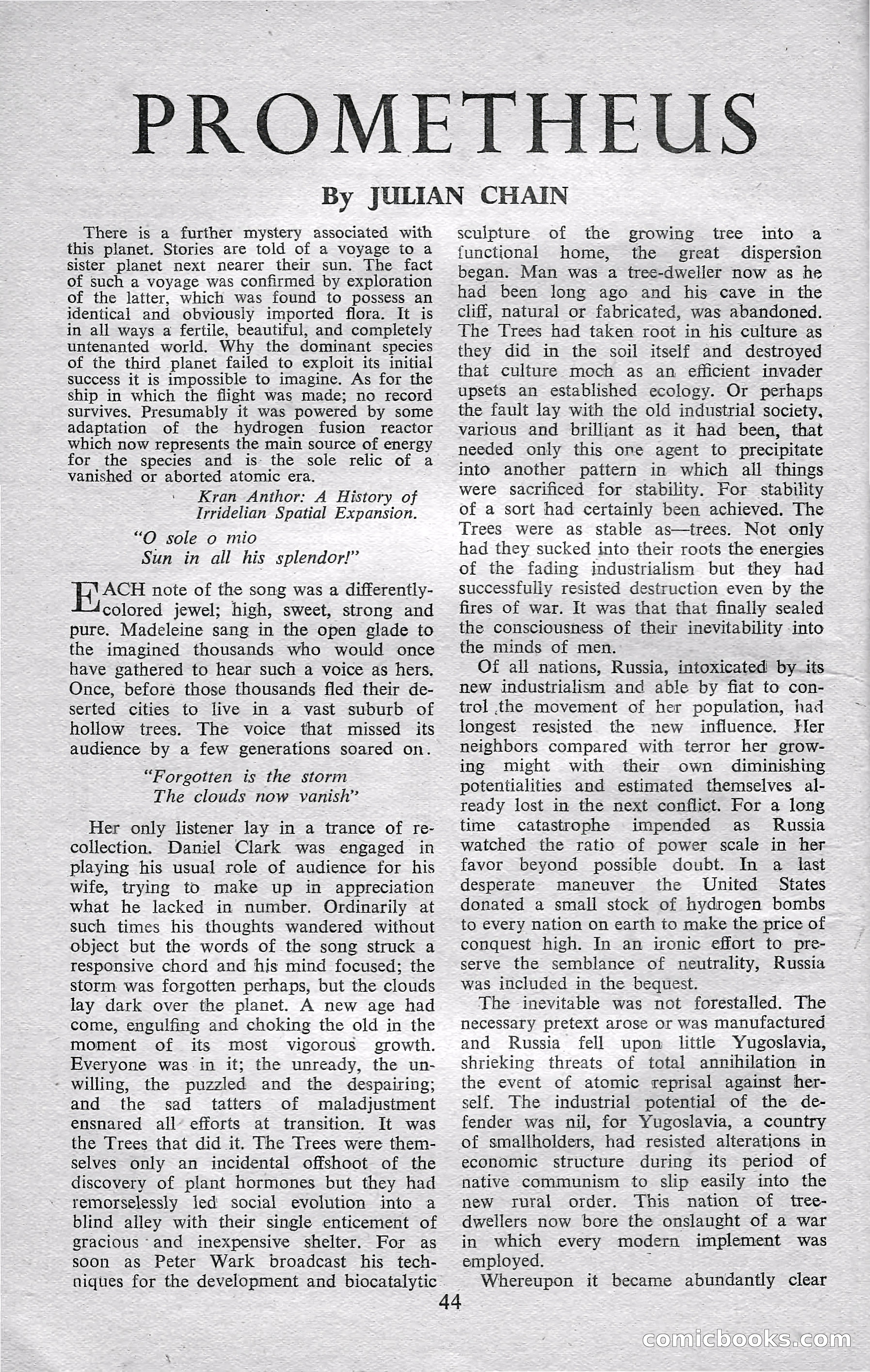
~PROMETHEUS By JULIAN CHAIN There is a further mystery associated with this planet. Stories are told of a voyage to a sister planet next nearer their sun. The fact of such a voyage was confirmed by exploration of the latter, which was found to possess an identical and obviously imported flora. It is in all ways a fertile, beautiful, and completely untenanted world. Why the dominant species of the third planet failed to exploit its initial success it is impossible to imagine. As for the ship in which the flight was made; no record survives. Presumably it was powered by some adaptation of the hydrogen fusion reactor which now represents the main source of energy for the species and is the sole relic of a vanished or aborted atomic era. Kran Anthor: A History of Irridelian Spatial Expansion. “O sole o mio Sun in all his splendor!” ACH note of the song was a differently- colored jewel; high, sweet, strong and pure. Madeleine sang in the open glade to the imagined thousands who would once have gathered to hear such a voice as hers. Once, before those thousands flied their de- serted cities to live in a vast suburb of hollow trees. The voice that missed its audience by a few generations soared on. “Forgotten is the storm The clouds now vanish” Her only listener lay in a trance of re- collection. Daniel Clark was engaged in playing his usual role of audience for his wife, trying to make up in appreciation What he lacked in number. Ordinarily at such times his thoughts wandered without object but the words of the song struck a responsive chord and his mind focused; the storm was forgotten perhaps, but the clouds lay dark over the planet. A new age had come, engulfing and choking the old in the moment of its most vigorous growth. Everyone was in it; the unready, the un- - willing, the puzzled and the despairing; and the sad tatters of maladjustment ensnared all- efforts at transition. It was the Trees that did it. The Trees were them- selves only an incidental offshoot of the discovery of plant hormones but they had remorselessly lied social evolution into a blind alley with their single enticement of gracious and inexpensive shelter. For as soon as Peter Wark broadcast his tech- niques for the development and biocatalytic: 44 sculpture of the growing tree into a functional home, the great dispersion began. Man was a tree-dweller now as he had been long ago and his cave in the cliff, natural or fabricated, was abandoned. The Trees had taken root in his culture as © they did in the soil itself and destroyed that culture moch as an efficient invader upsets an established ecology. Or perhaps the fault lay with the old industrial society, various and brilliant as it had been, that needed only this one agent to precipitate into another pattern in which all things were sacrificed for stability. For stability of a sort had certainly been achieved. The Trees were as stable as—trees. Not only had they sucked into their roots the energies of the fading industrialism but they had successfuliy resisted destruction even by the fires of war. It was that that finally sealed the consciousness of their inevitability into the minds of men. Of all nations, Russia, intoxicated by-~its new industrialism and able by fiat to con- trol the movement of her population, had longest resisted the new influence. Fler neighbors compared with terror her grow- ing might with their own diminishing potentialities and estimated themselves al- ready lost in the next conflict. For a long time catastrophe impended as Russia watched the ratio of power scale in her favor beyond possible doubt. In a fast desperate maneuver the United States donated a small stock of hydrogen bombs to every nation on earth to make the price of conguest high. In an ironic effort to pre- serve the semblance of neutrality, Russia was included in the bequest. The inevitable was not forestalled. The necessary pretext arose or was manufactured and Russia fell upon little Yugoslavia, shrieking threats of total annihilation in the event of atomic reprisal against her- self. The industrial potential of the de- fender was nil, for Yugoslavia, a country of smallholders, had resisted alterations in economic structure during its period of native communism to slip easily into the new rural order. This nation of ftree- dwellers now bore the onslaught of a war in which every modern implement was employed. : Whereupon it became abundantly clear GEoOmiGsoo c <SiGO