
Pulp Fiction, 1952 · page 32 of 68
Astounding Science Fiction, February 1952 (British Edition) — page 32: what you’re looking at
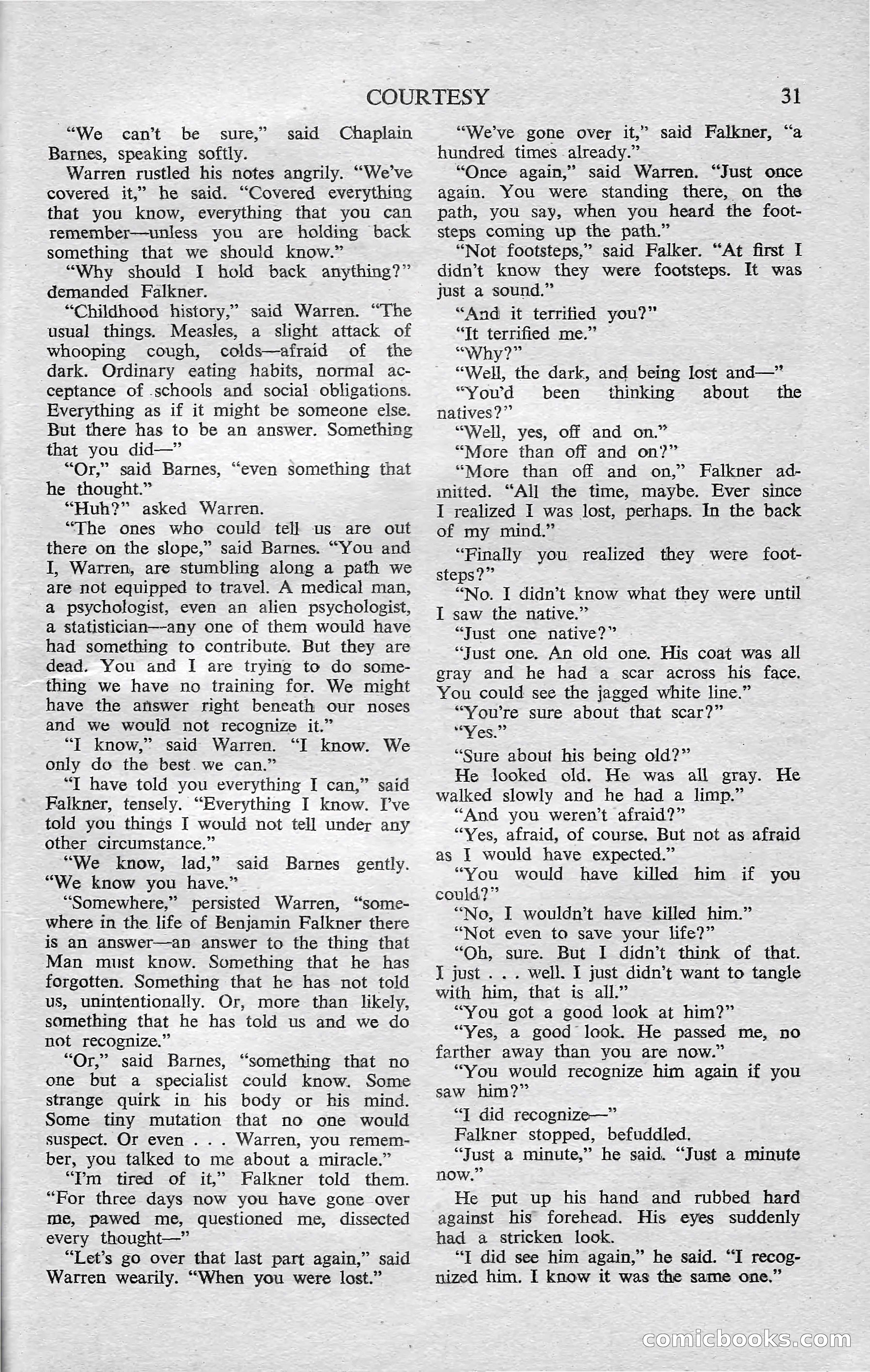
A restored page from Pulp Fiction, 1952. Page through the whole issue in the reader above.
📄 Transcribed text from this page (OCR, searchable)
Machine-transcribed from the original scan — historical spelling and the odd misread are preserved.
COURTESY 31 We —-can’t:- be sure,” Barnes, speaking softly. Warren rustled his notes angrily. “We’ve covered it,’ he said. “Covered everything that you know, everything that you can remember—unless you are holding back something that we should know.” “Why should I hold back anything?” demanded Falkner. “Childhood history,” said Warren. “The usual things. Measles, a slight attack of whooping cough, colds—afraid of the dark. Ordinary eating habits, normal ac- ceptance of schools and social obligations. Everything as if it might be someone else. But there has to be an answer. Something that you did—” “Or,” said Barnes, he thought.” “Huh?” asked Warren. “The ones who could tell us are out there on the slope,” said Barnes. “You and I, Warren, are stumbling along a path we - are not equipped to travel. A medical man, a psychologist, even an alien psychologist, a statistician—-any one of them would have had something to contribute. But they are dead. You and I are trying to do some- thing we have no training for. We might have the afiswer right beneath our noses and we would not recognize it.” “I know,” said Warren. “I know. We only do the best. we can.” “T have told you everything I can,” said Falkner, tensely. “Everything I know. [I’ve told you things I would not tell under any other circumstance.” “We know, lad,” said Barnes gently. “We know you have.” “Somewhere,” persisted Warren, “some- where in the life of Benjamin Falkner there is an answer—an answer to the thing that Man must know. Something that he has forgotten. Something that he has not told us, unintentionally. Or, more than likely, something that he has told us and we do not recognize.” “Or,” said Barnes, “something that no one but a specialist could know. Some strange quirk in his body or his mind. Some tiny mutation that no one would suspect. Or even . . . Warren, you remem- ber, you talked to me about a miracle.” “Pm tired of it,” Falkner told them. “For three days now you have gone over me, pawed me, questioned me, dissected every thought—” “Let’s go over that last part again,” said Warren wearily. “When you were lost.” said Chaplain “even something that 66 “We've gone over it,” said Falkner, “a hundred times already.” “Once again,” said Warren. “Just once again. You were standing there, on the path, you say, when you heard the foot- steps coming up the path.” “Not footsteps.” said Falker. “At first I didn’t know they were footsteps. It was just a sound.” “And it territied you?” “Tt terrified me.” “Why?” “Well, the dark, and being lost and—” “You'd been thinking about the natives?” “Well, yes, off and on.” “More than off and on?” “More than off and on,” Falkner ad- mitted. “All the time, maybe. Ever since I realized I was lost, perhaps. In the back of my mind.” “Finally you realized they were foot- steps?” “No. I didn’t know what they were until I saw the native.” “Just one native?” “Just one. An old one. His coat was all gray and he had a scar across his face. You could see the jagged white line.” “You’re sure about that scar?” “Ves.” “Sure about his bene old?” He looked old. He was all gray. He walked slowly and he had a limp.” “And you weren’t afraid?” “Yes, afraid, of course. But not as afraid as | would have expected.” “You would have killed him if you could?” “No, I wouldn’t have killed him.” “Not even ta save your life?” “Oh, sure. But I didn’t think of that. I just . .. well. I just didn’t want to tangle with him, that is all.” “You got a good look at him?” “Yes, a good look. He passed me, no farther away than you are now.” “You would recognize him again if you saw him?” “J did recognize—” Falkner stopped, befuddled. 3 “Just a minute,” he said. “Just a minute now.” — He put up his hand and rubbed hard against his forehead. His eyes suddenly had a stricken look. “I did see him again,” he said. “I recog- nized him. I know it was the same one.” Eomichbooksnco