
Pulp Fiction, 1952 · page 31 of 68
Astounding Science Fiction, February 1952 (British Edition) — page 31: what you’re looking at
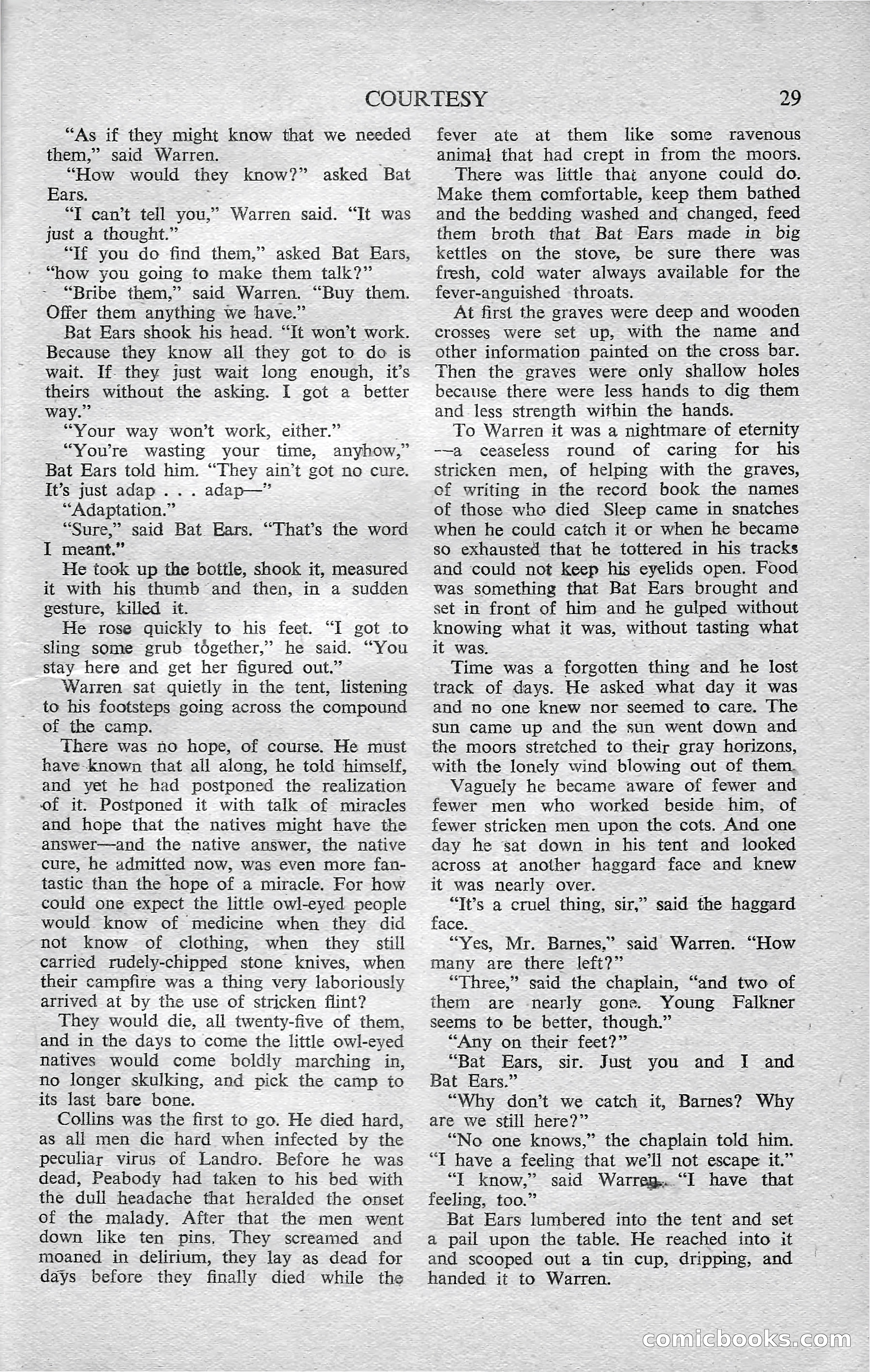
A restored page from Pulp Fiction, 1952. Page through the whole issue in the reader above.
📄 Transcribed text from this page (OCR, searchable)
Machine-transcribed from the original scan — historical spelling and the odd misread are preserved.
COURTESY “As if they might know that we needed them,” said Warren. “How would they know?” asked Bat Ears. “IT can’t tell you,” Warren said. “It was just a thought.” “If you do find them,” asked Bat Ears, “how you going to make them talk?” “Bribe them,” said Warren. “Buy them. Offer them anything we have.” Bat Ears shook his head. “It won’t work. Because they know all they got to do is wait. If- they just wait long enough, it’s ‘theirs without the asking. I got a better way.” “Your way won’t work, either.” ; “You're wasting your time, anyhow,” Bat Ears told him. “They ain’t got no cure. It’s just adap . . . adap—” “Adaptation.” 7 “Sure,” said Bat. Ears. “That’s the word I meant.” He took up the bottle, shook it, measured it with his thumb and then, in a sudden gesture, killed it. He rose quickly to his feet. “I got to sling some grub together,” he said. “You stay here and get her figured out.” Warren sat quietly in the tent, listening to his footsteps going across the compound of the camp. There was no hope, of course. He must have known that all along, he told himself, and yet he had postponed the realization of it. Postponed it with talk of miracles and hope that the natives might have the answer—and the native answer, the native cure, he admitted now, was even more fan- tastic than the hope of a miracle. For how could one expect the little owl-eyed people would know of medicine when they did not know of clothing, when they still carried rudely-chipped stone knives, when their campfire was a thing very laboriously arrived at by the use of stricken flint? They would die, all twenty-five of them, and in the days to come the little owl-eyed natives would come boldly marching in, no longer skulking, and pick the camp to its last bare bone. Collins was the first to go. He died hard, as all men die hard when infected by the peculiar virus of Landro. Before he was dead, Peabody had taken to his bed with the dull headache that heralded the onset of the malady. After that the men went down like ten pins, They screamed and moaned in delirium, they lay as dead for days before they finally died while the 29 fever ate at them like some ravenous animal that had crept in from the moors. There was little that anyone could do. Make them comfortable, keep them bathed and the bedding washed and changed, feed them broth that Bat Ears made in big kettles on the stove, be sure there was fresh, cold water always available for the fever-anguished throats. At first the graves were deep and wooden crosses were set up, with the name and other information painted on the cross bar. Then the graves were only shallow holes because there were less hands to dig them and less strength within the hands. To Warren it was a nightmare of eternity -—a ceaseless round of caring for his stricken men, of helping with the graves, ef writing in the record book the names of those whe died Sleep came in snatches when he could catch it or when he became so exhausted that he tottered in his tracks and could not keep his eyelids open. Food was something that Bat Ears brought and set in front of him and he gulped without knowing what it was, without tasting what it was. Time was a forgotten thing and he lost track of days. He asked what day it was and no one knew nor seemed to care. The sun came up and the sun went down and the moors stretched to their gray horizons, with the lonely wind blowing out of them. Vaguely he became aware of fewer and fewer men who worked beside him, of fewer stricken men upon the cots. And one day he sat down in his tent and looked across at another haggard face and knew it was nearly over. “Tt’s a cruel thing, sir,’ said the haggard face. “Yes, Mr. Barnes,” said Warren. “How many are there left?” “Three,” said the chaplain, “and two of them are nearly gone. Young Falkner seems to be better, though.” “Any on their feet?” “Bat Ears, sir. Just you and I and Bat Ears.” “Why don’t we catch it, Barnes? Why are we still here?” ‘No one knows,” the chaplain told him. “I have a feeling that we'll not escape it.” “I know,” said Warreg.. “I have that feeling, too.” Bat Ears lumbered into the tent and set a pail upon the table. He reached into it and scooped out a tin cup, dripping, and handed it to Warren. : (S@) Eomichook