
Pulp Fiction, 1950 · page 6 of 68
Astounding Science Fiction, October 1950 — page 6: what you’re looking at
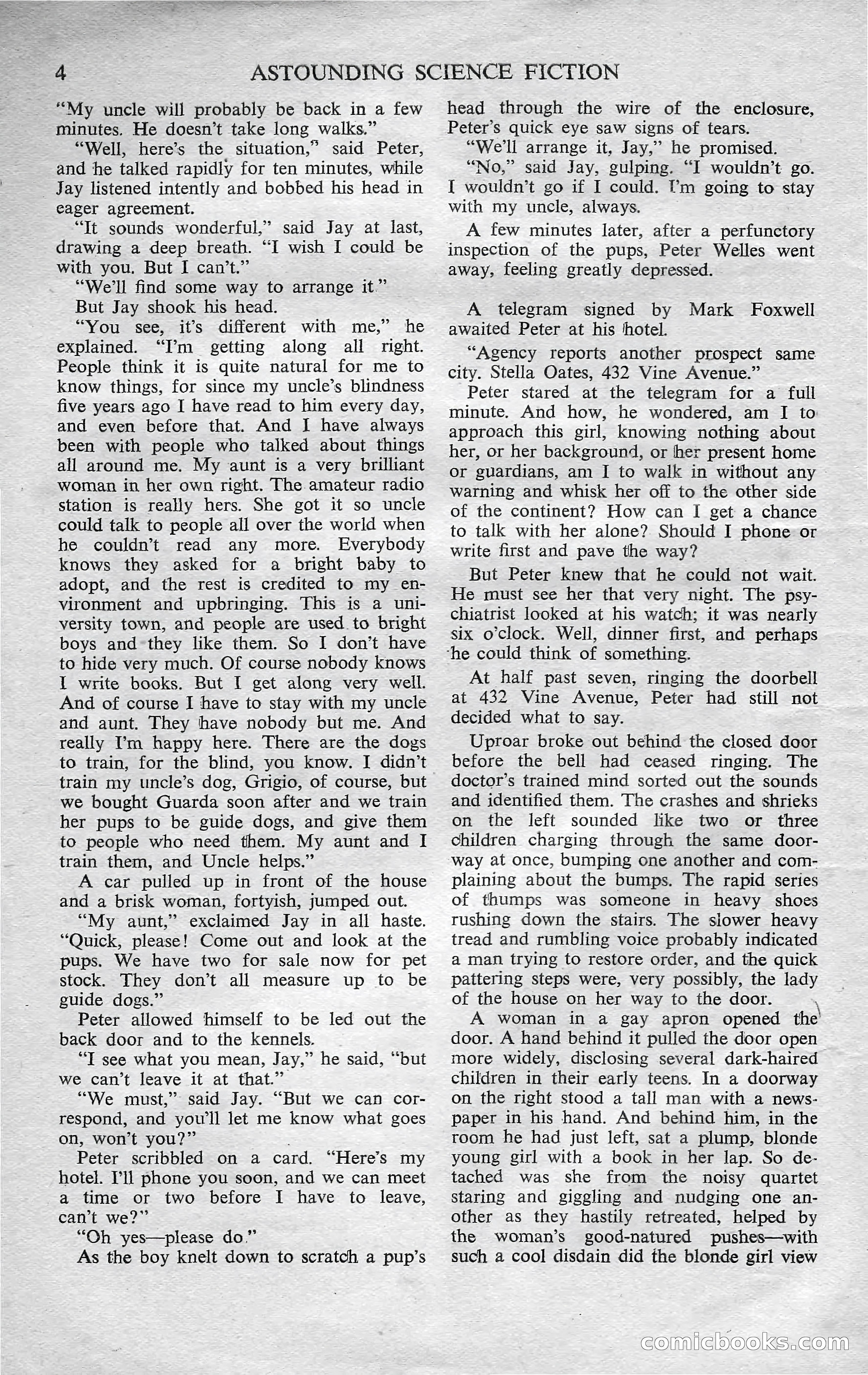
A restored page from Pulp Fiction, 1950. Page through the whole issue in the reader above.
📄 Transcribed text from this page (OCR, searchable)
Machine-transcribed from the original scan — historical spelling and the odd misread are preserved.
4 ASTOUNDING SCIENCE FICTION “My uncle will probably be back in a few minutes. He doesn’t take long walks.” “Well, here’s the situation,” said Peter, and he talked rapidly for ten minutes, while _ Jay listened intently and bobbed his head in eager agreement. “It sounds wonderful,” said Jay at last, drawing a deep breath. “I wish I could be with you. But I can’t.” “We'll find some way to arrange it.” But Jay shook his head. “You see, its different with me,” he explained. “I’m getting along all right. People think it is quite natural for me to know things, for since my uncle’s blindness five years ago I have read to him every day, and even before that. And J have always been with people who talked about things all around me. My aunt is a very brilliant woman in her own right. The amateur radio station is really hers. She got it so uncle could talk to people all over the world when he couldn’t read any more. Everybody knows they asked for a bright baby to adopt, and the rest is credited to my en- vironment and upbringing. This is a uni- versity town, and people are used to bright boys and they like them. So I don’t have to hide very much. Of course nobody knows I write books. But I get along very well. And of course I have to stay with my uncle and aunt. They have nobody but me. And really I’m happy here. There are the dogs to train, for the blind, you know. J didn’t train my uncle’s dog, Grigio, of course, but we bought Guarda soon after and we train her pups to be guide dogs, and give them to people who need them. My aunt and I train them, and Uncle helps.” A car pulled up in front of the house and a brisk woman, fortyish, jumped out. “My aunt,” exclaimed Jay in all haste. “Quick, please! Come out and look at the pups. We have two for sale now for pet stock. They don’t all measure up to be guide dogs.” Peter allowed himself to be led out the back door and to the kennels. “T see what you mean, Jay,” he said, “but we can’t leave it at that.” “We must,” said Jay. “But we can cor- respond, and you'll let me know what goes on, won’t you?” Peter scribbled on a card. “Here’s my hotel. ’'ll phone you soon, and we can meet a time or two before I have to leave, can’t we?” “Ch yes—please do.” As the boy knelt down to scratch a pup’s head through the wire of the enclosure, Peter’s quick eye saw signs of tears. “We'll arrange it, Jay,” he promised. “No,” said Jay, gulping. “I wouldn’t go. [I wouldn’t go if I could. ?m going to stay with my uncle, always. A few minutes later, after a perfunctory inspection of the pups, Peter Welles went away, feeling greatly depressed. A telegram signed by Mark Foxwell awaited Peter at his ‘hotel. “Agency reports another prospect same city. Stella Oates, 432 Vine Avenue.” Peter stared at the telegram for a full minute. And how, he wondered, am I to approach this girl, knowing nothing about her, or her background, or her present home or guardians, am I to walk in without any warning and whisk her off to the other side of the continent? How can I get a chance to talk with her alone? Should I phone or write first and pave the way? But Peter knew that he could not wait. He must see her that very night. The psy- chiatrist looked at his watch; it was nearly six o'clock. Well, dinner first, and perhaps ‘he could think of something. At half past seven, ringing the doorbell at 432 Vine Avenue, Peter had still not decided what to say. Uproar broke out behind the closed door before the bell had ceased ringing. The doctor’s trained mind sorted out the sounds and identified them. The crashes and shrieks on the left sounded like two or three children charging through the same door- way at once, bumping one another and com- plaining about the bumps. The rapid series of thumps was someone in heavy shoes rushing down the stairs. The siower heavy tread and rumbling voice probably indicated a man trying to restore order, and the quick pattering steps were, very possibly, the lady of the house on her way to the door. A woman in a gay apron opened the’ door. A hand behind it pulled the door open more widely, disclosing several dark-haired children in their early teens. In a doorway on the right stood a tall man with a news- paper in his hand. And behind him, in the room he had just left, sat a plump, blonde young girl with a book in her lap. So de- tached was she from the noisy quartet staring and giggling and nudging one an- other as they hastily retreated, helped by the woman’s good-natured pushes—with such a cool disdain did the blonde girl view comicbook (S@)