
Pulp Fiction, 1950 · page 5 of 68
Astounding Science Fiction, October 1950 — page 5: what you’re looking at
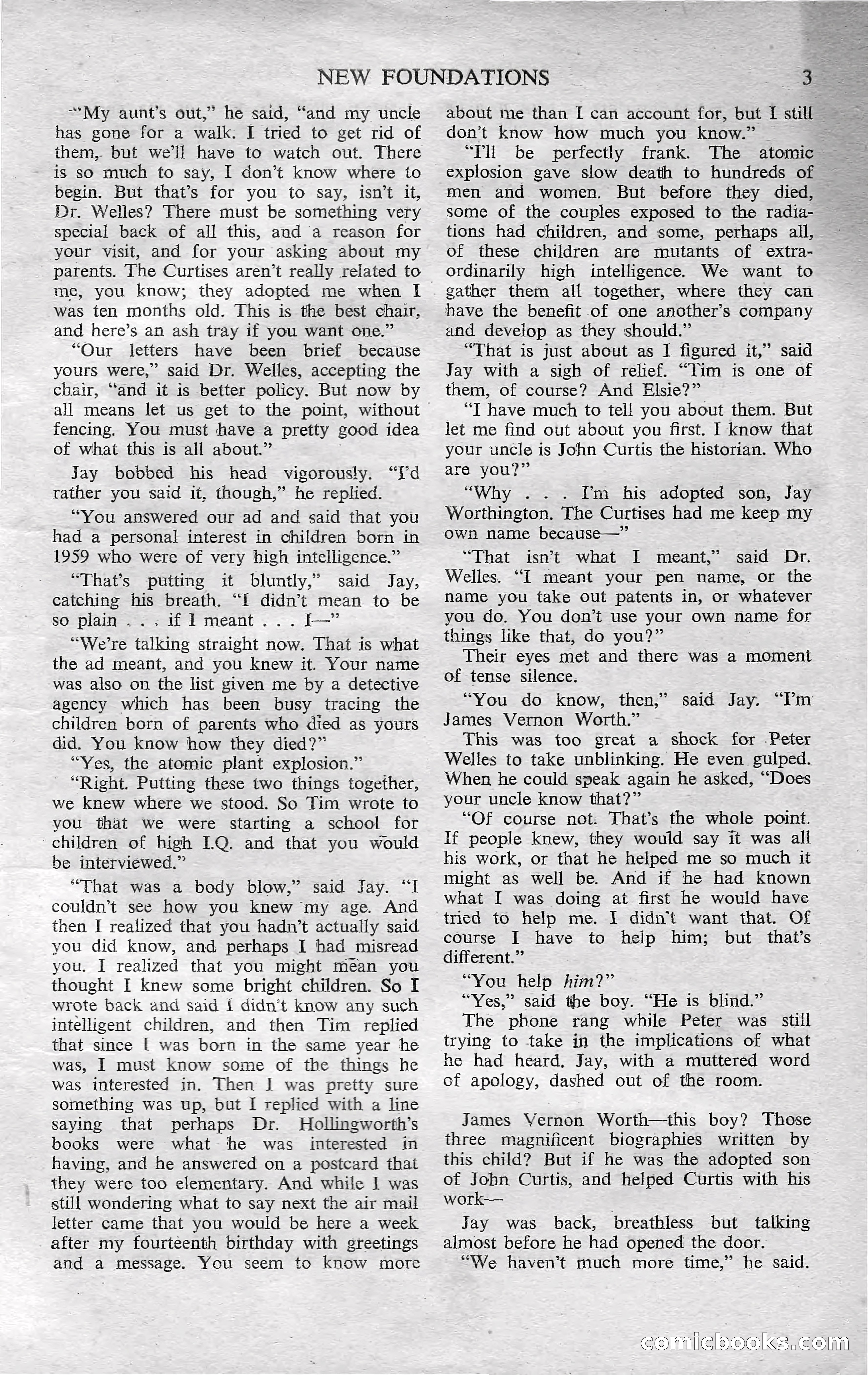
A restored page from Pulp Fiction, 1950. Page through the whole issue in the reader above.
📄 Transcribed text from this page (OCR, searchable)
Machine-transcribed from the original scan — historical spelling and the odd misread are preserved.
NEW FOUNDATIONS — =3 “My aunt’s out,” he said, “and my uncle has gone for a walk. I tried to get rid of them,. but we'll have to watch out. There is so much to say, I don’t know where to begin. But that’s for you to say, isn’t it, Dr. Welles? There must be something very — special back of all this, and a reason for your visit, and for your asking about my parents. The Curtises aren’t really related to — me, you know; they adopted me when I was ten months old. This is the best chair, and here’s an ash tray if you want one.” “Our letters have been brief because yours were,” said Dr. Welles, accepting the chair, “and it is better policy. But now by all means let us get to the point, without | fencing. You must have a pretty good idea of what this is all about.” Jay bobbed his head vigorously. rather you said it, though,” he replied. “You answered our ad and said that you had a personal interest in children born in 1959 who were of very high intelligence.” “That’s putting it bluntly,” said Jay, catching his breath. “I didn’t mean to be so plain... if l meant... [—” “We're talking straight now. That is what the ad meant, and you knew it. Your name was also on the list given me by a detective agency which has been busy tracing the children born of parents who died as yours did. You know how they died?” “Yes, the atomic plant explosion.” ~ “Right. Putting these two things together, we knew where we stood. So Tim wrote to you that we were starting a school for ‘children of high I.Q. and that you would be interviewed.” “That was a body blow,” said Jay. “I couldn’t see how you Knew my age. And then I realized that you hadn’t actually said you did know, and perhaps I had misread you. I realized that you might mean you thought I knew some bright children. So I wrote back and said {i didn’t know any such intelligent children, and then Tim replied that since | was born in the same year he was, I must know some of the things he was interested in. Then I was pretty sure something was up, but I replied with a line saying that perhaps Dr. MHollingworth’s books were what he was interested in having, and he answered on a postcard that they were too elementary. And while I was still wondering what to say next the air mail letter came that you would be here a week after my fourteenth birthday with greetings and a message. You seem to know more “Pd about me than [ can account for, but [I still — don’t know how much you know.” “Tll be perfectly frank. The atomic explosion gave slow death to hundreds of men and women. But before they died, some of the couples exposed to the radia- tions had children, and some, perhaps all, - of these children are mutants of extra- ordinarily high intelligence. We want to gather them all together, where they can have the benefit of one another’s company and develop as they should.” “That is just about as I figured it,” said Jay with a sigh of relief. “Tim is one of them, of course? And Elsie?” “I have much to tell you about them. But let me find out about you first. I know that your uncle is John Curtis the historian. Who are you?” “Why .-.. Tm his adopted son, Jay Worthington. The Curtises had me keep my own name because—” “That isn’t what I meant,’ said Dr. Welles. “I meant your pen name, or the name you take out patents in, or whatever you do. You don’t use your own name for things like that, do you?” 3 Their eyes met and there was a moment of tense silence. “You do know, then,” said Jay. “Pm James Vernon Worth.” This was too great a shock for Peter Welles to take unblinking. He even gulped. When he could speak again he asked, “Does your uncle know that?” “Of course not. That’s the whole point. If people knew, they would say it was all his work, or that he helped me so much it might as well be. And if he had known what I was doing at first he would have tried to help me. I didn’t want that. Of course I have to help him; but that’s different.” “You help him?” “Yes,” said the boy. “He is blind.” The phone rang while Peter was still trying to take in the implications of what he had heard. Jay, with a muttered word of apology, dashed out of the room. James Vernon Worth—this boy? Those three magnificent biographies written by this child? But if he was the adopted son of John Curtis, and helped Curtis with his work— jay was back, breathless but talking almost before he had opened the door. “We haven’t much more time,” he said. COTmMiclaoolK<