
Pulp Fiction, 1949 · page 44 of 68
Astounding British Edition, Vol. 6, No. 8 — page 44: what you’re looking at
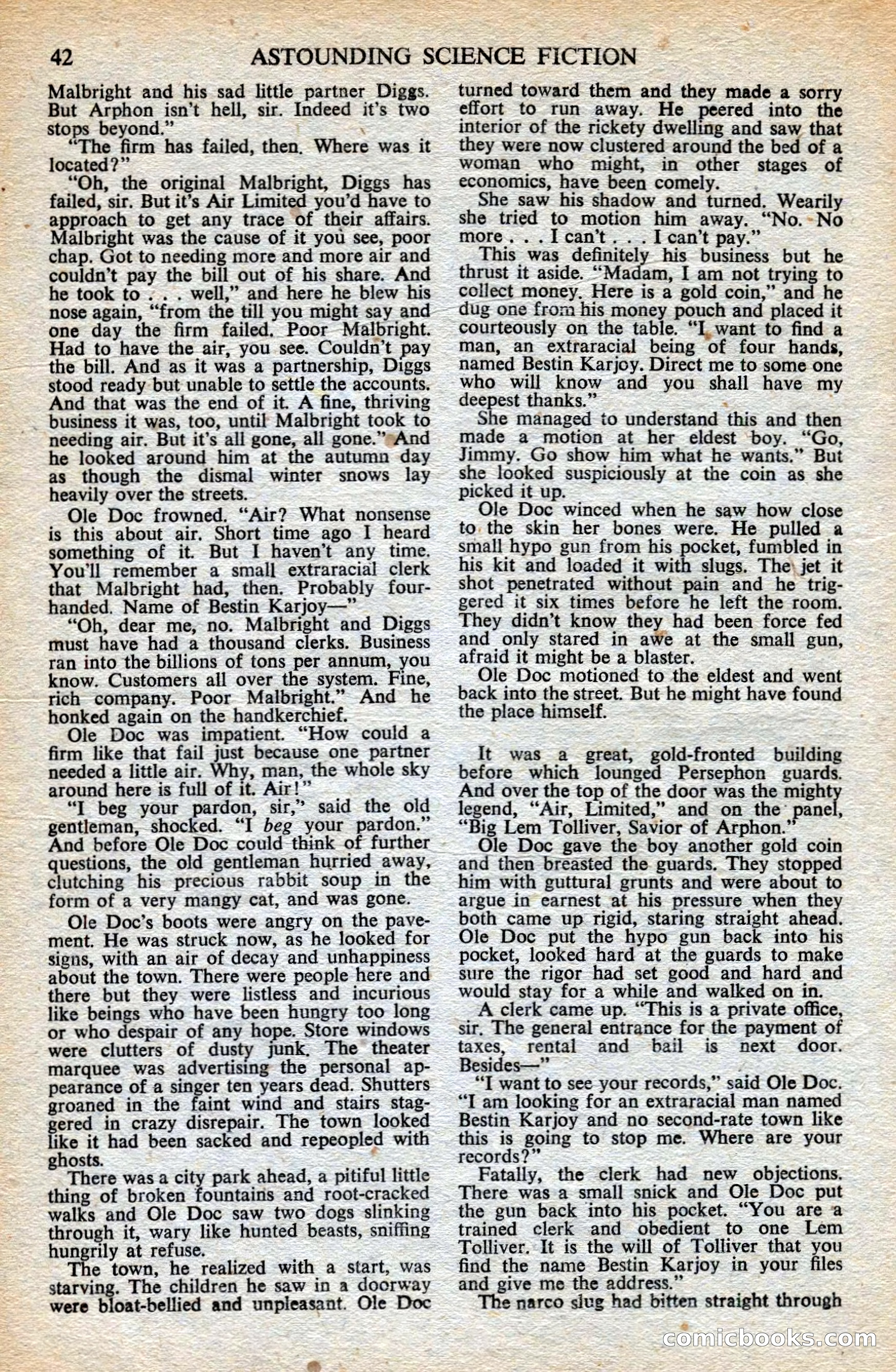
A restored page from Pulp Fiction, 1949. Page through the whole issue in the reader above.
📄 Transcribed text from this page (OCR, searchable)
Machine-transcribed from the original scan — historical spelling and the odd misread are preserved.
-¥ 42 Malbright and his sad little partner Diggs. But Arphon isn't hell, sir. Indeed it’s two stops beyond.” ‘ “The firm has failed, then. Where was it located?” “Oh, the original Malbright, Diggs has failed, sir. But it’s Air Limited you’d have to approach to get any trace of their affairs. Malbright was the cause of it you see, poor chap. Got to needing more and more air and couldn’t pay the bill out of his share. And he took to . . . well,” and here he blew his nose again, “from the till you might say and one day the firm failed, Poor Malbright. Had to have the air, you see. Couldn't pay the bill. And as it was a partnership, Diggs stood ready but unable to settle the accounts. And that was the end of it. A fine, thriving -_ business it was, too, until Malbright took to needing air. But it’s all gone, all gone.”"And he looked around him at the autumn day as though the dismal winter snows lay heavily over the streets. Ole Doc frowned. “Air? What nonsense is this about air. Short time ago I heard something of it. But I haven’t any time. You'll remember a small extraracial clerk that Malbright had, then. Probably four- handed. Name of Bestin Karjoy—” “Oh, dear me, no. Malbright and Diggs must have had a thousand clerks. Business ran into the billions of tons per annum, you know. Customers all over the system. Fine, rich company. Poor Malbright.” And he honked again on the handkerchief. Ole Doc was impatient. “How could a firm like that fail just because one partner needed a little air. Why, man, the whole sky around here is full of it. Air!” “I beg your pardon, sir,” said the old gentleman, shocked. “I beg your pardon.” And before Ole Doc could think of further questions, the old gentleman hurried away, clutching his precious rabbit soup in the form of a very mangy cat, and was gone. Ole Doc’s boots were angry on the pave- ment. He was struck now, as he looked for signs, with an air of decay and unhappiness about the town. There were people here and there but they were listless and incurious like beings who have been hungry too long or who despair of any hope. Store windows were clutters of dusty junk. The theater marquee was advertising the personal ap- pearance of a singer ten years dead. Shutters groaned in the faint wind and stairs stag- ered in crazy disrepair. The town looked like it had been sacked and repeopled with osts. There was a city park ahead, a pitiful little thing of broken fountains and root-cracked walks and Ole Doc saw two dogs slinking through it, wary like hunted beasts, sniffing hungrily at refuse. e town, he realized with a start, was starving. The children he saw in a doorway were bloat-bellied and unpleasant. Ole Doc ASTOUNDING SCIENCE FICTION - a turned toward them and they made a sorry effort to run away. He peered into the interior of the rickety dwelling and saw that they were now clustered around the bed of a woman who might, in other stages of economics, have been comely. She saw his shadow and turned. Wearily she tried to motion him away. “No.-No more. ..I can’t. . . I can’t pay.” This was definitely his business but he thrust it aside. “Madam, I am not trying to collect money. Here is a gold coin,” and he dug one from his money pouch and placed it courteously on the table. “I want to find a man, an extraracial being of four hands, named Bestin Karjoy. Direct me to some one who will know and you shall have my deepest thanks.” > She managed to understand this and then made a motion at her eldest boy. “Go, Jimmy. Go show him what he wants.” But she looked suspiciously at the coin as she picked it up. Ole Doc winced when he saw how close to the skin her bones were. He pulled a small hypo gun from his pocket, fumbled in his kit and loaded it with slugs. The: jet it shot penetrated without pain and he trig- gered it six times before he left the room. They didn’t know they had been force fed and only stared in awe at the small gun, afraid it might be a blaster. Ole Doc motioned to the eldest and went back into the street. But he might have found the place himself. It was a great, gold-fronted building before which lounged Persephon guards. And over the top of the door was the migh legend, “Air, Limited,” and on the’ panel, “Big Lem Tolliver, Savior of Arphon.’ Ole Doc gave the boy another gold coin and then breasted the guards. They stopped him with guttural grunts and were about to argue in earnest at his pressure when the both came up rigid, staring straight ahead. Ole Doc put the hypo gun back into his pocket, looked hard at the guards to make sure the rigor had set good and hard and would stay for a while and walked on in. A clerk came up. “This is a private office, sir, The general entrance for the payment of taxes, rental and bail is next door. Besides—” “T want to see your records,” said Ole Doc. “T am looking for an extraracial man named Bestin Karjoy and no second-rate town like this is going to stop me. Where are your records?” . Fatally, the clerk had new objections. There was a small snick and Ole Doc put the gun back into his pocket. “You are a trained clerk and obedient to one Lem Tolliver. It is the will of Tolliver that you find the name Bestin Karjoy in your files and give me the address.” The narco sivg had bitten straight through ] Qo EOmMmIGdOokS: Eo