
Pulp Fiction, 1949 · page 43 of 68
Astounding British Edition, Vol. 6, No. 8 — page 43: what you’re looking at
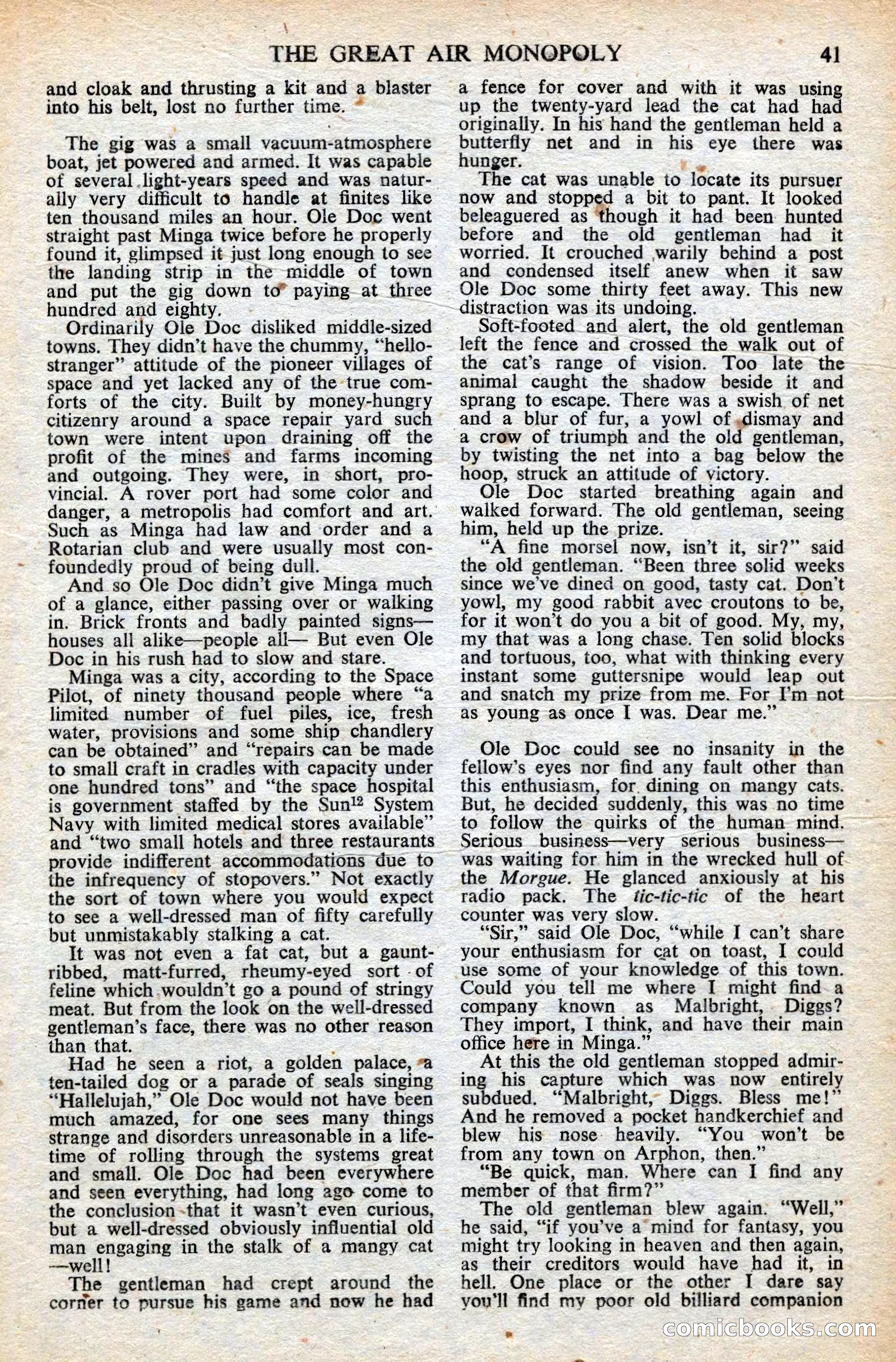
A restored page from Pulp Fiction, 1949. Page through the whole issue in the reader above.
📄 Transcribed text from this page (OCR, searchable)
Machine-transcribed from the original scan — historical spelling and the odd misread are preserved.
\ and cloak and thrusting a kit and a blaster into his belt, lost no further time. The gig was a small vacuum-atmosphere boat, jet powered and armed. It was capable of several light-years speed and was natur- ally very difficult to handle at finites like ten thousand miles an hour. Ole Doc went straight past Minga twice before he properly found it, glimpsed it just long enough to see the landing strip in the middle of town and put the gig down to” paying. at three hundred and eighty. : Ordinarily Ole Doc disliked middle-sized towns. They didn’t have the chummy, “hello- stranger” attitude of the pioneer villages of space and yet lacked any of the true com- forts of the city. Built by money-hungry citizenry around a space repair yard such town were intent upon draining off the profit of the mines and farms incoming and outgoing. They were, in short, pro- vincial. A rover port had some color and danger, a metropolis had comfort and art. Such as Minga had law and order and a Rotarian club and were usually most con- foundedly proud of being dull. And so Ole Doc didn’t give Minga much of a glance, either passing over or walking in. Brick fronts and badly painted signs— houses all alike—people all— But even Ole Doc in his rush had to slow and stare. Minga was a city, according to the Space Pilot, of ninety thousand people where “a limited number of fuel piles, ice, fresh water, provisions and some ship chandlery can be obtained” and “repairs can be made to small craft in cradles with capacity under one hundred tons” and “the space hospital is government staffed by the Sun! System Navy with limited medical stores available” and “two small hotels and three restaurants provide indifferent accommodations due to the infrequency of stopovers.” Not exactly the sort of town where you would expect to see a well-dressed man of fifty carefully but unmistakably stalking a cat. It was not even a fat cat, but a gaunt- ribbed, matt-furred, rheumy-eyed sort - of feline which wouldn’t go a pound of stringy meat. But from the look on the well-dressed gentleman’s face, there was no other reason than that. : Had he seen a riot, a golden palace, a ten-tailed dog or a parade of seals singing “Hallelujah,” Ole Doc would not have been much amazed, for one sees many things strange and disorders unreasonable in a life- time of rolling through the systems great and small. Ole Doc had been everywhere and seen everything, had long ago come to the conclusion that it wasn’t even curious, but a well-dressed obviously influential old man engaging in the stalk of a mangy cat —well! The gentleman had crept around the corner to pursue his game and now he had a crow of triumph and the ol THE GREAT AIR MON@POLY 5 a fence for cover and with it was using up the twenty-yard lead the cat had had originally. In his hand the gentleman held a butterfly net and in his eye there was hunger. = The cat was unable to locate its pursuer now and stopped a bit to pant. It looked beleaguered as though it had been hunted before and the old gentleman had it worried. It crouched warily behind a post and condensed itself anew when it saw - Ole Doc some thirty feet away. This new distraction was its undoing. Soft-footed_and alert, the old gentleman left the fence and crossed the walk out of the cat’s range of vision. Too late the animal caught the shadow beside it and sprang to escape. There was a swish of net and a blur of fur, a yowl of.dismay and gentleman, by twisting the net into a bag below the hoop, struck an attitude of victory. Ole Doc started breathing again and walked forward. The old gentleman, seeing him, held up the prize. “A fine morsel now, isn’t it, sir?” said the old gentleman. “Been three solid weeks since we've dined on good, tasty cat. Don’t yowl, my good rabbit avec croutons to be, for it won't do you a bit of good. My, my, my that was a long chase. Ten solid blocks and tortuous, too, what with thinking every instant some guttersnipe would leap out and snatch my prize from me. For I’m not as young as once I was. Dear me.” Ole Doc could see no insanity in the fellow’s eyes nor find any fault other than this enthusiasm, for. dining on mangy cats. But, he decided suddenly, this was no time to follow the quirks of the human mind. Serious _business—very serious business— was waiting for him in the wrecked hull of the Morgue. He glanced anxiously at his radio pack. The fic-tic-tic of the heart counter was very slow. “Sir,” said Ole Doc, “while I can’t share your enthusiasm for cat on toast, I could use some of your knowledge of this town. Could you tell me where I might find a company known as Malbright, Diggs? They import, I think, and have their main office here in Minga.” At this the old gentleman stopped admir- ing his capture which was now entirely subdued. “Malbright, Diggs. Bless me!” And he removed a pocket handkerchief and blew his nose: heavily. “You won't be from any town on Arphon, then.” “Be quick, man. Where can I find any member of that firm?” The old gentleman blew again: “Well,” he said, “if you’ve a mind for fantasy, you might try looking in heaven and then again, as their creditors would have had it, in hell. One place or the other I dare say you'll find my poor old billiard companion ‘ EOMIGDOOKSAjCo