
Pulp Fiction, 1922 · page 92 of 187
Argosy All-Story Weekly — page 92: what you’re looking at
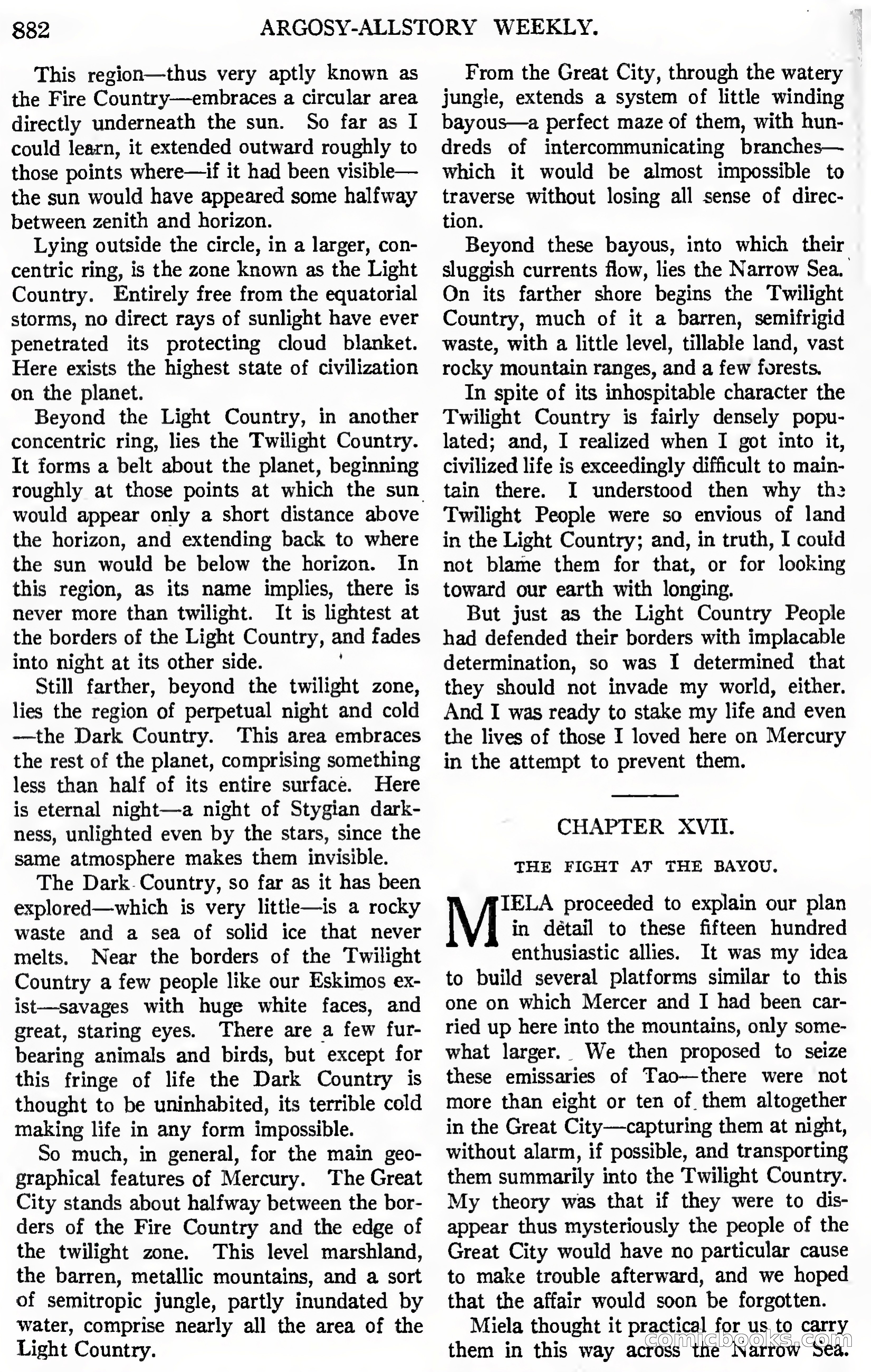
A restored page from Pulp Fiction, 1922. Page through the whole issue in the reader above.
📄 Transcribed text from this page (OCR, searchable)
Machine-transcribed from the original scan — historical spelling and the odd misread are preserved.
$82 This region—thus very aptly known as the Fire Country—embraces a circular area directly underneath the sun. So far as I could learn, it extended outward roughly to those points where—if it had been visible— the sun would have appeared some halfway between zenith and horizon. Lying outside the circle, in a larger, con- centric ring, is the zone known as the Light Country. Entirely free from the equatorial storms, no direct rays of sunlight have ever penetrated its protecting cloud blanket. Here exists the highest state of civilization on the planet. Beyond the Light Country, in another concentric ring, lies the Twilight Country. It forms a belt about the planet, beginning roughly at those points at which the sun would appear only a short distance above the horizon, and extending back to where the sun would be below the horizon. In this region, as its name implies, there is never more than twilight. It is lightest at the borders of the Light Country, and fades into night at its other side. Still farther, beyond the twilight zone, lies the region of perpetual night and cold -—the Dark Country. This area embraces the rest of the planet, comprising something less than half of its entire surface. Here is eternal night—a night of Stygian dark- ness, unlighted even by the stars, since the same atmosphere makes them invisible. The Dark.Country, so far as it has been explored—which is very little—is a rocky waste and a sea of solid ice that never melts. Near the borders of the Twilight Country a few people like our Eskimos ex- ist—savages with huge white faces, and great, staring eyes. There are a few fur- bearing animals and birds, but except for this fringe of life the Dark Country is thought to be uninhabited, its terrible cold making life in any form impossible. So much, in general, for the main geo- graphical features of Mercury. ‘The Great City stands about halfway between the bor- ders of the Fire Country and the edge of the twilight zone. This level marshland, the barren, metallic mountains, and a sort of semitropic jungle, partly inundated by water, comprise nearly all the area of the Light Country. ARGOSY-ALLSTORY WEEKLY. From the Great City, through the watery jungle, extends a system of little winding bayous—a perfect maze of them, with hun- dreds of intercommunicating branches— which it would be almost impossible to traverse without losing all sense of direc- tion. Beyond these bayous, into which their sluggish currents flow, lies the Narrow Sea. On its farther shore begins the Twilight Country, much of it a barren, semifrigid waste, with a little level, tillable land, vast rocky mountain ranges, and a few forests. In spite of its inhospitable character the Twilight Country is fairly densely popu- lated; and, I realized when I got into it, civilized life is exceedingly difficult to main- tain there. I understood then why th: Twilight People were so envious of land in the Light Country; and, in truth, I could not blame them for that, or for looking toward our earth with longing. But just as the Light Country People had defended their borders with implacable determination, so was I determined that they should not invade my world, either. And I was ready to stake my life and even the lives of those I loved here on Mercury in the attempt to prevent them. CHAPTER XVII. THE FIGHT AT THE BAYOU. IELA proceeded to explain our plan in détail to these fifteen hundred enthusiastic allies. It was my idea to build several platforms similar to this one on which Mercer and I had been car- ried up here into the mountains, only some- what larger. We then proposed to seize these emissaries of Tao—there were not more than eight or ten of them altogether in the Great City—capturing them at night, without alarm, if possible, and transporting them summarily into the Twilight Country. My theory was that if they were to dis- appear thus mysteriously the people of the Great City would have no particular cause to make trouble afterward, and we hoped that the affair would soon be forgotten. Miela thought it precimtic® to c them in this way across. th Boke ncoing