
Pulp Fiction, 1922 · page 91 of 187
Argosy All-Story Weekly — page 91: what you’re looking at
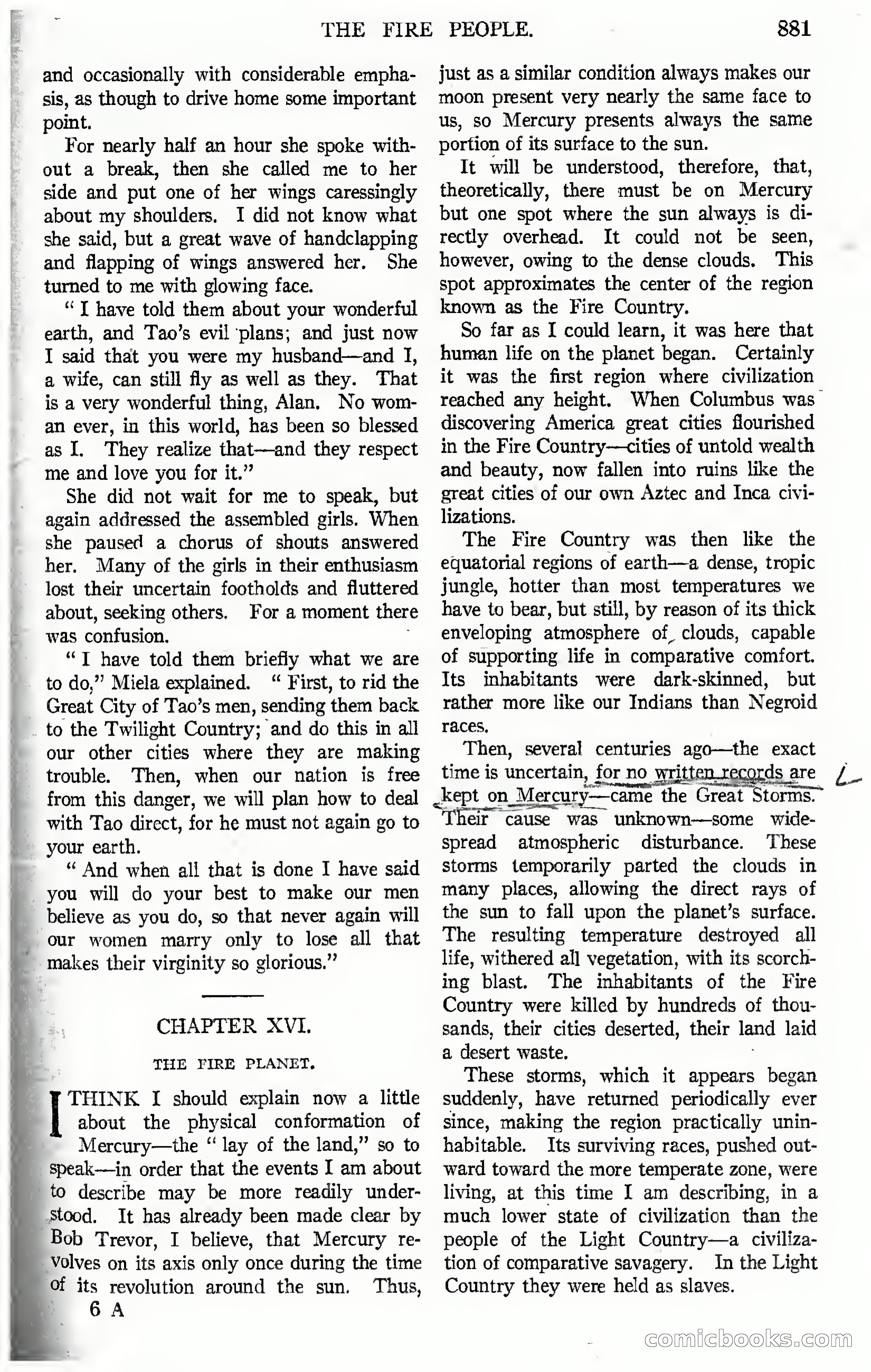
A restored page from Pulp Fiction, 1922. Page through the whole issue in the reader above.
📄 Transcribed text from this page (OCR, searchable)
Machine-transcribed from the original scan — historical spelling and the odd misread are preserved.
—__— |. __—., THE FIRE PEOPLE. and occasionally with considerable empha- sis, as though to drive home some important point. For nearly half an hour she spoke with- out a break, then she called me to her side and put one of her wings caressingly about my shoulders. I did not know what she said, but a great wave of handclapping and flapping of wings answered her. She turned to me with glowing face. “ T have told them about your wonderful earth, and Tao’s evil ‘plans; and just now I said that you were my husband—and I, a wife, can still fly as well as they. That is a very wonderful thing, Alan. No wom- an ever, in this world, has been so blessed as I. They realize that—and they respect me and love you for it.” She did not wait for me to speak, but again addressed the assembled girls. When she paused a chorus of shouts answered her. Many of the girls in their enthusiasm lost their uncertain footholds and fluttered about, seeking others. For a moment there was confusion. “T have told them briefly what we are to do,” Miela explained. “ First, to rid the Great City of Tao’s men, sending them back _ to the Twilight Country; and do this in all our other cities where they are making trouble. Then, when our nation is free from this danger, we will plan how to deal with Tao direct, for he must not again go to your earth. “ And when all that is done I have said you will do your best to make our men believe as you do, so that never again will our women marry only to lose all that makes their virginity so glorious.” CHAPTER XVI. THE FIRE PLANET. THINE I should explain now a little about the physical conformation of Mercury—the “ lay of the land,” so to -speak—in order that the events I am about to describe may be more readily under- Stood. It has already been made clear by Bob Trevor, I believe, that Mercury re- Volves on its axis only once during the time Of its revolution around the sun. Thus, 6A 881 just as a similar condition always makes our moon present very nearly the same face to us, so Mercury presents always the same portion of its surface to the sun. It will be understood, therefore, that, theoretically, there must be on Mercury but one spot where the sun always is di- rectly overhead. It could not be seen, however, owing to the dense clouds. This spot approximates the center of the region known as the Fire Country. So far as I could learn, it was here that human life on the planet began. Certainly it was the first region where civilization reached any height. discovering America great cities flourished in the Fire Country—cities of untold wealth and beauty, now fallen into ruins like the great cities of our own Aztec and Inca civi- lizations. The Fire Country was then like the equatorial regions of earth—a dense, tropic jungle, hotter than most temperatures we have to bear, but still, by reason of its thick enveloping atmosphere of clouds, capable of supporting life in comparative comfort. Its inhabitants were dark-skinned, but rather more like our Indians than N eproid races, Then, several centuries ago—the exact time is uncertain, for no Written_records ¢ are kept on _Mercury—came the Great Storms. elr cause was unknown—some wide- spread atmospheric disturbance. These storms temporarily parted the clouds in many places, allowing the direct rays of the sun to fall upon the planet’s surface. The resulting temperature destroyed all life, withered all vegetation, with its scorch- ing blast. The inhabitants of the Fire Country were killed by hundreds of thou- sands, their cities deserted, their land laid a desert waste. These storms, which it appears began suddenly, have returned periodically ever since, making the region practically unin- habitable. Its surviving races, pushed out- ward toward the more temperate zone, were living, at this time I am describing, in a much lower state of civilization than the people of the Light Country—a civiliza- tion of comparative savagery. In the Light Country they were held as slaves. CoOmiclbooks.€O When Columbus was L-