
Pulp Fiction, 1922 · page 123 of 172
Argosy All-Story Weekly, July 1, 1922 — page 123: what you’re looking at
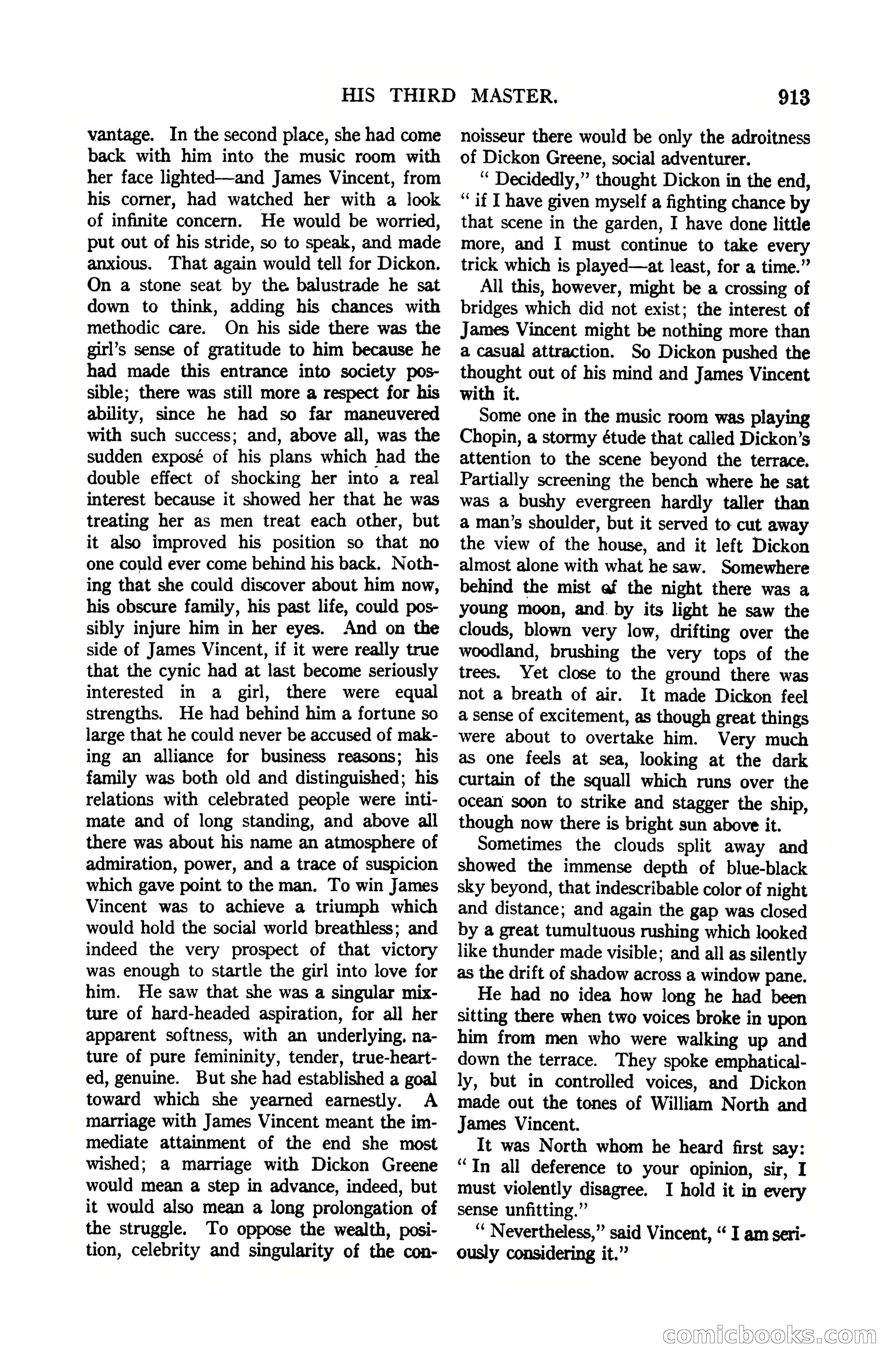
A restored page from Pulp Fiction, 1922. Page through the whole issue in the reader above.
📄 Transcribed text from this page (OCR, searchable)
Machine-transcribed from the original scan — historical spelling and the odd misread are preserved.
HIS THIRD MASTER, vantage. In the second place, she had come back with him into the music room with her face lighted—and James Vincent, from his corner, had watched her with a look of infinite concern. He would be worried, put out of his stride, so to speak, and made anxious. That again would tell for Dickon. On a stone seat by the balustrade he sat down to think, adding his chances with methodic care. On his side there was the girl’s sense of gratitude to him because he had made this entrance into society pos- sible; there was still more a respect for his ability, since he had so far maneuvered with such success; and, above all, was the sudden exposé of his plans which had the double effect of shocking her into a real interest because it showed her that he was treating her as men treat each other, but it also improved his position so that no one could ever come behind his back. Noth- ing that she could discover about him now, his obscure family, his past life, could pos- sibly injure him in her eyes. And on the side of James Vincent, if it were really true that the cynic had at last become seriously interested in a girl, there were equal strengths. He had behind him a fortune so large that he could never be accused of mak- ing an alliance for business reasons; his family was both old and distinguished; his relations with celebrated people were inti- mate and of long standing, and above all there was about his name an atmosphere of admiration, power, and a trace of suspicion which gave point to the man. To win James Vincent was to achieve a triumph which would hold the social world breathless; and indeed the very prospect of that victory was enough to startle the girl into love for him. He saw that she was a singular mix- ture of hard-headed aspiration, for all her apparent softness, with an underlying. na- ture of pure femininity, tender, true-heart- ed, genuine. But she had established a goal toward which she yearned earnestly. A marriage with James Vincent meant the im- mediate attainment of the end she most wished; a marriage with Dickon Greene would mean a step in advance, indeed, but it would also mean a long prolongation of the struggle. To oppose the wealth, posi- tion, celebrity and singularity of the con- 913 noisseur there would be only the adroitness of Dickon Greene, social adventurer. “ Decidedly,” thought Dickon in the end, “if I have given myself a fighting chance by that scene in the garden, I have done little more, and I must continue to take every trick which is played—at least, for a time.” All this, however, might be a crossing of bridges which did not exist; the interest of James Vincent might be nothing more than a casual attraction. So Dickon pushed the thought out of his mind and James Vincent with it. Some one in the music room was playing Chopin, a stormy étude that called Dickon’s attention to the scene beyond the terrace. Partially screening the bench where he sat was a bushy evergreen hardly taller than a man’s shoulder, but it served to cut away the view of the house, and it left Dickon almost alone with what he saw. Somewhere behind the mist af the night there was a young moon, and. by its light he saw the clouds, blown very low, drifting over the woodland, brushing the very tops of the trees. Yet close to the ground there was not a breath of air. It made Dickon feel a sense of excitement, as though great things were about to overtake him. Very much as one feels at sea, looking at the dark curtain of the squall which runs over the ocean soon to strike and stagger the ship, though now there is bright sun above it. Sometimes the clouds split away and showed the immense depth of blue-black sky beyond, that indescribable color of night and distance; and again the gap was closed by a great tumultuous rushing which looked like thunder made visible; and all as silently as the drift of shadow across a window pane. He had no idea how long he had been sitting there when two voices broke in upon him from men who were walking up and down the terrace. They spoke emphatical- ly, but in controlled voices, and Dickon made out the tones of William North and James Vincent. It was North whom he heard first say: “In all deference to your opinion, sir, I must violently disagree. I hold it in every sense unfitting.”’ ‘‘ Nevertheless,” said Vincent, ‘“ I am seri- ously considering it.” DOOK C©