
Pulp Fiction, 1922 · page 122 of 172
Argosy All-Story Weekly, July 1, 1922 — page 122: what you’re looking at
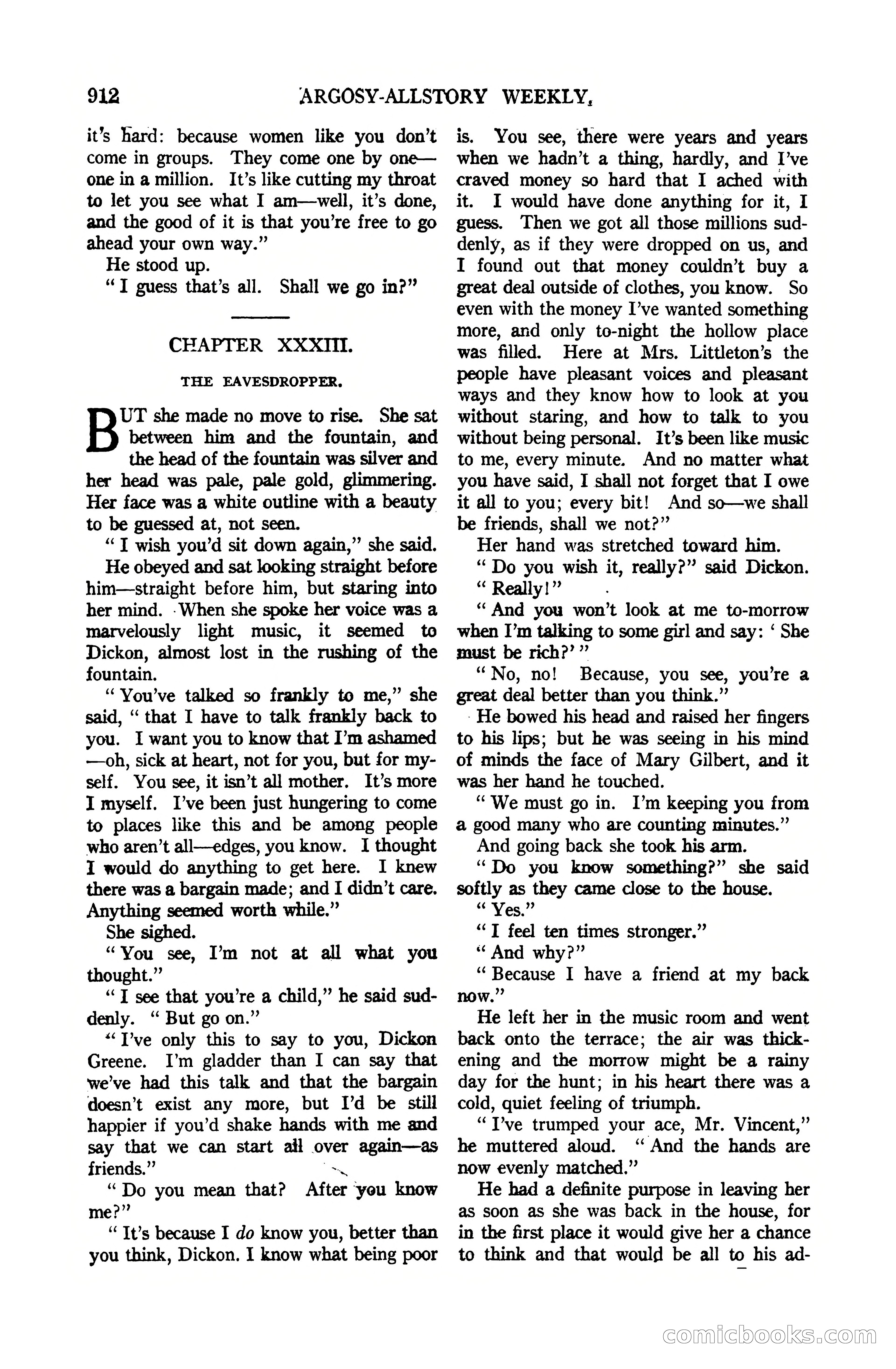
A restored page from Pulp Fiction, 1922. Page through the whole issue in the reader above.
📄 Transcribed text from this page (OCR, searchable)
Machine-transcribed from the original scan — historical spelling and the odd misread are preserved.
912 it’s hard: because women like you don’t come in groups. They come one by one— one ina million. It’s like cutting my throat to let you see what I am—vwell, it’s done, and the good of it is that you’re free to go ahead your own way.” He stood up. “T guess that’s all. Shall we go in?” CERAPTER XXXIII. THE EAVESDROPPER, UT she made no move to rise. She sat between him and the fountain, and the head of the fountain was silver and her head was pale, pale gold, glimmering. Her face was a white outline with a beauty to be guessed at, not seen. “T wish you’d sit down again,” she said. He obeyed and sat looking straight before him—straight before him, but staring into her mind. -When she spoke her voice was a marvelously light music, it seemed to Dickon, almost lost in the rushing of the fountain. ‘“You’ve talked so frankly to me,” she said, ‘“ that I have to talk frankly back to you. I want you to know that I’m ashamed —oh, sick at heart, not for you, but for my- self. You see, it isn’t all mother. It’s more I myself. I’ve been just hungering to come to places like this and be among people who aren’t all—edges, you know. I thought I would do anything to get here. I knew there was a bargain made; and I didn’t care. Anything seemed worth while.” She sighed. “You see, I’m not at all what you thought.” ‘“‘T see that you’re a child,” he said sud- denly. ‘ But go on.” “T’ve only this to say to you, Dicken Greene. I’m gladder than I can say that we've had this talk and that the bargain doesn’t exist any more, but I’d be still happier if you’d shake hands with me and say that we can start all over again—as friends.”’ — “Do you mean that? After you know me?”’ “It’s because I do know you, better than you think, Dickon. I know what being poor ARGOSY-ALLSTORY WEEKLY, is. You see, there were years and years when we hadn’t a thing, hardly, and I’ve craved money so hard that I ached with it. I would have done anything for it, I guess. Then we got all those millions sud- denly, as if they were dropped on us, and I found out that money couldn’t buy a great deal outside of clothes, you know. So even with the money I’ve wanted something more, and only to-night the hollow place was filled. Here at Mrs. Littleton’s the people have pleasant voices and pleasant ways and they know how to look at you without staring, and how to talk to you without being personal. It’s been like music to me, every minute. And no matter what you have said, I shall not forget that I owe it all to you; every bit! And so—we shall be friends, shall we not?” Her hand was stretched toward him. ‘Do you wish it, really?” said Dickon. “‘ And you won’t look at me to-morrow when I’m talking to some girl and say: ‘ She must be rich?’ ” ‘““No, no! Because, you see, you're a great deal better than you think.” - He bowed his head and raised her fingers to his lips; but he was seeing in his mind of minds the face of Mary Gilbert, and it was her hand he touched. “We must go in. I’m keeping you from a good many who are counting minutes.” And going back she took his arm. ‘Do you know something?” she said softly as they came close to the house. ce Yes.” ““T feel ten times stronger.” * And why?” ‘“‘ Because I have a friend at my back now.” He left her in the music room and went back onto the terrace; the air was thick- ening and the morrow might be a rainy day for the hunt; in his heart there was a cold, quiet feeling of triumph. “T’ve trumped your ace, Mr. Vincent,” he muttered aloud. “And the hands are now evenly matched.” He had a definite purpose in leaving her as soon as she was back in the house, for in the first place it would give her a chance to think and that would be all to his ad- comicloool C©