
Pulp Fiction, 1922 · page 169 of 172
Argosy All-Story Weekly, January 21, 1922 — page 169: what you’re looking at
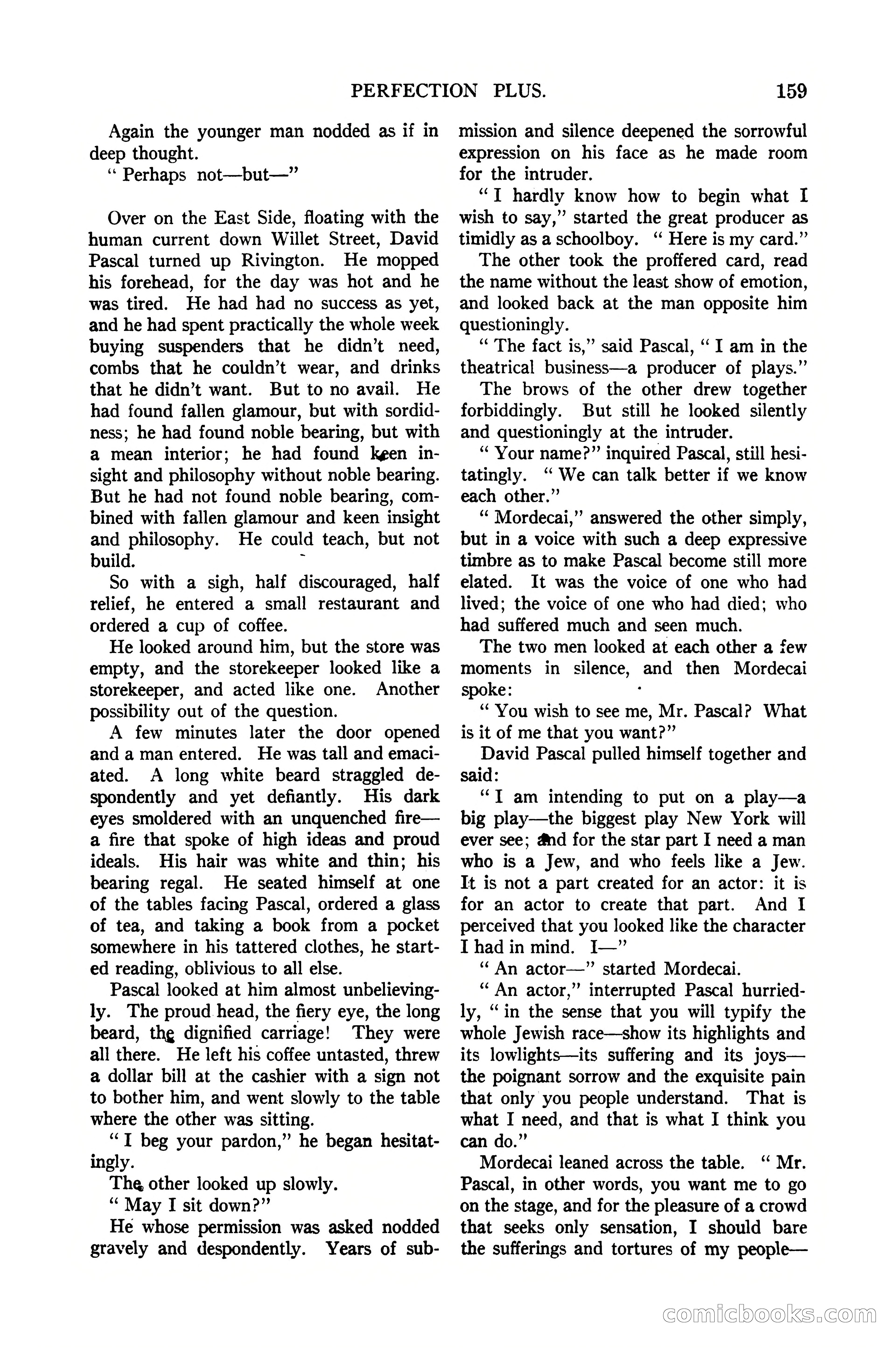
A restored page from Pulp Fiction, 1922. Page through the whole issue in the reader above.
📄 Transcribed text from this page (OCR, searchable)
Machine-transcribed from the original scan — historical spelling and the odd misread are preserved.
PERFECTION PLUS. Again the younger man nodded as if in deep thought. ‘Perhaps not—but—” Over on the East Side, floating with the human current down Willet Street, David Pascal turned up Rivington. He mopped his forehead, for the day was hot and he was tired. He had had no success as yet, and he had spent practically the whole week buying suspenders that he didn’t need, combs that he couldn’t wear, and drinks that he didn’t want. But to no avail. He had found fallen glamour, but with sordid- ness; he had found noble bearing, but with a mean interior; he had found keen in- sight and philosophy without noble bearing. But he had not found noble bearing, com- bined with fallen glamour and keen insight and philosophy. He could teach, but not build. So with a sigh, half discouraged, half relief, he entered a small restaurant and ordered a cup of coffee. He looked around him, but the store was empty, and the storekeeper looked like a storekeeper, and acted like one. Another possibility out of the question. A few minutes later the door opened and a man entered. He was tall and emaci- ated. A long white beard straggled de- spondently and yet defiantly. His dark eyes smoldered with an unquenched fire— a fire that spoke of high ideas and proud ideals. His hair was white and thin; his bearing regal. He seated himself at one of the tables facing Pascal, ordered a glass of tea, and taking a book from a pocket somewhere in his tattered clothes, he start- ed reading, oblivious to all else. Pascal looked at him almost unbelieving- ly. The proud head, the fiery eye, the long beard, the dignified carriage! They were all there. He left his coffee untasted, threw a dollar bill at the cashier with a sign not to bother him, and went slowly to the table where the other was sitting. ‘“‘T beg your pardon,” he began hesitat- ingly. The other looked up slowly. ‘* May I sit down?” He whose permission was asked nodded gravely and despondently. Years of sub- 159 mission and silence deepened the sorrowful expression on his face as he made room for the intruder. “IT hardly know how to begin what I wish to say,” started the great producer as timidly asa schoolboy. ‘ Here is my card.” The other took the proffered card, read the name without the least show of emotion, and looked back at the man opposite him questioningly. “The fact is,” said Pascal, ‘‘ I am in the theatrical business—a producer of plays.” The brows of the other drew together forbiddingly. But still he looked silently and questioningly at the intruder. “ Your name?” inquired Pascal, still hesi- tatingly. “ We can talk better if we know each other.”’ ‘* Mordecai,” answered the other simply, but in a voice with such a deep expressive timbre as to make Pascal become still more elated. It was the voice of one who had lived; the voice of one who had died; who had suffered much and seen much. The two men looked at each other a few moments in silence, and then Mordecai spoke: ; ‘You wish to see me, Mr. Pascal? What is it of me that you want?” David Pascal pulled himself together and said: ‘‘I am intending to put on a play—a big play—the biggest play New York will ever see; @nd for the star part I need a man who is a Jew, and who feels like a Jew. It is not a part created for an actor: it is for an actor to create that part. And I perceived that you looked like the character T had in mind. I—” ‘‘ An actor—” started Mordecai. *“‘ An actor,” interrupted Pascal hurried- ly, “in the sense that you will typify the whole Jewish race—show its highlights and its lowlights—its suffering and its joys— the poignant sorrow and the exquisite pain that only you people understand. That is what I need, and that is what I think you can do.”’ Mordecai leaned across the table. ‘ Mr. Pascal, in other words, you want me to go on the stage, and for the pleasure of a crowd that seeks only sensation, I should bare the sufferings and tortures of my people— COMmiclboo SS C©