
Pulp Fiction, 1922 · page 168 of 172
Argosy All-Story Weekly, January 21, 1922 — page 168: what you’re looking at
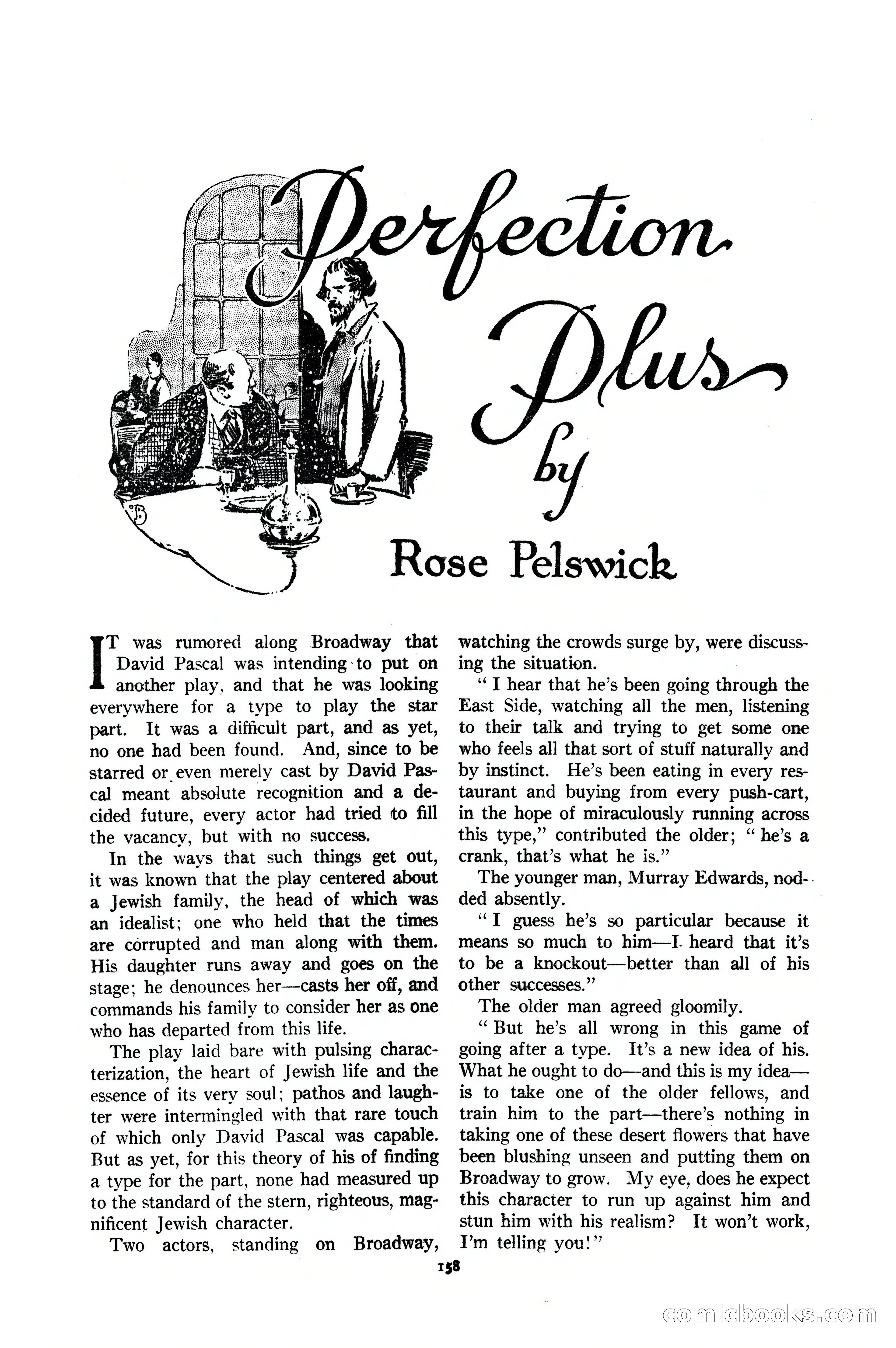
A restored page from Pulp Fiction, 1922. Page through the whole issue in the reader above.
📄 Transcribed text from this page (OCR, searchable)
Machine-transcribed from the original scan — historical spelling and the odd misread are preserved.
David Pascal was intending-to put on another play, and that he was looking everywhere for a type to play the star part. It was a difficult part, and as yet, no one had been found. And, since to be starred or even merely cast by David Pas- cal meant absolute recognition and a de- cided future, every actor had tried to fill the vacancy, but with no success. In the ways that such things get out, it was known that the play centered about a Jewish family, the head of which was an idealist; one who held that the times are corrupted and man along with them. His daughter runs away and goes on the stage; he denounces her—casts her off, and commands his family to consider her as one who has departed from this life. The play laid bare with pulsing charac- terization, the heart of Jewish life and the essence of its very soul; pathos and laugh- ter were intermingled with that rare touch of which only David Pascal was capable. But as yet, for this theory of his of finding a type for the part, none had measured up to the standard of the stern, righteous, mag- nificent Jewish character. Two actors, standing on Broadway, [ was rumored along Broadway that by Rose Pelswick watching the crowds surge by, were discuss- ing the situation. ‘“‘T hear that he’s been going through the East Side, watching all the men, listening to their talk and trying to get some one who feels all that sort of stuff naturally and by instinct. He’s been eating in every res- taurant and buying from every push-cart, in the hope of miraculously running across this type,” contributed the older; “ he’s a crank, that’s what he is.” The younger man, Murray Edwards, nod-.- ded absently. ‘““I guess he’s so particular because it means so much to him—I. heard that it’s to be a knockout—better than all of his other successes.”’ The older man agreed gloomily. “ But he’s all wrong in this game of going after a type. It’s a new idea of his. What he ought to do—and this is my idea— is to take one of the older fellows, and train him to the part—there’s nothing in taking one of these desert flowers that have been blushing unseen and putting them on Broadway to grow. My eye, does he expect this character to run up against him and stun him with his realism? It won’t work, I’m telling you!” 158 MICLOOOK C© inn