
Pulp Fiction, 1922 · page 140 of 172
Argosy All-Story Weekly, January 21, 1922 — page 140: what you’re looking at
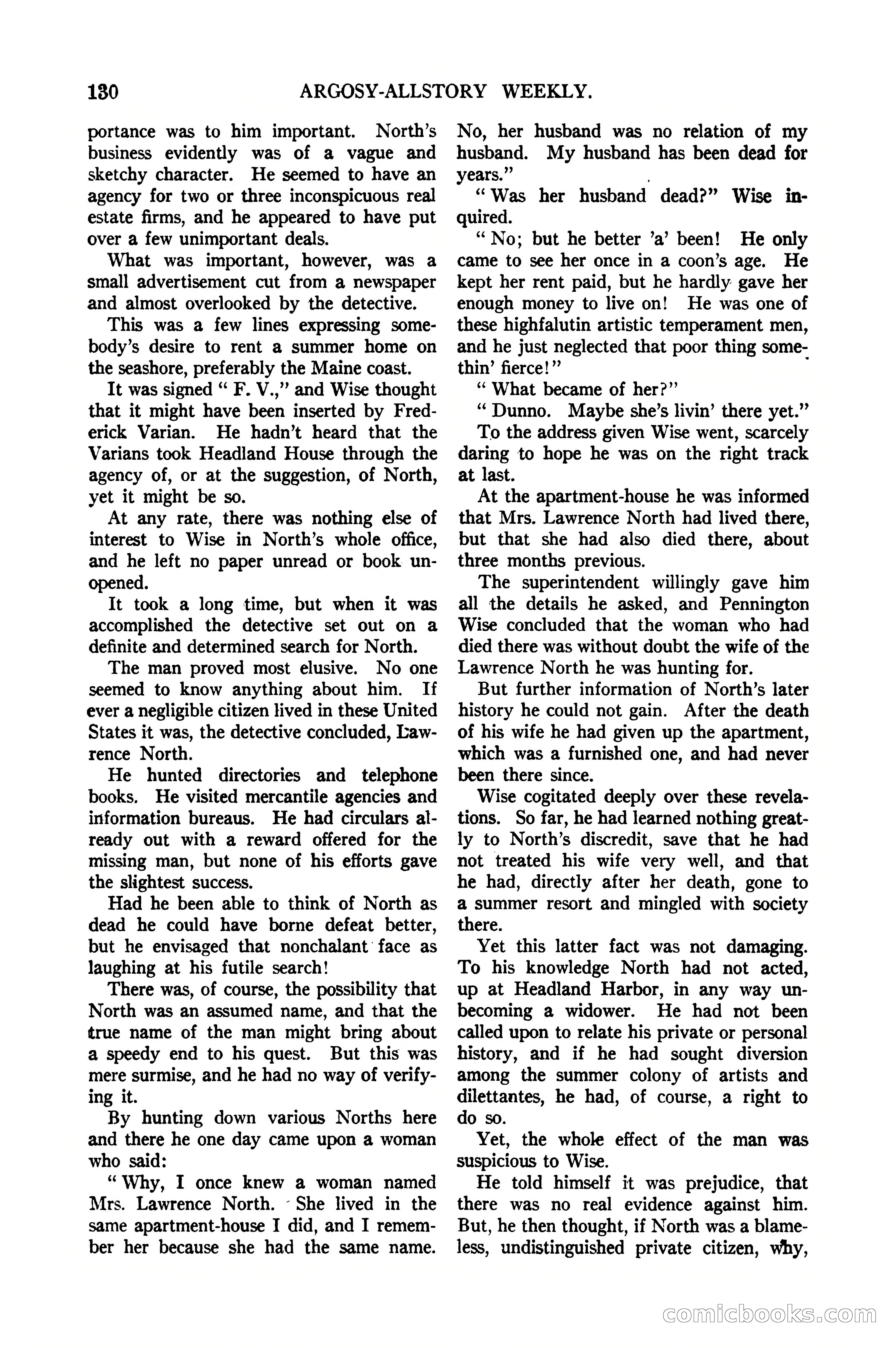
A restored page from Pulp Fiction, 1922. Page through the whole issue in the reader above.
📄 Transcribed text from this page (OCR, searchable)
Machine-transcribed from the original scan — historical spelling and the odd misread are preserved.
130 portance was to him important. North’s business evidently was of a vague and sketchy character. He seemed to have an agency for two or three inconspicuous real estate firms, and he appeared to have put over a few unimportant deals. What was important, however, was a small advertisement cut from a newspaper and almost overlooked by the detective. This was a few lines expressing some- body’s desire to rent a summer home on the seashore, preferably the Maine coast. It was signed “ F. V.,”’ and Wise thought that it might have been inserted by Fred- erick Varian. He hadn’t heard that the Varians took Headland House through the agency of, or at the suggestion, of North, yet it might be so. At any rate, there was nothing else of interest to Wise in North’s whole office, and he left no paper unread or book un- opened. It took a long time, but when it was accomplished the detective set out on a definite and determined search for North. The man proved most elusive. No one seemed to know anything about him. If ever a negligible citizen lived in these United States it was, the detective concluded, Law- rence North. He hunted directories and _ telephone books. He visited mercantile agencies and information bureaus. He had circulars al- ready out with a reward offered for the missing man, but none of his efforts gave the slightest success. Had he been able to think of North as dead he could have borne defeat better, but he envisaged that nonchalant face as laughing at his futile search! There was, of course, the possibility that North was an assumed name, and that the true name of the man might bring about a speedy end to his quest. But this was mere surmise, and he had no way of verify- ing it. By hunting down various Norths here and there he one day came upon a woman who said: “Why, I once knew a woman named Mrs. Lawrence North. ~ She lived in the same apartment-house I did, and I remem- ber her because she had the same name. ARGOSY-ALLSTORY WEEKLY. No, her husband was no relation of my husband. My husband has been dead for years.” “Was her husband dead?” Wise in- quired. ‘““No; but he better ’a’ been! He only came to see her once in a coon’s age. He kept her rent paid, but he hardly gave her enough money to live on! He was one of these highfalutin artistic temperament men, and he just neglected that poor thing some- thin’ fierce!” ‘“‘'What became of her?”’ ‘*Dunno. Maybe she’s livin’ there yet.” To the address given Wise went, scarcely daring to hope he was on the right track at last. At the apartment-house he was informed that Mrs. Lawrence North had lived there, but that she had also died there, about three months previous. The superintendent willingly gave him all the details he asked, and Pennington Wise concluded that the woman who had died there was without doubt the wife of the Lawrence North he was hunting for. But further information of North’s later history he could not gain. After the death of his wife he had given up the apartment, which was a furnished one, and had never been there since. Wise cogitated deeply over these revela- tions. So far, he had learned nothing great- ly to North’s discredit, save that he had not treated his wife very well, and that he had, directly after her death, gone to a summer resort and mingled with society there. Yet this latter fact was not damaging. To his knowledge North had not acted, up at Headland Harbor, in any way un- becoming a widower. He had not been called upon to relate his private or personal history, and if he had sought diversion among the summer colony of artists and dilettantes, he had, of course, a right to do so. Yet, the whole effect of the man was suspicious to Wise. He told himself it was prejudice, that there was no real evidence against him. But, he then thought, if North was a blame- less, undistinguished private citizen, why, comiclboooks C©