
Pulp Fiction, 1921 · page 117 of 157
Argosy All-Story Weekly, April 16, 1921 — page 117: what you’re looking at
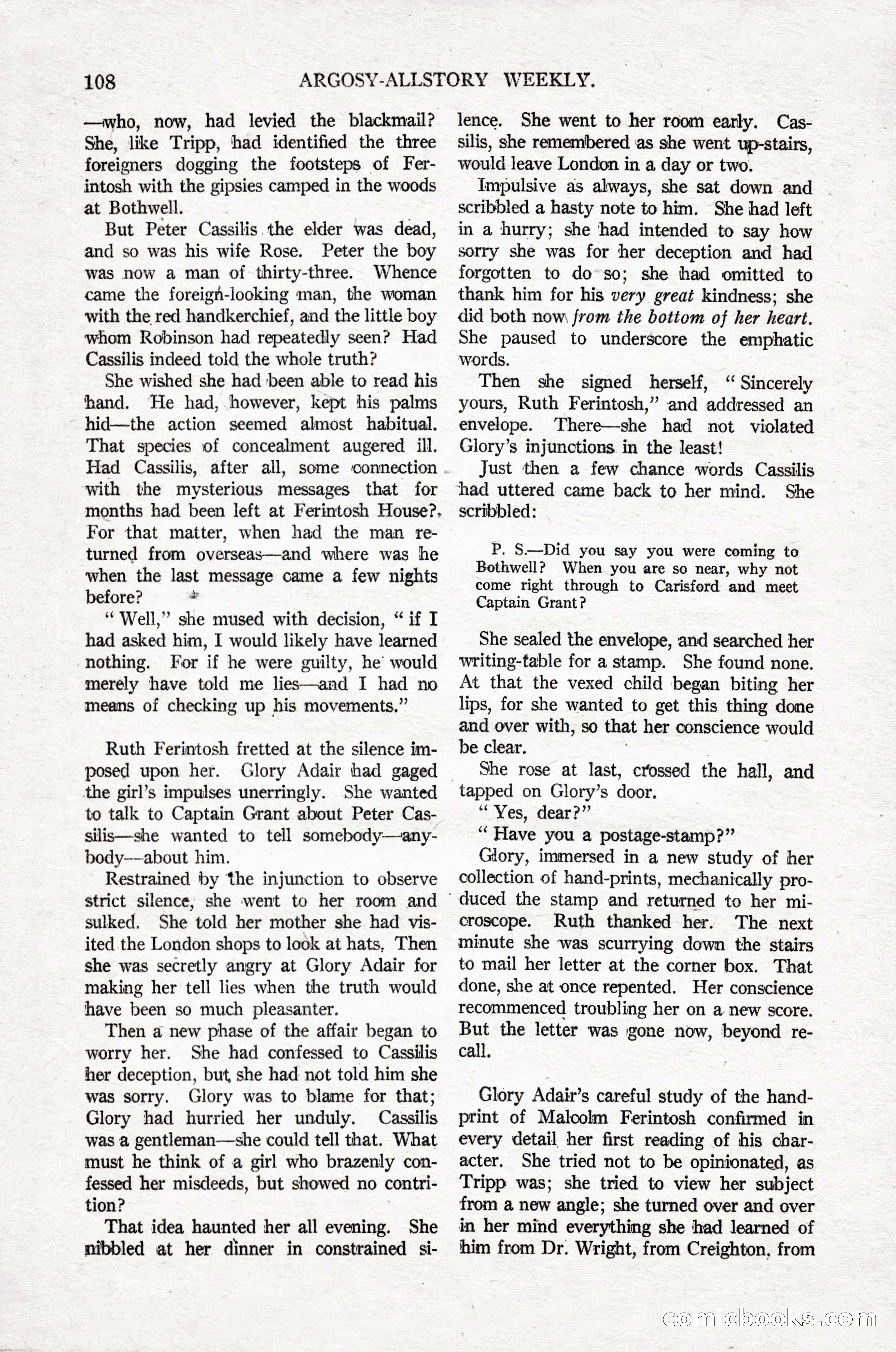
A restored page from Pulp Fiction, 1921. Page through the whole issue in the reader above.
📄 Transcribed text from this page (OCR, searchable)
Machine-transcribed from the original scan — historical spelling and the odd misread are preserved.
108 —who, now, had levied the blackmail? She, like Tripp, had identified the three foreigners dogging the footsteps of Fer- intosh with the gipsies camped in the woods at Bothwell. But Peter Cassilis the elder was dead, and so was his wife Rose. Peter the boy was now a man of thirty-three. Whence came the foreigh-looking man, the woman with the red handkerchief, and the little boy whom Robinson had repeatedly seen? Had Cassilis indeed told the whole truth? She wished she had ‘been able to read his hand. He had, however, kept his palms hid—the action seemed almost habitual. That species of concealment augered ill. Had Cassilis, after all, some ‘connection with the mysterious messages that for months had been left at Ferintosh House?. For that matter, when had the man re- turned from overseas—and where was he when the last message came a few nights before? + ‘“ Well,” she mused with decision, “ if I had asked him, I would likely have learned nothing. For if he were guilty, he would merely have told me lies—and I had no means of checking up his movements,” Ruth Ferintosh fretted at the silence im- posed upon her. Glory Adair had gaged the girl’s impulses unerringly. She wanted to talk to Captain Grant about Peter Cas- silis—she wanted to tell somebody—any- body——about him. Restrained by the injunction to observe strict silence, she went to her room and sulked. She told her mother she had vis- ited .the London shops to look at hats, Then she was secretly angry at Glory Adair for making her tell lies when the truth would have been so much pleasanter. Then a new phase of the affair began to worry her. She had confessed to Cassilis her deception, but, she had not told him she was sorry. Glory was to blame for that; Glory had hurried her unduly. Cassilis was a gentleman—she could tell that. What must he think of a girl who brazenly con- fessed her misdeeds, but showed no contri- tion? That idea haunted her all evening. She nibbled at her dinner in constrained si- ARGOSY-ALLSTORY WEEKLY. lence. She went to her room early. Cas- silis, she remembered as she went up-stairs, would leave London in a day or two. Impulsive as always, she sat down and scribbled a hasty note to him. She had left in a hurry; she had intended to say how sorry she was for her deception and had forgotten to do so; she had omitted to thank him for his very great kindness; she did both now from the bottom of her heart. She paused to underscore the emphatic words. Then she signed herself, ‘Sincerely yours, Ruth Ferintosh,” and addressed an envelope. There—she had not violated Glory’s injunctions in the least! Just then a few chance words Cassilis had uttered came back to her mind. She scribbled: P. S—Did you say you were coming to Bothwell? When you are so near, why not come right through to Carisford and meet Captain Grant? She sealed the envelope, and searched her writing-table for a stamp. She found none. At that the vexed child began biting her lips, for she wanted to get this thing done and over with, so that her conscience would be clear. 3 She rose at last, crossed the hall, and tapped on Glory’s door. “Yes, dear?” “Have you a postage-stamp?”’ Gdory, immersed in a new study of her collection of hand-prints, mechanically pro- ‘duced the stamp and returned to her mi- croscope. Ruth thanked her. The next minute she ‘was scurrying down the stairs to mail her letter at the corner box. That done, she at once repented. Her conscience recommenced troubling her on a. new score. But the letter was gone now, beyond re- call. Glory Adair’s careful study of the hand- print of Malcolm Ferintosh confirmed in every detail her first reading of his char- acter. She tried not to be opinionated, as Tripp was; she tried to view her subject from a new angle; she turned over and over in her mind everything she had learned of him from Dr. Wright, from Creighton, from GO JOO ANG S C@