
Pulp Fiction, 1921 · page 116 of 157
Argosy All-Story Weekly, April 16, 1921 — page 116: what you’re looking at
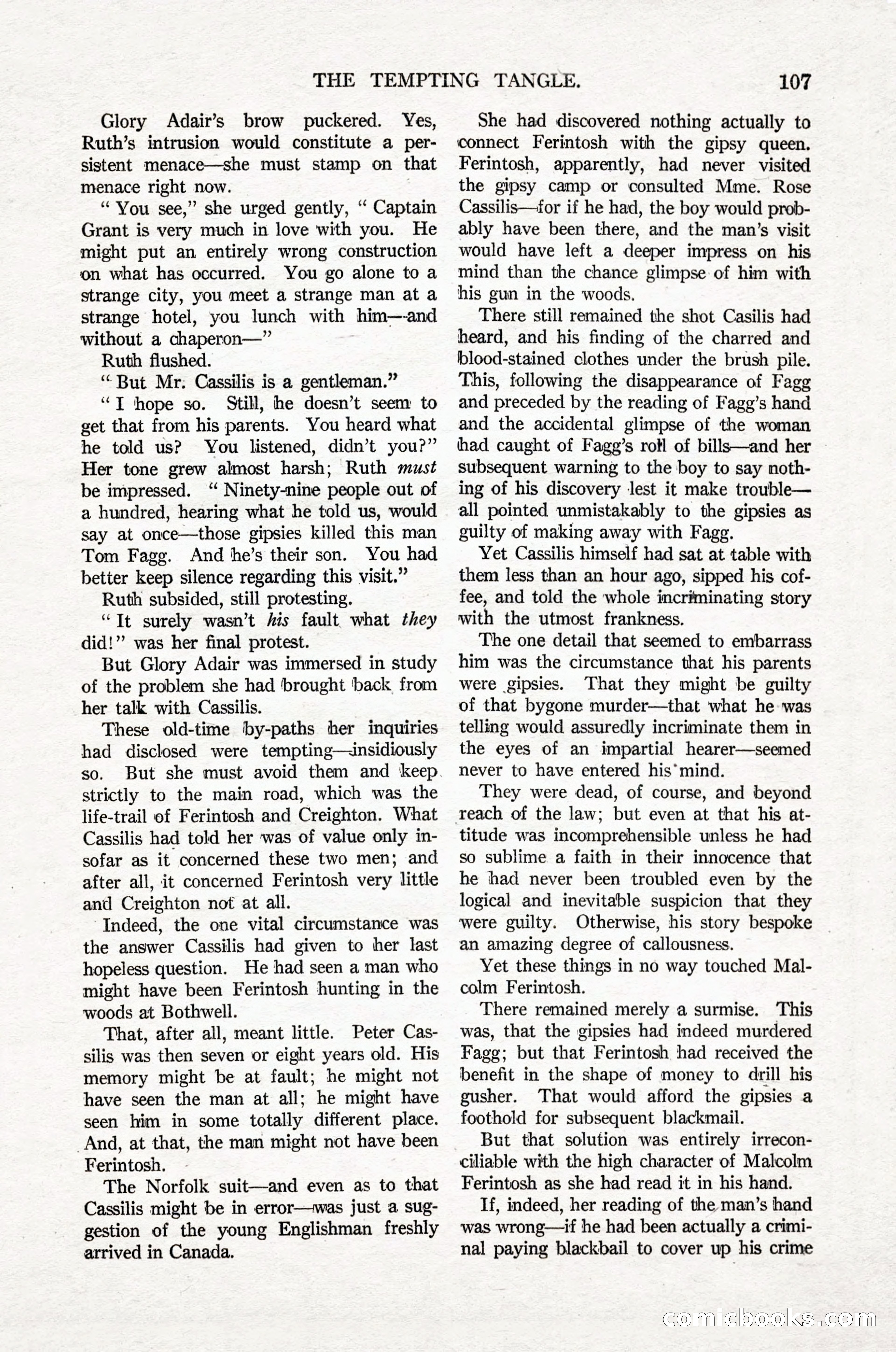
A restored page from Pulp Fiction, 1921. Page through the whole issue in the reader above.
📄 Transcribed text from this page (OCR, searchable)
Machine-transcribed from the original scan — historical spelling and the odd misread are preserved.
THE TEMPTING TANGLE. Glory Adair’s brow puckered. Yes, Ruth’s intrusion would constitute a per- sistent menace—she must stamp on that menace right now. “You see,” she urged gently, “ Captain Grant is very much in love with you. He might put an entirely wrong construction on what has occurred. You go alone to a strange city, you meet a strange man at a strange hotel, you lunch with him—-and without a chaperon—”’ Ruth flushed. ‘But Mr. Cassilis is a gentleman.” ‘“T hope so. Still, he doesn’t seem to get that from his parents. You heard what he told us? You listened, didn’t you?” Her tone grew almost harsh; Ruth must be impressed. “‘ Ninety-nine people out of a hundred, hearing what he told us, would say at once—those gipsies killed this man Tom Fagg. And he’s their son. You had better keep silence regarding this visit.” Ruth subsided, still protesting. “Tt surely wasn’t his fault what they did!” was her final protest. But Glory Adair was immersed in study of the problem she had brought ‘back from her talk with Cassilis. These old-time by-paths her inquiries had disclosed were tempting—insidiously so. But she must avoid them and keep strictly to the main road, which was the life-trail of Ferintosh and Creighton. What Cassilis had told her was of value only in- sofar as it concerned these two men; and after all, it concerned Ferintosh very little and Creighton not at all. ‘Indeed, the one vital circumstance was the answer Cassilis had given to her last hopeless question. He had seen a man who might have been Ferintosh hunting in the woods at Bothwell. That, after all, meant little. Peter Cas- silis was then seven or eight years old. His memory might be at fault; he might not have seen the man at all; he might have seen him in some totally different place. And, at that, the man might not have been Ferintosh. The Norfolk suit—and even as to that Cassilis might be in error—was just a sug- gestion of the young Englishman freshly arrived in Canada. 107 She had discovered nothing actually to connect Ferintosh with the gipsy queen. Ferintosh, apparently, had never visited the gipsy camp or consulted Mme. Rose Cassilis—for if he had, the boy would prob- ably have been there, and the man’s visit would have left a deeper impress on his mind than the chance glimpse of him with his gun in the woods. There still remained the shot Casilis had heard, and his finding of the charred and blood-stained clothes under the brush pile. This, following the disappearance of Fagg and preceded by the reading of Fagg’s hand and the accidental glimpse of the woman had caught of Fagg’s rotl of bills—and her subsequent warning to the boy to say noth- ing of his discovery lest it make trouble— all pointed unmistakably to the gipsies as guilty of making away with Fagg. Yet Cassilis himself had sat at table with them less than an hour ago, sipped his cof- fee, and told the whole incriminating story with the utmost frankness. The one detail that seemed to embarrass him was the circumstance that his parents were gipsies. That they might be guilty of that bygone murder—that what he was telling would assuredly incriminate them in the eyes of an impartial hearer—seemed never to have entered his’ mind. They were dead, of course, and beyond reach of the law; but even at that his at- titude was incomprehensible unless he had so sublime a faith in their innocence that he had never been troubled even by the logical and inevitable suspicion that they were guilty. Otherwise, his story bespoke an amazing degree of callousness. Yet these things in no way touched Mal- colm Ferintosh. There remained merely a surmise. This was, that the gipsies had indeed murdered Fagg; but that Ferintosh had received the benefit in the shape of money to drill his gusher. That would afford the gipsies a foothold for subsequent blackmail. But that solution was entirely irrecon- ciliable with the high character of Malcolm Ferintosh as she had read it in his hand. If, indeed, her reading of the man’s hand was wrong—if he had been actually a crimi- nal paying blackbail to cover up his crime COMMICLOO S (C@ S|