
Pulp Fiction, 1920 · page 89 of 164
Argosy All-Story Weekly, November 13, 1920 — page 89: what you’re looking at
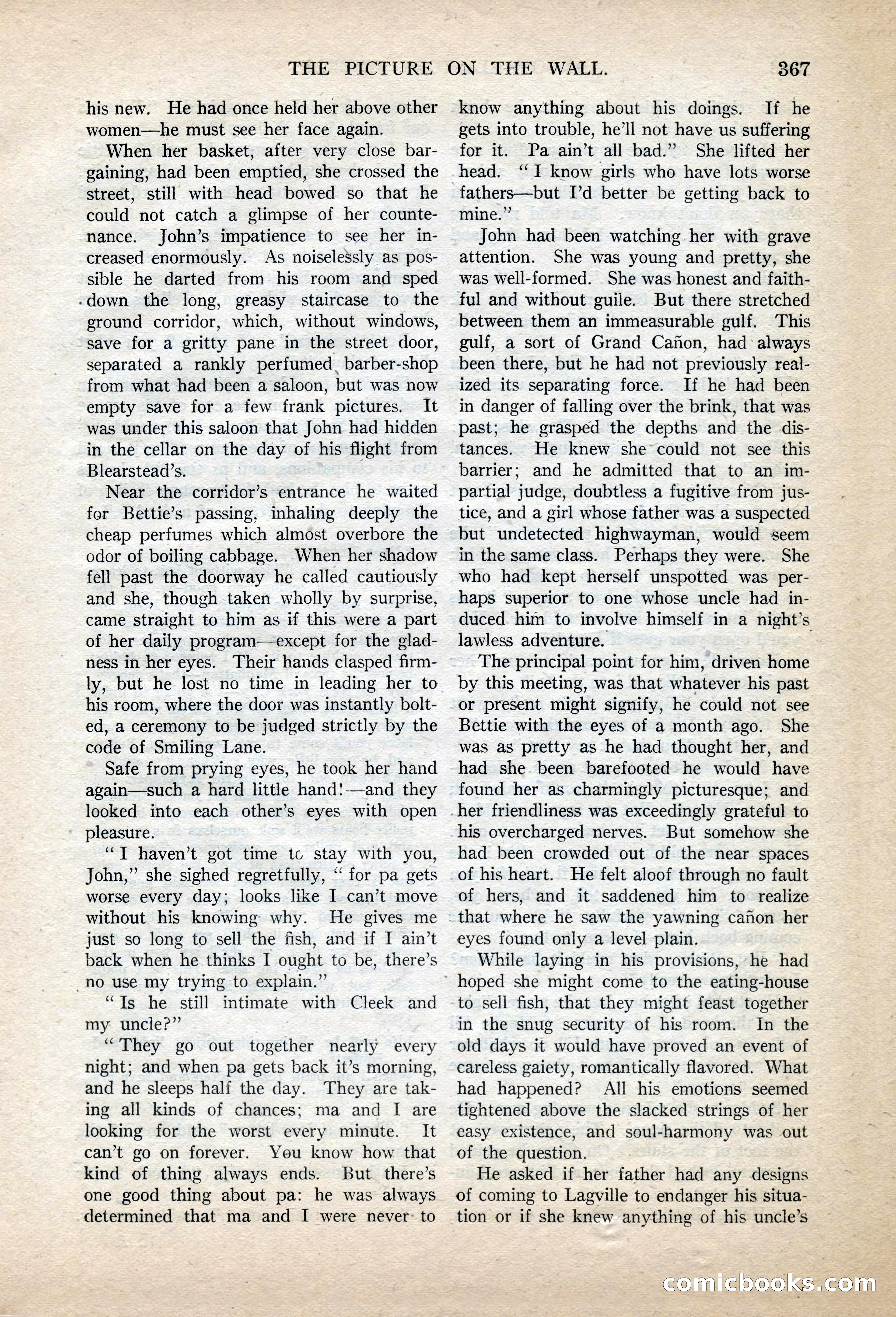
A restored page from Pulp Fiction, 1920. Page through the whole issue in the reader above.
📄 Transcribed text from this page (OCR, searchable)
Machine-transcribed from the original scan — historical spelling and the odd misread are preserved.
THE PICTURE ON THE WALL. his new. He had once held her above other women—he must see her face again. When her basket, after very close bar- gaining, had been emptied, she crossed the street, still with head bowed so that he could not catch a glimpse of her counte- nance. John’s impatience to see her in- creased enormously. As noiselessly as pos- sible he darted from his room and sped -down the long, greasy staircase to the ground corridor, which, without windows, save for a gritty pane in the street door, separated a rankly perfumed_barber-shop from what had been a saloon, but was now empty save for a few frank pictures. It was under this saloon that John had hidden in the cellar on the day of his flight from Blearstead’s. Near the corridor’s entrance he waited for Bettie’s passing, inhaling deeply the cheap perfumes which almost overbore the odor of boiling cabbage. When her shadow fell past the doorway he called cautiously and she, though taken wholly by surprise, came straight to him as if this were a part of her daily program—except for the glad- ness in her eyes. Their hands clasped firm- ly, but he lost no time in leading her to his room, where the door was instantly bolt- ed, a ceremony to be judged strictly by the code of Smiling Lane. Safe from prying eyes, he took her hand again—such a hard little hand!—and they looked into each other’s eyes with open pleasure. “T haven’t got time tc stay with you, John,” she sighed regretfully, ‘‘ for pa gets worse every day; looks like I can’t move without his knowing why. He gives me just so long to sell the fish, and if I ain’t back when he thinks I ought to be, there’s no use my trying to explain.” “Ts he still intimate with Cleek and my uncle?” “They go out together nearly every night; and when pa gets back it’s morning, and he sleeps half the day. They are tak- ing all kinds of chances; ma and I are looking for the worst every minute. It can’t go on forever. You know how that kind of thing always ends. But there’s one good thing about pa: he was always determined that ma and I were never: to 367 know anything about his doings. If he gets into trouble, he’ll not have us suffering for it. Pa ain’t all bad.” She lifted her head. ‘I know girls who have lots worse -fathers—but I’d better be getting back to mine.”’ John had been watching her with grave attention. She was young and pretty, she was well-formed. She was honest and faith- ful and without guile. But there stretched between them an immeasurable gulf. This gulf, a sort of Grand Cafon, had always been there, but he had not previously real- ized its separating force. If he had been in danger of falling over the brink, that was past; he grasped the depths and the dis- tances. He knew she could not see this barrier; and he admitted that to an im- partial judge, doubtless a fugitive from jus- tice, and a girl whose father was a suspected but undetected highwayman, would seem in the same class. Perhaps they were. She who had kept herself unspotted was per- haps superior to one whose uncle had in- duced him to involve himself in a night’s lawless adventure. The principal point for him, driven home by this meeting, was that whatever his past or present might signify, he could not see Bettie with the eyes of a month ago. She was as pretty as he had thought her, and had she been barefooted he would have found her as charmingly picturesque; and her friendliness was exceedingly grateful to his overcharged nerves. But somehow she had been crowded out of the near spaces of his heart. He felt aloof through no fault of hers, and it saddened him to realize _that where he saw the yawning canon her eyes found only a level plain. While laying in his provisions, he had ’ hoped she might come to the eating-house to sell fish, that they might feast together in the snug security of his room. In the old days it would have proved an event of careless gaiety, romantically flavored. What had happened? All his emotions seemed tightened above the slacked strings of her easy existence, and soul-harmony was out of the question. He asked if her father had any designs of coming to Lagville to endanger his situa- tion or if she knew anything of his uncle’s Eomicbooks (eo)