
Pulp Fiction, 1920 · page 88 of 164
Argosy All-Story Weekly, November 13, 1920 — page 88: what you’re looking at
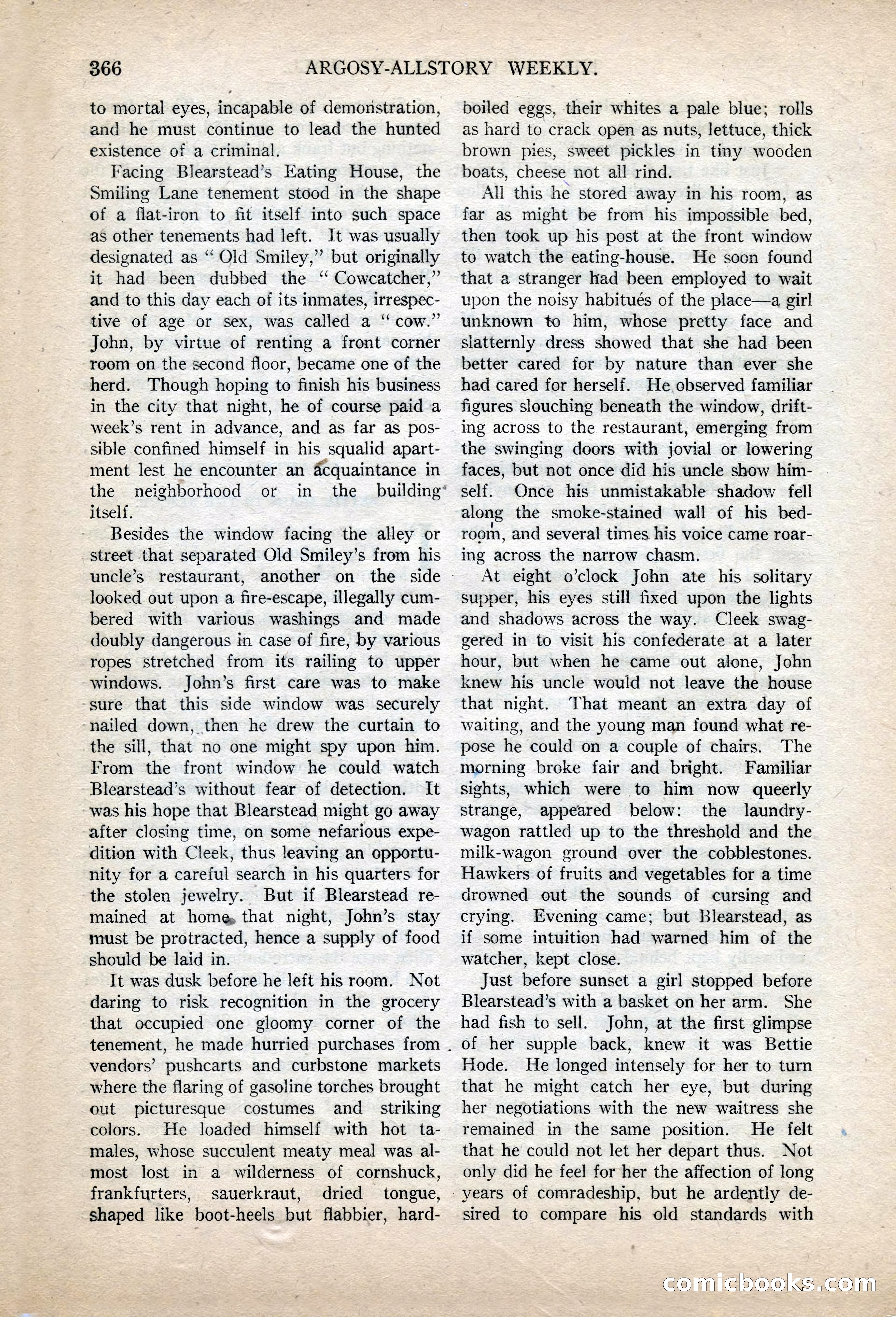
A restored page from Pulp Fiction, 1920. Page through the whole issue in the reader above.
📄 Transcribed text from this page (OCR, searchable)
Machine-transcribed from the original scan — historical spelling and the odd misread are preserved.
366 to mortal eyes, incapable of demonstration, and he must continue to lead the hunted existence of a criminal. Facing Blearstead’s Eating House, the Smiling Lane tenement stood in the shape of a flat-iron to fit itself into such space as other tenements had left. It was usually designated as “ Old Smiley,” but originally it had been dubbed the ‘‘ Cowcatcher,” and to this day each of its inmates, irrespec- tive of age or sex, was called a “ cow.” John, by virtue of renting a front corner room on the second floor, became one of the herd. Though hoping to finish his business in the city that night, he of course paid a week’s rent in advance, and as far as pos- sible confined himself in his squalid apart- ment lest he encounter an Acquaintance in the neighborhood or in_ the itself. Besides the window facing the alley or street that separated Old Smiley’s from his uncle’s restaurant, another on the side - looked out upon a fire-escape, illegally cum- bered with various washings and made doubly dangerous in case of fire, by various ropes stretched from its railing to upper windows. John’s first care was to make ‘sure that this side window was securely -nailed down, then he drew the curtain to the sill, that no one might spy upon him. From the front window he could watch Blearstead’s without fear of detection. It was his hope that Blearstead might go away after closing time, on some nefarious expe- dition with Cleek, thus leaving an opportu- nity for a careful search in his quarters for the stolen jewelry. But if Blearstead re- mained at home that night, John’s stay must be protracted, hence a supply of food should be laid in. It was dusk before he left his room. Not daring to risk recognition in the grocery that occupied one gloomy corner of the tenement, he made hurried purchases from . vendors’ pushcarts and curbstone markets where the flaring of gasoline torches brought out picturesque costumes and_ striking colors. He loaded himself with hot ta- males, whose succulent meaty meal was al- most lost in a wilderness of cornshuck, frankfurters, sauerkraut, dried tongue, shaped like boot-heels but flabbier, hard- building’ ARGOSY-ALLSTORY WEEKLY. boiled eggs, their whites a pale blue; rolls as hard to crack open as nuts, lettuce, thick brown pies, sweet pickles in tiny wooden boats, cheese not all rind. All this he stored away in his room, as far as might be from his impossible bed, then took up his post at the front window to watch the eating-house. He soon found that a stranger had been employed to wait upon the noisy habitués of the place—a girl unknown to him, whose pretty face and slatternly dress showed that she had been better cared for by nature than ever she had cared for herself. He observed familiar figures slouching beneath the window, drift- ing across to the restaurant, emerging from the swinging doors with jovial or lowering faces, but not once did his uncle show him- self. Once his unmistakable shadow fell along the smoke-stained wall of his bed- room, and several times his voice came roar- ing across the narrow chasm. At eight o’clock John ate his solitary supper, his eyes still fixed upon the lights and shadows across the way. Cleek swag- gered in to visit his confederate at a later hour, but when he came out alone, John knew his uncle would not leave the house that night. That meant an extra day of waiting, and the young man found what re- pose he could on a couple of chairs. The morning broke fair and bright. Familiar sights, which were to him now queerly strange, appeared below: the laundry- wagon rattled up to the threshold and the milk-wagon ground over the cobblestones. Hawkers of fruits and vegetables for a time drowned out the sounds of cursing and crying. Evening came; but Blearstead, as if some intuition had warned him of the watcher, kept close. | Just before sunset a girl stopped before Blearstead’s with a basket on her arm. She had fish to sell. John, at the first glimpse of her supple back, knew it was Bettie Hode. He longed intensely for her to turn that he might catch her eye, but during her negotiations with the new waitress she remained in the same position. He felt that he could not let her depart thus. Not only did he feel for her the affection of long - years of comradeship, but he ardently de- sired to compare his old standards with Gomichoo () “S) (F@)