
Pulp Fiction, 1920 · page 24 of 164
Argosy All-Story Weekly, November 13, 1920 — page 24: what you’re looking at
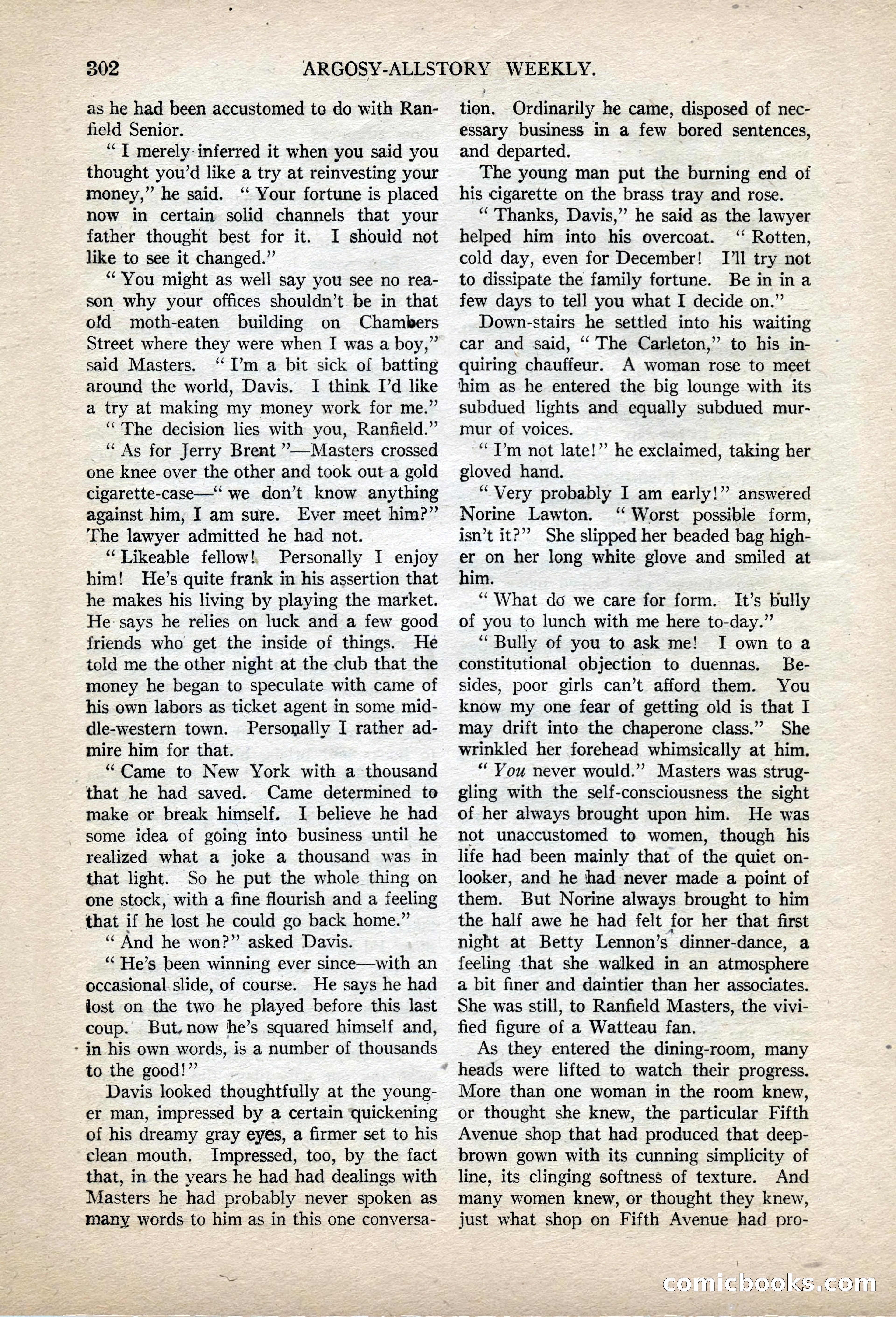
A restored page from Pulp Fiction, 1920. Page through the whole issue in the reader above.
📄 Transcribed text from this page (OCR, searchable)
Machine-transcribed from the original scan — historical spelling and the odd misread are preserved.
302 as he had been accustomed to do with Ran- field Senior. ‘J merely-inferred it when you said you thought you’d like a try at reinvesting your money,” he said. ‘‘ Your fortune is placed now in certain solid channels that your father thought best for it. I should not like to see it changed.” “You might as well say you see no rea- son why your offices shouldn’t be in that ofd moth-eaten building on Chambers Street where they were when I was a boy,” said Masters. “I’m a bit sick of batting around the world, Davis. 1 think Id like a try at making my money work for me.” ‘The decision lies with you, Ranfield.” “As for Jerry Brent ”—Masters crossed one knee over the other and took out a gold cigarette-case—“‘ we don’t know anything against him, I am sure. Ever meet him?” The lawyer admitted he had not. “‘ Likeable fellow! Personally I enjoy him! He’s quite frank in his assertion that he makes his living by playing the market. He: says he relies on luck and a few good friends who get the inside of things. He told me the other night at the club that the money he began to speculate with came of his own labors as ticket agent in some mid- dle-western town. Personally I rather ad- mire him for that. “Came to New York with a thousand that he had saved. Came determined to make or break himself. I believe he had - some idea of going into business until he realized what a joke a thousand was in that light. So he put the whole thing on one stock, with a fine flourish and a feeling _ that if he lost he could go back home.” ‘And he won?” asked Davis. ‘“‘ He’s been winning ever since—with an occasional slide, of course. He says he had lost on the two he played before this last coup. But,now he’s squared himself and, - in his own words, is a number of thousands to the good!” Davis looked thoughtfully at the young- er man, impressed by a certain quickening of his dreamy gray eyes, a firmer set to his clean mouth. Impressed, too, by the fact that, in the years he had had dealings with Masters he had probably never spoken as many words to him as in this one conversa- ARGOSY-ALLSTORY WEEKLY. tion. Ordinarily he came, disposed of nec- essary business in a few bored sentences, and departed. The young man put the burning end of his cigarette on the brass tray and rose. “Thanks, Davis,” he said as the lawyer helped him into his overcoat. ‘“‘ Rotten, cold day, even for December! I'll try not to dissipate the family fortune. Be in ina few days to tell you what I decide on.” Down-stairs he settled into his waiting car and said, “ The Carleton,” to his in- quiring chauffeur. A woman rose to meet him as he entered the big lounge with its subdued lights and equally subdued mur- mur of voices. ‘T’m not late!” he exclaimed, taking her gloved hand. “Very probably I am early!” answered Norine Lawton. ‘“ Worst possible form, isn’t it?”’ She slipped her beaded bag high- er on her long white glove and smiled at him. ; ‘What do we care for form. It’s bully of you to lunch with me here to-day.” “Bully of you to ask me! I own to a constitutional objection to duennas. Be- sides, poor girls can’t afford them. You know my one fear of getting old is that I may drift into the chaperone class.’’ She wrinkled her forehead whimsically at him. “ You never would.” Masters was strug- gling with the self-consciousness the sight of her always brought upon him. He was not unaccustomed to women, though his life had been mainly that of the quiet on- looker, and he had never made a point of them. But Norine always brought to him the half awe he had felt for her that first night at Betty Lennon’s dinner-dance, a feeling that she walked in an atmosphere a bit finer and daintier than her associates. She was still, to Ranfield Masters, the vivi- fied figure of a Watteau fan. As they entered the dining-room, many heads were lifted to watch their progress. More than one woman in the room knew, or thought she knew, the particular Fifth Avenue shop that had produced that deep- brown gown with its cunning simplicity of line, its clinging softness of texture. And many women knew, or thought they knew, just what shop on Fifth Avenue had pro- Eomicbooks