
Pulp Fiction, 1920 · page 23 of 164
Argosy All-Story Weekly, November 13, 1920 — page 23: what you’re looking at
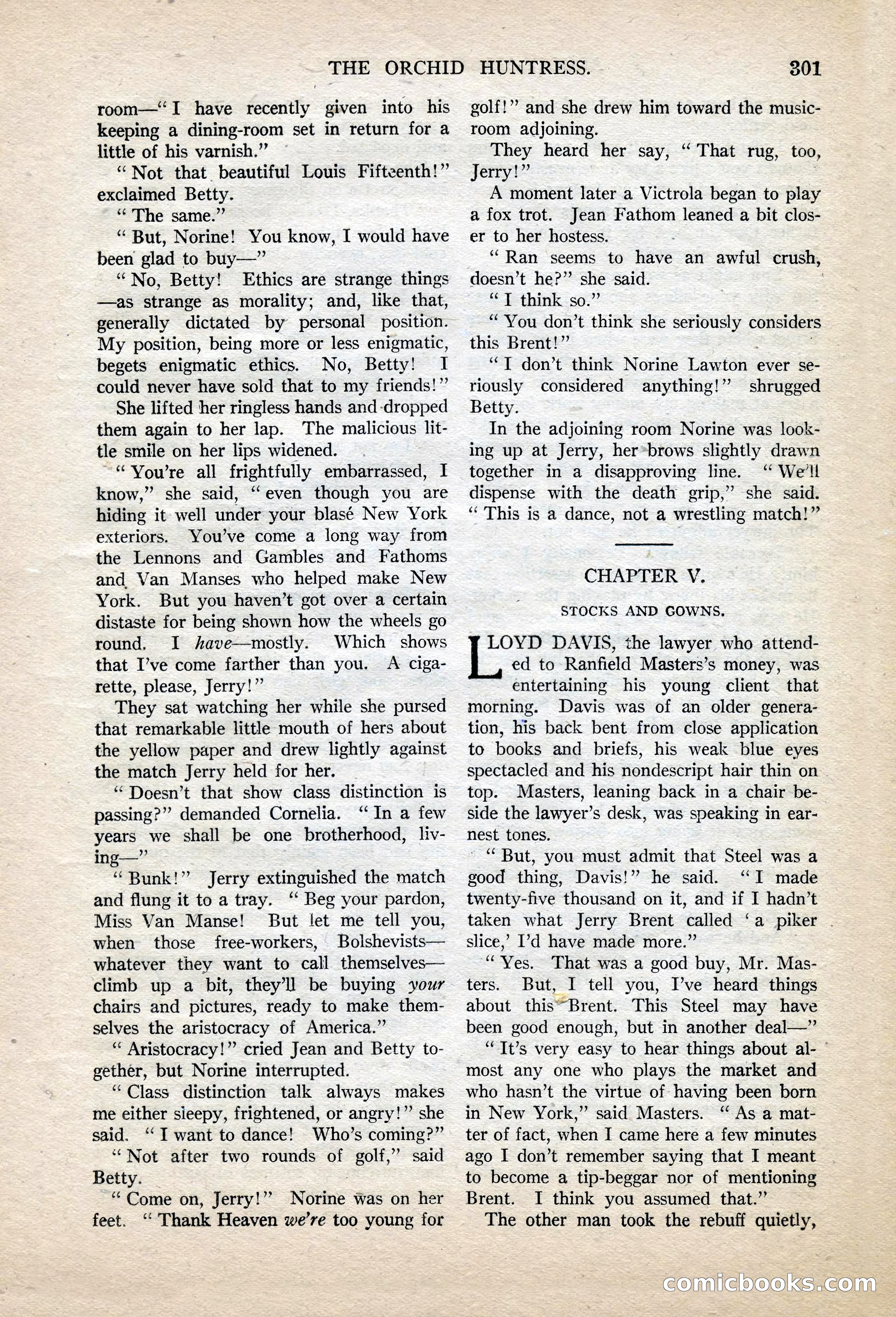
A restored page from Pulp Fiction, 1920. Page through the whole issue in the reader above.
📄 Transcribed text from this page (OCR, searchable)
Machine-transcribed from the original scan — historical spelling and the odd misread are preserved.
THE ORCHID HUNTRESS. room—I have recently given into his keeping a dining-room set in return for a little of his varnish.” “Not that beautiful Louis Fifteenth!”’ exclaimed Betty. “The same.” “ But, Norine! You know, I would have been glad to buy—”’ ‘No, Betty! Ethics are strange things —as strange as morality; and, like that, generally dictated by personal position. My position, being more or less enigmatic, begets enigmatic ethics. No, Betty! I could never have sold that to my friends!” She lifted her ringless hands and dropped them again to her lap. The malicious lit- tle smile on her lips widened. ~“ Vowre all frightfully embarrassed, I know,” she said, ‘even though you are hiding it well under your blasé New York exteriors. You’ve come a long way from the Lennons and Gambles and Fathoms and Van Manses who helped make New York. But you haven’t got over a certain distaste for being shown how the wheels go round, I fave—mostly. Which shows that I’ve come farther than you. A ciga- rette, please, Jerry!”’ They sat watching her while she pursed that remarkable little mouth of hers about the yellow paper and drew lightly against the match Jerry held for her. “ Doesn’t that show class distinction is passing?”” demanded Cornelia. “In a few years we shall be one brotherhood, liv- ing—” “Bunk!” Jerry extinguished the match and flung it to a tray. ‘ Beg your pardon, Miss Van Manse! But let me tell you, when those free-workers, Bolshevists— whatever they want to call themselves— climb up a bit, they'll be buying your chairs and pictures, ready to make them- selves the aristocracy of America.” * Aristocracy!”’ cried Jean and Betty to- gether, but Norine interrupted. “Class distinction talk always makes me either sieepy, frightened, or angry!” she said. ‘‘I want to dance! Who’s coming?” “Not after two ae of golf,” said Betty. ‘““ Come on, Jerry!”’ Notine was on her feet. “ Thank Heaven we’re too young for 301 golf!” and she drew him toward the music- room adjoining. They heard her say, “ That rug, too, Jerry!” A moment later a Victrola began to play a fox trot. Jean Fathom leaned a bit clos- er to her hostess. “Ran seems to have an awful crush, doesn’t he?” she said. “T think so.” “You don’t think she seriously considers this Brent!” “T don’t think Norine Lawions ever se- rlously considered anything!” shrugged Betty. | In the adjoining room Norine was look- ing up at Jerry, her*brows slightly drawn together in a disapproving line. ‘“ We'll dispense with the death grip,” she said. “This is a dance, not a wrestling match!” CHAPTER V. STOCKS AND GOWNS, LOYD DAVIS, the lawyer who attend- ed to Ranfield Masters’s money, was entertaining his young client that morning. Davis was of an older genera- tion, his back bent from close application to books and briefs, his weak blue eyes spectacled and his nondescript hair thin on top. Masters, leaning back in a chair be- side the lawyer’s desk, was speaking in ear- nest tones. ~ “ But, you must admit that Steel was a good thing, Davis!” he said. “I made twenty-five thousand on it, and if I hadn’t taken what Jerry Brent called ‘a piker . slice,’ I’d have made more.” “Yes. That was a good buy, Mr. Mas- ters. But, I tell you, I’ve heard things about this*Brent. This Steel may have been good enough, but in another deal—” ‘It’s very easy to hear things about al- ~ most any one who plays the market and who hasn’t the virtue of having been born in New York,” said Masters. “As a mat- ter of fact, when I came here a few minutes ago I don’t remember saying that I meant to become a tip-beggar nor of mentioning Brent. I think you assumed that.” The other man took the rebuff quietly, Gomicbooks (E(o) i)