
Pulp Fiction, 1920 · page 27 of 156
Argosy, Vol. 123, No. 1 — page 27: what you’re looking at
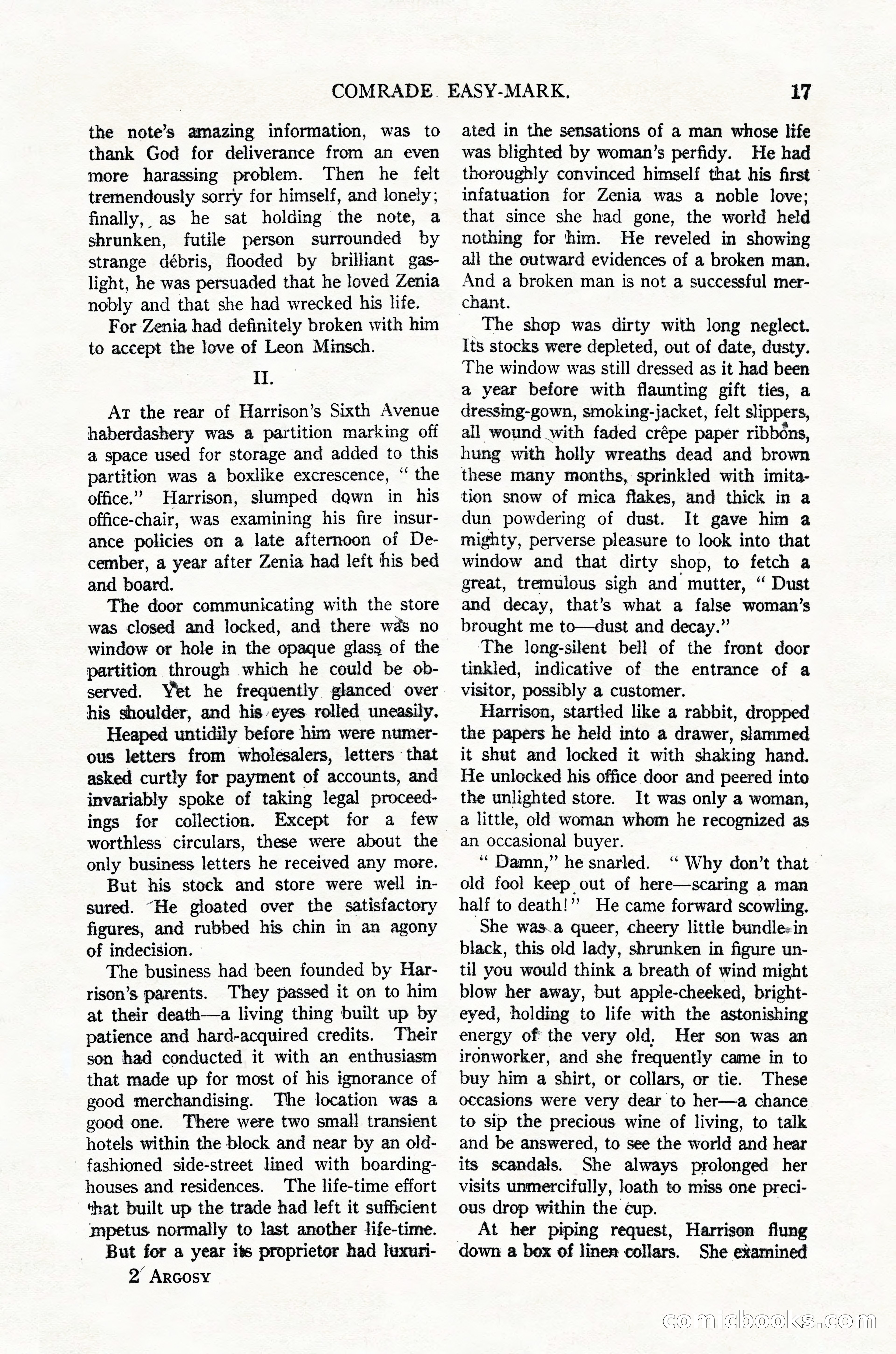
A restored page from Pulp Fiction, 1920. Page through the whole issue in the reader above.
📄 Transcribed text from this page (OCR, searchable)
Machine-transcribed from the original scan — historical spelling and the odd misread are preserved.
COMRADE. EASY-MARK. the note’s amazing information, was to thank God for deliverance from an even more harassing problem. Then he felt tremendously sorry for himself, and lonely; finally, as he sat holding the note, a shrunken, futile person surrounded by strange débris, flooded by brilliant gas- light, he was persuaded that he loved Zenia nobly and that she had wrecked his life. For Zenia had definitely broken with him to accept the love of Leon Minsch. II. At the rear of Harrison’s Sixth Avenue haberdashery was a partition marking off a space used for storage and added to this partition was a boxlike excrescence, ‘ the office.’ Harrison, slumped dqwn in his office-chair, was examining his fire insur- ance policies on a late afternoon of De- cember, a year after Zenia had left his bed and board. The door communicating with the store was closed and locked, and there wads no window or hole in the opaque glass of the partition through which he could be ob- served. Yet he frequently glanced over. his shoulder, and his eyes rolled uneasily. Heaped untidily before him were numer- ous letters from wholesalers, letters that asked curtly for payment of accounts, and invariably spoke of taking legal proceed- ings for collection. worthless circulars, these were about the only business letters he received any more. But his stock and store were well in- sured. “He gloated over the satisfactory figures, and rubbed his chin in an agony of indecision. - The business had been founded by Har- rison’s parents. They passed it on to him at their death—a living thing built up by patience and hard-acquired credits. Their son had conducted it with an enthusiasm that made up for most of his ignorance of good merchandising. The location was a good one. There were two small transient hotels within the block and near by an old- fashioned side-street lined with boarding- houses and residences. The life-time effort that built up the trade had left it sufficient ‘Mmpetus normally to last another life-time. But for a year its proprietor had luxur- 2° ARGOSY Except for a few 17 ated in the sensations of a man whose life was blighted by woman’s perfidy. He had thoroughly convinced himself that his first infatuation for Zenia was a noble love; that since she had gone, the world held nothing for him. He reveled in showing all the outward evidences of a broken man. And a broken man is not a successful mer- | chant. The shop was dirty with long neglect. Its stocks were depleted, out of date, dusty. The window was still dressed as it had been a year before with flaunting gift ties, a dressmg-gown, smoking-jacket, felt slippers, all wound with faded crépe paper ribbdns, hung with holly wreaths dead and brown these many months, sprinkled with imita- tion snow of mica flakes, and thick in a dun powdering of dust. It gave him a mighty, perverse pleasure to look into that window and that dirty shop, to fetch a great, tremulous sigh and mutter, “ Dust and decay, that’s what a false woman’s brought me to—dust and decay.” ‘The long-silent bell of the front door tinkled, indicative of the entrance of a visitor, possibly a customer. Harrison, startled like a rabbit, dropped. the papers he held into a drawer, slammed it shut and locked it with shaking hand. He unlocked his office door and peered into the unlighted store. It was only a woman, a little, old woman whom he recognized as an occasional buyer. ‘“ Damn,” he snarled. old fool keep out of here—scaring a man half to death!”” He came forward scowling. She was.a queer, cheery little bundle-in black, this old lady, shrunken in figure un- til you would think a breath of wind might blow her away, but apple-cheeked, bright- eyed, holding to life with the astonishing energy of the very old, Her son was an ironworker, and she frequently came in to buy him a shirt, or collars, or tie. These occasions were very dear to her—a chance to sip the precious wine of living, to talk and be answered, to see the world and hear its scandals. She always prolonged her visits unmercifully, loath to miss one preci- ous drop within the cup. | At her piping request, Harrison flung down a box of linen collars. She examined cCoOmicloooks “ Why don’t that C©