
Pulp Fiction, 1920 · page 26 of 156
Argosy, Vol. 123, No. 1 — page 26: what you’re looking at
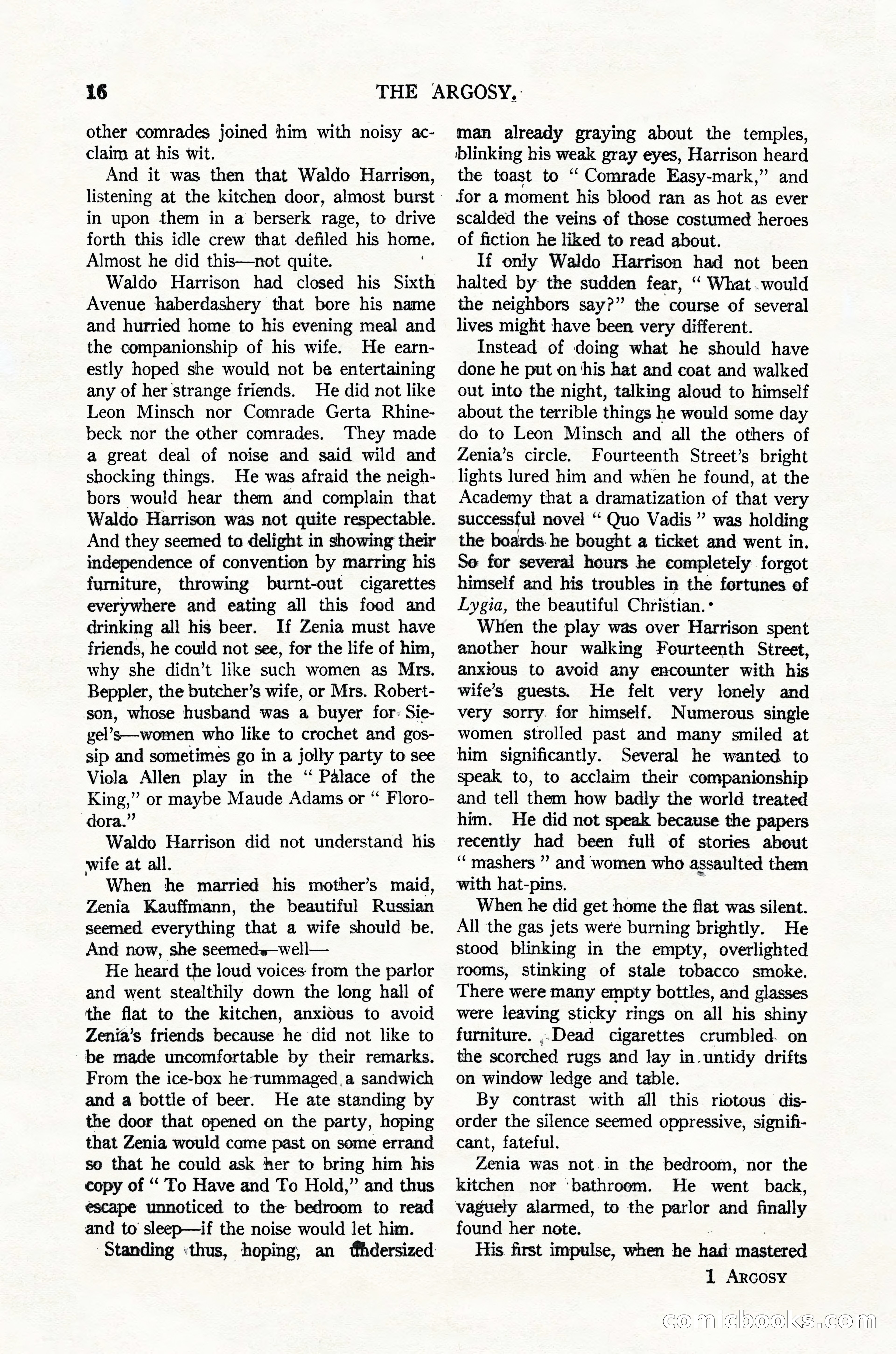
A restored page from Pulp Fiction, 1920. Page through the whole issue in the reader above.
📄 Transcribed text from this page (OCR, searchable)
Machine-transcribed from the original scan — historical spelling and the odd misread are preserved.
16 other comrades joined him with noisy ac- claim at his wit. And it was then that Waldo Harrison, listening at the kitchen door, almost burst in upon them in a berserk rage, to drive forth this idle crew that defiled his Hien Almost he did this—not quite. Waldo Harrison had closed his Sixth Avenue haberdashery that bore his name and hurried home to his evening meal and the companionship of his wife. He earn- estly hoped she would not be entertaining any of her strange friends. He did not like Leon Minsch nor Comrade Gerta Rhine- beck nor the other comrades. They made a great deal of noise and said wild and shocking things. He was afraid the neigh- bors would hear them and complain that Waldo Harrison was not quite respectable. And they seemed to delight in showing their independence of convention by marring his furniture, throwing burnt-out cigarettes everywhere and eating all this food and drinking all his beer. If Zenia must have friends, he could not see, for the life of him, why she didn’t like such women as Mrs. Beppler, the butcher’s wife, or Mrs. Robert- son, whose husband was a buyer for: Sie- gel’s—women who like to crochet and gos- sip and sometimes go in a jolly party to see Viola Allen play in the “ Palace of the King,” or maybe Maude Adams or “ Floro- dora.” Waldo Harrison did not understand his » wife at all. When he married his mother’s maid, Zenia Kauffmann, the beautiful Russian seemed everything that a wife should be. And now, she seemeds—well— He heard the loud voices from the parlor and went stealthily down the long hall of the flat to the kitchen, anxious to avoid Zenia’s friends because he did not like to be made uncomfortable by their remarks. From the ice-box he tummaged a sandwich and a bottle of beer. He ate standing by the door that opened on the party, hoping that Zenia would come past on some errand so that he could ask her to bring him his copy of ‘‘ To Have and To Hold,” and thus escape unnoticed to the bedroom to read and to sleep—if the noise would let him. Standing ‘thus, hoping, an fhdersized THE ARGOSY.: man already graying about the temples, ‘blinking his weak gray eyes, Harrison heard the toast to ‘“‘ Comrade Easy-mark,” and for a moment his blood ran as hot as ever scalded the veins of these costumed heroes of fiction he liked to read about. If only Waldo Harrison had not been halted by the sudden fear, “ What. would the neighbors say?” the course of several lives might have been very different. Instead of doing what he should have done he put on ‘his hat and coat and walked out into the night, talking aloud to himself about the terrible things he would some day do to Leon Minsch and all the others of Zenia’s circle. Fourteenth Street’s bright lights lured him and when he found, at the Academy that a dramatization of that very successful novel “ Quo Vadis ” was holding the boards. he bought a ticket and went in. So for several hours he completely forgot himself and his troubles in the fortunes of Lygia, the beautiful Christian. When the play was over Harrison spent another hour walking Fourteenth Street, anxious to avoid any encounter with his wife’s guests. He felt very lonely and very sorry. for himself. Numerous single women strolled past and many smiled at him significantly. Several he wanted to speak to, to acclaim their companionship and tell them how badly the world treated him. He did not speak because the papers recently had been full of stories about ‘“mashers ” and women who assaulted them with hat-pins. Be When he did get home the flat was silent. All the gas jets were burning brightly. He stood blinking in the empty, overlighted rooms, stinking of stale tobacco smoke. There were many empty bottles, and glasses were leaving sticky rmgs on all his shiny furniture. ,.Dead cigarettes crumbled. on the scorched rugs and lay in untidy drifts on window ledge and table. By contrast with all this riotous dis- order the silence seemed oppressive, signifi- cant, fateful. Zenia was not.in the bedroom, nor the kitchen nor ‘bathroom. He went back, vaguely alarmed, to the parlor and finally found her note. His first impulse, when he had mastered 1 Arcosy comiclbooolx C©