
Pulp Fiction, 1920 · page 146 of 164
Argosy, Vol. 122, No. 1 — page 146: what you’re looking at
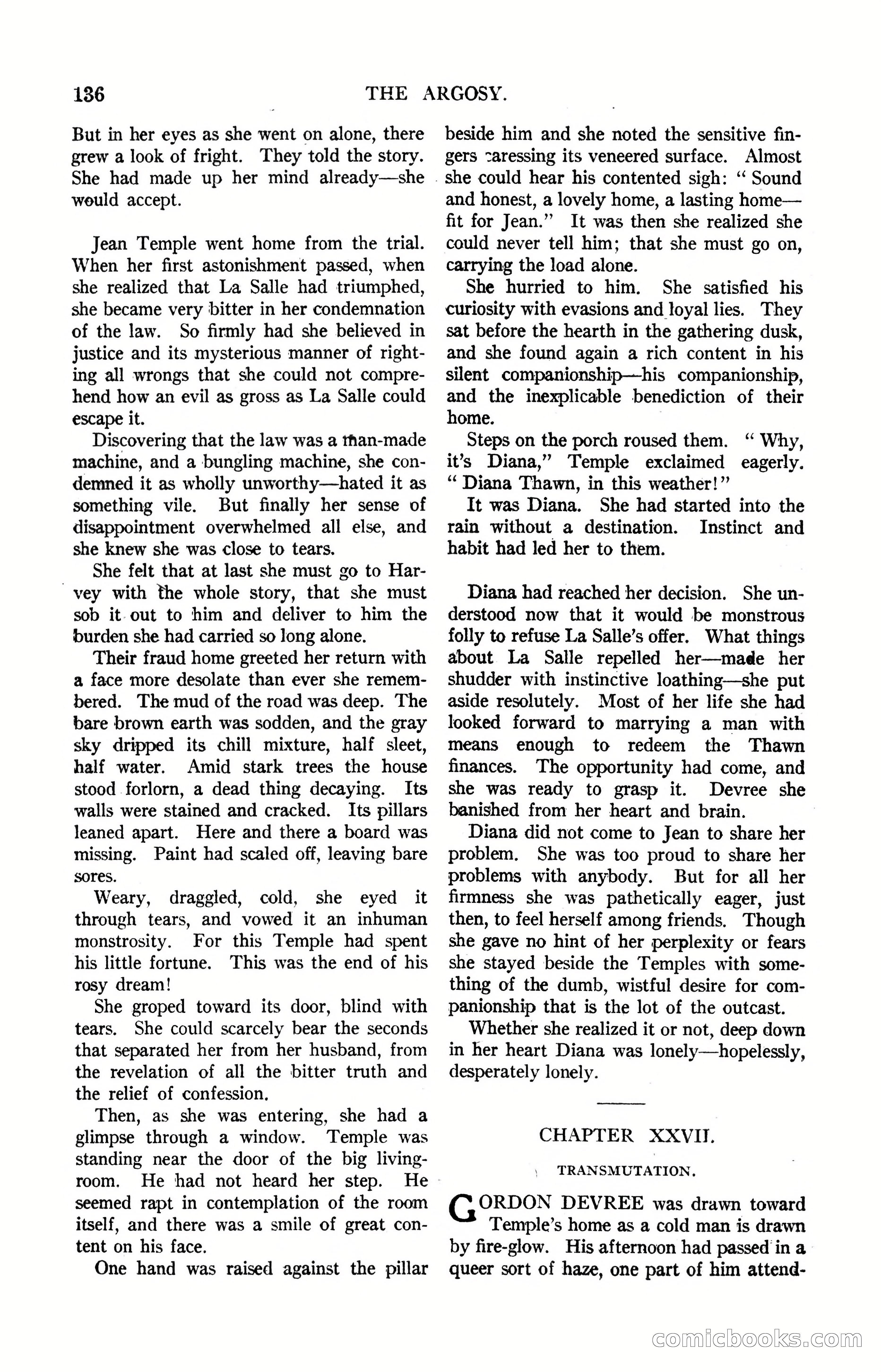
A restored page from Pulp Fiction, 1920. Page through the whole issue in the reader above.
📄 Transcribed text from this page (OCR, searchable)
Machine-transcribed from the original scan — historical spelling and the odd misread are preserved.
136 But in her eyes as she went on alone, there grew a look of fright. They told the story. She had made up her mind already—she would accept. Jean Temple went home from the trial. When her first astonishment passed, when she realized that La Salle had triumphed, she became very bitter in her condemnation of the law. So firmly had she believed in justice and its mysterious manner of right- ing all wrongs that she could not compre- hend how an evil as gross as La Salle could escape it. Discovering that the law was a than-made machine, and a bungling machine, she con- demned it as wholly unworthy—hated it as something vile. But finally her sense of disappointment overwhelmed all else, and she knew she was close to tears. She felt that at last she must go to Har- vey with the whole story, that she must sob it-out to him and deliver to him the burden she had carried so long alone. Their fraud home greeted her return with a face more desolate than ever she remem- bered. The mud of the road was deep. The bare brown earth was sodden, and the gray sky dripped its chill mixture, half sleet, half water. Amid stark trees the house stood forlorn, a dead thing decaying. Its walls were stained and cracked. Its pillars leaned apart. Here and there a board was missing. Paint had scaled off, leaving bare sores. Weary, draggled, cold, she eyed it through tears, and vowed it an inhuman monstrosity. For this Temple had spent his little fortune. This was the end of his rosy dream! She groped toward its door, blind with tears. She could scarcely bear the seconds that separated her from her husband, from the revelation of all the bitter truth and the relief of confession. Then, as she was entering, she had a glimpse through a window. ‘Temple was standing near the door of the big living- room. He had not heard her step. He seemed rapt in contemplation of the room itself, and there was a smile of great con- tent on his face. One hand was raised against the pillar THE ARGOSY. beside him and she noted the sensitive fin- gers caressing its veneered surface. Almost . She could hear his contented sigh: ‘“ Sound and honest, a lovely home, a lasting home— fit for Jean.”” It was then she realized she could never tell him; that she must go on, carrying the load alone. She hurried to him. She satisfied his curiosity with evasions and loyal lies. They sat before the hearth in the gathering dusk, and she found again a rich content in his silent companionship—his companionship, and the inexplicable benediction of their home. | Steps on the porch roused them. ‘“ Why, it’s Diana,” Temple exclaimed eagerly. ‘“‘ Diana Thawn, in this weather!”’ It was Diana. She had started into the rain without a destination. Instinct and habit had led her to them. Diana had reached her decision. She un- derstood now that it would be monstrous folly to refuse La Salle’s offer. What things about La Salle repelled her—made her shudder with instinctive loathing—she put aside resolutely. Most of her life she had looked forward to marrying a man with means enough to redeem the Thawn finances. The opportunity had come, and she was ready to grasp it. Devree she banished from her heart and brain. Diana did not come to Jean to share her problem. She was too proud to share her problems with anybody. But for all her firmness she was pathetically eager, just then, to feel herself among friends. Though she gave no hint of her perplexity or fears she stayed beside the Temples with some- thing of the dumb, wistful desire for com- panionship that is the lot of the outcast. Whether she realized it or not, deep down in her heart Diana was lonely—hopelessly, desperately lonely. es CHAPTER XXVII. TRANSMUTATION. ORDON DEVREE was drawn toward Temple’s home as a cold man is drawn by fire-glow. His afternoon had passed in a queer sort of haze, one part of him attend- cComiclbooks.com